📘 Class 10 Maths 1 Chapter 1 Interactive Quiz
20 Questions | 20 Minutes | Instant Results
🏆 Your Quiz Result
📝 Answer Review and Explanations
🌈 Linear Equations in Two Variables – Class 10 Maharashtra Board Worksheet
Practise Maharashtra State Board Class 10 Maths 1 Chapter 1: Linear Equations in Two Variables with this free interactive worksheet. Answer 20 questions covering substitution, elimination, determinants, Cramer's Rule, ordered pairs and graphical solutions.
After completing the timed quiz, review your score and explanations. Explore the colourful chapter notes, formulas, step-by-step examples, extra practice questions and FAQs below. This worksheet supports Balbharati textbook revision, classroom practice and Maharashtra SSC Mathematics examination preparation.
📝 Chapter 1 Practice Questions
Review all 20 questions here. For instant scoring, answer them using the interactive quiz above.
📖 View All 20 Practice Questions
- Which is a linear equation in two variables?
- Which ordered pair satisfies x + y = 9?
- Solve x + y = 10 and x − y = 2.
- What is the purpose of the elimination method?
- Find D for 2x + 3y = 7 and x − y = 1.
- How many common solutions do two distinct parallel lines have?
- Which method uses determinants D, Dₓ and Dᵧ?
- What does the intersection point of two lines represent?
- Solve x + y = 12 and x − y = 4. Find x.
- Solve x + y = 12 and x − y = 4. Find y.
- If 3x + 2y = 16 and x = 4, find y.
- If x − 2y = 1 and y = 3, find x.
- Find x if 2x + y = 13 and x + y = 8.
- Find y if 2x + y = 13 and x + y = 8.
- Find D for x + 2y = 7 and 3x + y = 11.
- Two numbers have sum 20 and difference 6. Find the larger number.
- Solve x + y = 9 and x − y = 3.
- Solve 2x + y = 11 and x − y = 1.
- Solve x + 2y = 8 and x − y = 2.
- Solve 3x + y = 14 and x + y = 6.
🎯 What Will You Learn?
- Recognise linear equations in two variables.
- Check whether ordered pairs satisfy an equation.
- Solve simultaneous equations by substitution and elimination.
- Apply Cramer's Rule when the determinant is non-zero.
- Interpret intersecting, parallel and coincident lines.
- Form and solve equations from word problems.
📐 Linear Equations in Two Variables
A linear equation in two variables is an equation in x and y where each variable has power one. Its general form is:
Here a, b and c are real numbers, with a and b not both zero. An ordered pair (x, y) is a solution when substituting those values makes the equation true.
🌸 Check an Ordered Pair
For 2x + 3y = 12, test (3, 2):
Therefore (3, 2) is a solution.
🧮 Methods of Solving Simultaneous Equations
| Method | How it works |
|---|---|
| Substitution | Express one variable in terms of the other and substitute. |
| Elimination | Add or subtract equations to remove a variable. |
| Cramer's Rule | Use determinants to find a unique solution. |
| Graphical | Find the intersection of the two lines. |
🔵 Substitution Method – Solved Example
Solve x + y = 9 and x − y = 3.
Step 1: From x + y = 9, x = 9 − y.
Step 2: Substitute: 9 − y − y = 3.
9 − 2y = 3 ⇒ y = 3.
Step 3: x = 9 − 3 = 6.
Answer: x = 6, y = 3.
Verification: 6 + 3 = 9 and 6 − 3 = 3.
🌸 Elimination Method – Solved Example
Solve 2x + 3y = 16 and 2x − y = 8.
Step 1: Subtract the second equation from the first:
(2x + 3y) − (2x − y) = 16 − 8
4y = 8 ⇒ y = 2.
Step 2: Substitute into 2x − y = 8:
2x − 2 = 8 ⇒ x = 5.
Answer: x = 5, y = 2.
🟣 Cramer's Rule and Important Formulas
For a₁x + b₁y = c₁ and a₂x + b₂y = c₂:
Important: The division formulas apply only when D ≠ 0.
🌿 Worked Example
Solve 2x + y = 11 and x − y = 1.
D = 2(−1) − 1(1) = −3
Dₓ = 11(−1) − 1(1) = −12
Dᵧ = 2(1) − 1(11) = −9
x = −12 / −3 = 4; y = −9 / −3 = 3.
Answer: (4, 3). Both equations are satisfied.
📊 Graphical Interpretation
- Intersecting lines: one common solution.
- Distinct parallel lines: no common solution.
- Coincident lines: infinitely many solutions.
For example, x + y = 5 and x − y = 1 intersect at (3, 2).
🧠 Extra SSC-Style Practice
- Solve x + y = 14 and x − y = 4.
- Solve 3x + 2y = 16 and x + y = 6.
- Solve 2x + y = 13 and x − y = 2.
- Check whether (2, 3) satisfies 3x + 2y = 12.
- Solve 4x + y = 18 and x + y = 6.
- Find D, Dₓ and Dᵧ for 2x + 3y = 12 and x − y = 1.
- Explain the difference between distinct parallel and coincident lines.
- Find two solutions of x + 2y = 8.
- The sum of two numbers is 25 and their difference is 7. Find them.
- Two adult tickets and one child ticket cost ₹250. One adult ticket and two child tickets cost ₹200. Find each ticket price.
✅ View Practice Answers
- (9, 5)
- (4, 2)
- (5, 3)
- Yes; 3(2) + 2(3) = 12.
- (4, 2)
- D = −5, Dₓ = −15, Dᵧ = −10.
- Distinct parallel lines have no solution; coincident lines have infinitely many.
- For example (8, 0) and (4, 2).
- 16 and 9.
- Adult ticket ₹100; child ticket ₹50.
⚠️ Common Mistakes
- Changing a sign incorrectly during transposition.
- Forgetting brackets while subtracting equations.
- Multiplying only one term instead of the entire equation.
- Interchanging the coordinates in an ordered pair.
- Dividing by D when D = 0.
- Failing to verify the solution in both equations.
🏆 Five-Day Revision Plan
- Revise definitions, ordered pairs and substitution.
- Practise elimination with different coefficients.
- Memorise determinant formulas and solve examples.
- Study graphs and word problems.
- Retake this quiz and review every incorrect answer.
📚 Related Maharashtra Board Maths Resources
❓ Frequently Asked Questions
1. What is Chapter 1 of Maharashtra Board Class 10 Maths 1?
It covers Linear Equations in Two Variables, including algebraic methods, determinants and graphical interpretation.
2. How can we solve simultaneous linear equations?
Use substitution, elimination, graphical methods or Cramer's Rule when applicable.
3. What is Cramer's Rule?
It uses determinants D, Dₓ and Dᵧ to calculate x = Dₓ / D and y = Dᵧ / D when D ≠ 0.
4. What happens when D = 0?
The system does not have a unique solution; it may have no solution or infinitely many solutions.
5. Which is easier: substitution or elimination?
It depends on the equations. Substitution is convenient when a variable is easily isolated, while elimination works well when coefficients match.
6. What does the intersection of two lines show?
The point of intersection represents the ordered pair satisfying both equations.
7. Are MCQs enough for SSC Maths revision?
No. MCQs help recall concepts, but students should also practise complete step-by-step solutions and word problems.
8. How can I avoid sign errors?
Use brackets when subtracting equations and verify your final values in both original equations.
9. Is this worksheet suitable for Maharashtra Board Class 10?
Yes. Its questions focus on the concepts taught in Mathematics Part 1, Chapter 1.
10. Where can I practise the next chapter?
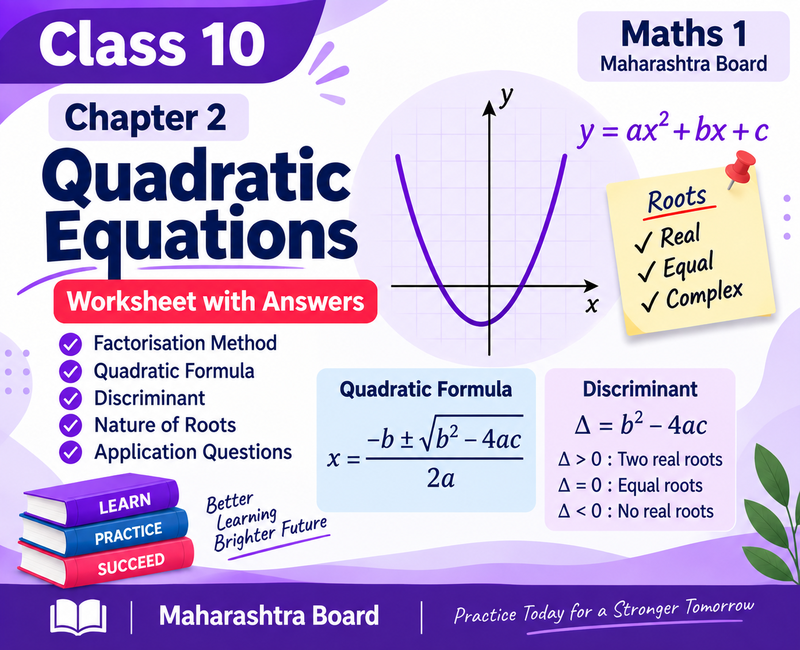
Use the linked WitKnowLearn Chapter 2 Quadratic Equations worksheet, solutions and mind map above.
🎯 Online Linear Equations Quiz for Class 10 Maharashtra Board
Practise with this free Class 10 Maths 1 Chapter 1 online quiz on Linear Equations in Two Variables. Answer 20 interactive questions covering substitution, elimination, Cramer's Rule, determinants and ordered pairs. Get instant results, review step-by-step explanations and strengthen your preparation for the Maharashtra SSC Mathematics examination.
Ready for another attempt? Return to the online quiz or explore the chapter-wise worksheets, textbook solutions and mind maps linked above.
 Download