Addition Class 5 Maths Worksheet with Quiz and Activities
Add large numbers in columns, carry, estimate and solve story problems. On WitKnowLearn you get the Addition Class 5 online quiz, online activities and interactive games, addition labs, a virtual lab and a worksheet-style practice sheet, all on one page.
Addition Class 5 Online Quiz
20 questions: 10 easy, 5 average and 5 thinking. Tap an answer and the next question comes up.
Addition Class 5 Activities
👆 Tap a tab to switch: Learn, Games, Labs, Challenges, Virtual Lab and Practice sheet
Addition: the Adding Story
A short read for Class 5 before you play. These notes are written for this page.
🛒 Why we add
We add when we join amounts: the cost of things in a bag, the people on a train, the books in a library or the steps we walk in a week.
🔢 Adding in columns
We line up the digits by place and add from the right. Ones go with ones, tens with tens and so on.
🎒 Carrying
When a column reaches ten or more, we keep the ones digit and carry the tens digit to the next column. Carrying makes sure no place gets too full.
✨ Helpful properties
We can add in any order, group numbers as we like and add zero without changing anything. These facts make sums easier.
🎯 Estimating
Rounding the numbers first gives a quick estimate. If the exact sum is far from the estimate, we know to check again.
📊 Bar models
A bar model shows two parts joined into one total. It helps us see when to add and when to find a missing part.
Addition Class 5 Activities
Add, carry and estimate on the Number Train. Earn up to 3 stars in every activity.
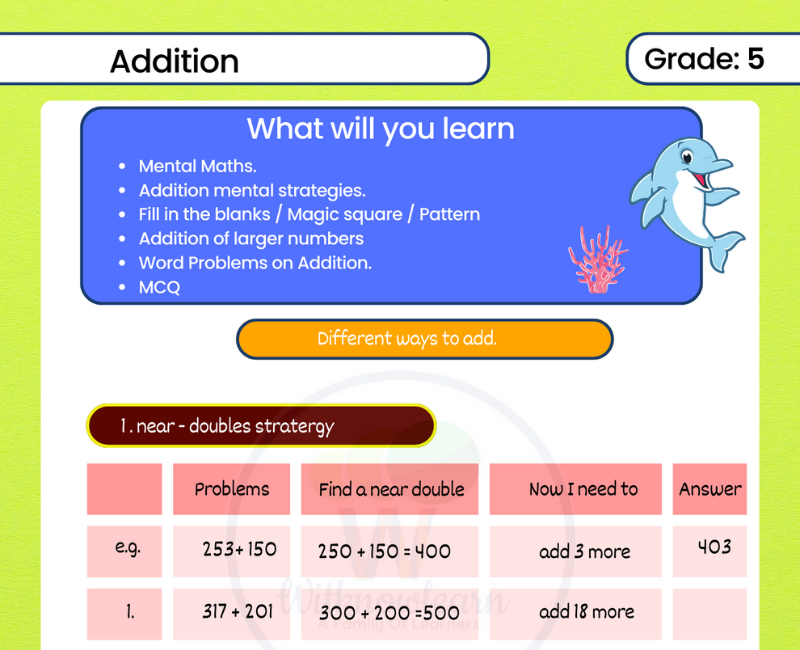
Addition is the first big skill of Class 5 maths. This page helps children add large numbers with confidence by using columns, number bonds, bar models and short stories.
The activities turn each idea into a game. Children sort sums by carrying, pop correct additions, match maths words, fill gaps and choose the greater sum. Explore more Class 5 maths worksheets on WitKnowLearn after this topic.
Words and facts to know
| Word | Meaning | Example |
|---|---|---|
| Addend | A number being added | In 25 + 17, both are addends |
| Sum | The answer of an addition | 25 + 17 = 42 |
| Carry | Extra ten moved to the next place | 9 + 8 = 17 |
| Estimate | A quick answer close to the real one | Round, then add |
How to use this page
- Flip the six cards and try the Column Addition Lab in the Learn tab.
- Play the five games and the five labs to practise each idea.
- Finish the five challenges to collect up to 15 points.
- Take the 20-question online quiz and fill in the practice sheet.
Worked examples
9 + 7 = 16, 8 + 5 + 1 = 14, 6 + 2 + 1 = 9, 3 + 4 = 7, so the sum is 7,946.
600 + 300 = 900, so the sum is about 900.
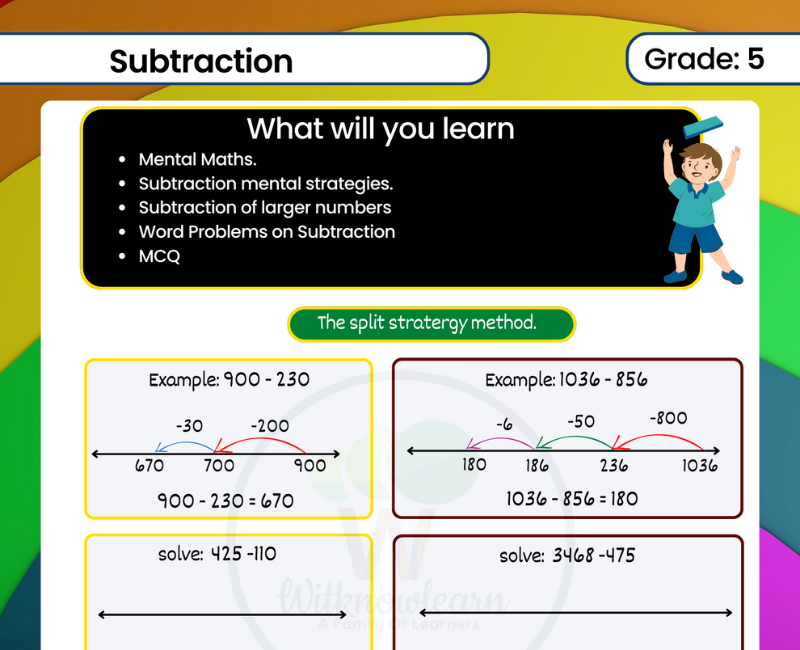
200 - 130 = 70.
This Addition worksheet for Class 5 maths gives you online activities and interactive games that turn adding into play. Every activity has a goal, a hint and a short fact, so children learn while they enjoy.
Complete Guide: Maths Addition Class 5
This guide is for Class 5 students, parents and teachers. It explains addition of large numbers in simple words and shows how to use the quiz, labs and games on this page.
Introduction to Addition
In Class 5 children add numbers with five, six or even seven digits, add three numbers at a time and use estimates to check answers. The same carrying idea works for numbers of every size.
What is there in this topic
- Adding large numbers in columns.
- Carrying in several places.
- Properties of addition.
- Adding three or more numbers.
- Number bonds and mental adding.
- Estimating sums.
- Word problems.
Learning objectives
- Add large numbers correctly with carrying.
- Use the commutative, associative and identity properties.
- Estimate sums by rounding.
- Find a missing addend.
- Solve addition word problems.
Learning outcomes
- The child can add two six-digit numbers without mistakes.
- The child can explain why we carry.
- The child can estimate a sum and check an answer.
- The child can solve a short story problem using a bar model.
Addition Class 5 resources on this page
| Resource | What it gives |
|---|---|
| Online quiz | 20 questions: 10 easy, 5 average and 5 thinking, with a full review |
| Flip cards | 6 picture cards with one-line rules |
| Column Addition Lab | A hands-on lab with 3 rounds |
| Games | 5 interactive games |
| Labs | 5 activity labs |
| Virtual Lab | 2 experiments with aim, procedure, observation table and conclusion |
| Challenges | 5 challenges, 15 points in all |
| Practice sheet | A worksheet-style sheet with 16 questions, name and date lines and a live score |
Key facts
| Topic | Key idea |
|---|---|
| Columns | Line up the places and add from the right. |
| Carry | Move the tens digit to the next column. |
| Commutative | Order does not change the sum. |
| Associative | Grouping does not change the sum. |
| Identity | Adding zero keeps the number. |
Types of questions you may see
- Adding in columns with carrying.
- Missing addends.
- Estimating sums.
- Properties of addition.
- Word problems with money, people and distance.
Solved examples
7,84,500.
100 + 38 - 1 = 137.
1,000 - 470 = 530.
2,000 + 3,000 = 5,000.
4,000.
8,250 litres.
Common mistakes
| Mistake | Correct idea |
|---|---|
| Forgetting to carry. | Write the carry above the next column. |
| Not lining up places. | Keep ones under ones and tens under tens. |
| Adding the carry twice. | Use each carry only once. |
| Skipping the estimate. | An estimate catches big mistakes. |
Addition in daily life
Children add when they total a shopping bill, count people at an event, add scores in a game or plan a savings goal. Doing these at home builds confidence.
Tips for parents and teachers
- Use graph paper to keep digits in columns.
- Ask children to estimate before they add.
- Play a game of making one hundred with number pairs.
- Let children add up a real shopping bill.
Related Class 5 Maths Worksheets
Addition Class 5 FAQs
What is Addition in Class 5 maths?
Addition is joining two or more numbers to find a total called the sum. In Class 5 children add large numbers up to lakhs, add three or more numbers, estimate sums and solve word problems.
How do we add large numbers in columns?
Write the numbers one below the other so that ones, tens, hundreds and other places line up. Add each column starting from the ones and carry whenever a column reaches ten or more.
What does carrying mean?
When the digits in a column add up to ten or more, we write the ones digit and move the tens digit to the next column. For example 8 + 9 = 17, so we write 7 and carry 1.
What are the properties of addition?
The commutative property says the order of addends does not change the sum. The associative property says the grouping does not change the sum. The identity property says adding zero leaves a number unchanged.
How do we estimate a sum?
Round each number to the nearest ten, hundred or thousand and add the rounded numbers. This gives a quick answer that is close to the real sum and helps us check our work.
What are number bonds?
Number bonds are pairs of numbers that make a target such as one hundred. Knowing that 64 and 36 make 100 helps children add in their heads.
How do we find a missing addend?
Subtract the known addend from the total. For example if 640 plus a number makes 1,000, the missing number is 1,000 minus 640, which is 360.
How do we solve addition word problems?
Read the story, find the numbers and decide what is being joined. Add the numbers, write the answer with its unit and check that it makes sense.
Does this page have Addition Class 5 questions and answers?
Yes. The 20-question online quiz ends with a full review that shows the correct answer and a short reason for every question. The practice sheet has 16 questions and a Show answers button.
Which class is this worksheet for?
This worksheet is for Class 5 maths. All questions are written for this page, so children can practise adding with fresh examples.
What can children do on this page?
Children can take the online quiz, play interactive games, try online activities and addition labs, finish challenges, do the hands-on Column Addition Lab, run two virtual experiments and solve a worksheet-style practice sheet. They can earn up to 3 stars in every activity.
Can my child use these activities on a phone?
Yes. The page works on phones, tablets and computers. Children can drag cards or simply tap a card and then tap its place, so it is easy on a small screen.
What is included on this page?
This page has a 20-question online quiz, 6 flip cards, the Column Addition Lab, 5 games, 5 labs, 5 challenges, a virtual lab with 2 experiments, a 16-question practice sheet, a story of adding, a topic description, a complete guide, related Class 5 maths worksheets and 12 FAQs.
 Download