Divisibility Rules Class 5 Maths Worksheet with Quiz and Activities
Test numbers with quick rules for 2, 3, 4, 5, 6, 9, 10 and 11, no long division needed. On WitKnowLearn you get the Divisibility Rules Class 5 online quiz, online activities and interactive games, divisibility labs, a virtual lab and a worksheet-style practice sheet, all on one page.
Divisibility Rules Class 5 Online Quiz
20 questions: 10 easy, 5 average and 5 thinking. Tap an answer and the next question comes up.
Divisibility Rules Class 5 Activities
👆 Tap a tab to switch: Learn, Games, Labs, Challenges, Virtual Lab and Practice sheet
Divisibility Rules: the Number Tester Story
A short read for Class 5 before you play. These notes are written for this page.
🔎 Why we test numbers
Long division takes time. A divisibility rule is a shortcut that looks at one small part of a number and gives a quick yes or no.
🔟 Last digit tests
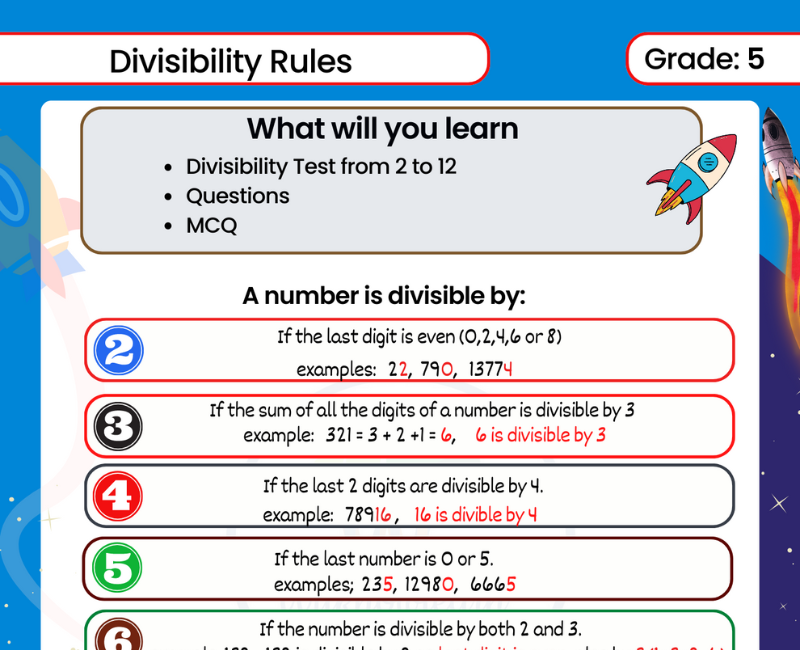
The last digit decides the tests for 2, 5 and 10. Even digits pass for 2, zero or five passes for 5 and only zero passes for 10.
➕ Digit sums
Add all the digits. A digit sum in the table of 3 passes the test for 3, and a digit sum in the table of 9 passes the test for 9.
🧮 Last two digits
For 4 we only need the last two digits, because every hundred splits into fours.
⚖ Two tests together
Some rules combine. A number that passes the tests for 2 and 3 also passes the test for 6.
🔬 The rule for 11
Add alternate digits in two groups and subtract. A difference of zero or in the table of 11 means the number is divisible by 11.
Divisibility Rules Class 5 Activities
Test, combine and decide on the Number Train. Earn up to 3 stars in every activity.
Divisibility rules are the quick-test skill of Class 5 maths. This page helps children decide whether a number divides exactly, using last digits, digit sums, the last two digits and the rule for 11.
The activities turn each rule into a game. Children sort numbers by the rule that fits, pop true bubbles, match maths words, fill gaps and compare digit sums. Explore more Class 5 maths worksheets on WitKnowLearn after this topic.
The rules at a glance
| Divisor | Test | Example |
|---|---|---|
| 2 | Last digit is even | 5,634 ends in 4 |
| 3 | Digit sum is in the table of 3 | 8,271 has sum 18 |
| 4 | Last two digits are in the table of 4 | 3,920 ends in 20 |
| 5 | Last digit is 0 or 5 | 6,315 ends in 5 |
| 6 | Passes the tests for 2 and 3 | 8,034 is even with sum 15 |
| 9 | Digit sum is in the table of 9 | 2,457 has sum 18 |
| 10 | Last digit is 0 | 9,460 ends in 0 |
| 11 | Alternate sums differ by 0 or 11 | 9,075 gives 16 and 5 |
How to use this page
- Flip the six cards and try the Divisibility Lab in the Learn tab.
- Play the five games and the five labs to practise each rule.
- Finish the five challenges to collect up to 15 points.
- Take the 20-question online quiz and fill in the practice sheet.
Worked examples
It is even and the digit sum is 1 + 8 + 9 + 0 = 18, so it passes the tests for 2 and 3, and therefore for 6.
The digit sum is 3 + 0 + 7 + 8 = 18, which is in the table of 9, so the answer is yes.
The last two digits are 12, and 12 is in the table of 4, so the answer is yes.
This Divisibility Rules worksheet for Class 5 maths gives you online activities and interactive games that turn testing into play. Every activity has a goal, a hint and a short fact, so children learn while they enjoy.
Complete Guide: Maths Divisibility Rules Class 5
This guide is for Class 5 students, parents and teachers. It explains the tests of divisibility in simple words and shows how to use the quiz, labs and games on this page.
Introduction to Divisibility Rules
A number is divisible by another when the division leaves no remainder. Divisibility rules let children decide this by looking at the end of a number or at its digit sum, without long division.
What is there in this topic
- Tests for 2, 5 and 10 using the last digit.
- Tests for 3 and 9 using the digit sum.
- The test for 4 using the last two digits.
- The test for 6 by combining 2 and 3.
- The test for 8 using the last three digits.
- The test for 11 using alternate sums.
- Finding a missing digit.
Learning objectives
- State the divisibility test for each divisor.
- Apply the test to numbers with up to five digits.
- Combine two tests to decide about 6.
- Find a missing digit that makes a number divisible.
- Use the rules to solve sharing and packing problems.
Learning outcomes
- The child can say at a glance whether a number is divisible by 2, 5 or 10.
- The child can find a digit sum and use it for 3 and 9.
- The child can explain why 6 needs two tests.
- The child can decide whether objects can be shared equally.
Divisibility Rules Class 5 resources on this page
| Resource | What it gives |
|---|---|
| Online quiz | 20 questions: 10 easy, 5 average and 5 thinking, with a full review |
| Flip cards | 6 picture cards with one-line rules |
| Divisibility Lab | A hands-on lab with 3 rounds |
| Games | 5 interactive games |
| Labs | 5 activity labs |
| Virtual Lab | 2 experiments with aim, procedure, observation table and conclusion |
| Challenges | 5 challenges, 15 points in all |
| Practice sheet | A worksheet-style sheet with 16 questions, name and date lines and a live score |
Key facts
| Topic | Key idea |
|---|---|
| Divisible | Divides exactly with remainder zero. |
| Digit sum | All the digits added together. |
| Zero | Zero is divisible by every non-zero number. |
| Ten | A number divisible by 10 is divisible by 2 and 5. |
| Nine | A number divisible by 9 is also divisible by 3. |
Types of questions you may see
- Yes or no questions for a given divisor.
- Finding digit sums.
- Missing digit questions.
- Combining tests for 6.
- Word problems about equal sharing.
Solved examples
Yes, it ends in 0.
5 + 2 + 0 + 8 = 15, so yes.
6 + 4 = 10 and 10 + 8 = 18, so the digit is 8.
The last three digits 640 divided by 8 is 80, so yes.
8 + 2 = 10 and 1 + 9 = 10. The difference is 0, so yes.
156 is divisible by 3 and by 4, so it is divisible by 12. Each child gets 13 sweets.
Common mistakes
| Mistake | Correct idea |
|---|---|
| Saying a number ending in 5 is divisible by 10. | Only a zero at the end gives 10. |
| Checking only the last digit for 4. | Check the last two digits. |
| Adding a digit sum wrongly. | Add every digit, even zeros, and add again. |
| Testing 6 with the digit sum only. | 6 needs both the even test and the sum test. |
Divisibility Rules in daily life
Children use divisibility when they share sweets, pay with coins, pack boxes or form equal teams. Doing these at home builds confidence.
Tips for parents and teachers
- Ask children to guess a rule from a list of numbers that pass it.
- Use real counters to see why a number does or does not share equally.
- Let children invent numbers that pass two tests.
- Use car numbers and page numbers for quick practice.
Related Class 5 Maths Worksheets
Divisibility Rules Class 5 FAQs
What are divisibility rules in Class 5 maths?
Divisibility rules are quick tests that tell us whether a number divides exactly by another number without doing the division. If the test passes, the remainder is zero. In Class 5 children use the tests for 2, 3, 4, 5, 6, 8, 9, 10 and 11.
What is the divisibility rule for 2, 5 and 10?
Look at the last digit. A number is divisible by 2 if it ends in 0, 2, 4, 6 or 8. It is divisible by 5 if it ends in 0 or 5. It is divisible by 10 if it ends in 0. For example 9,460 passes all three tests.
What is the divisibility rule for 3 and 9?
Add all the digits. If the digit sum is in the table of 3, the number is divisible by 3. If the digit sum is in the table of 9, the number is divisible by 9. For example 2,457 has digit sum 18, so it is divisible by both 3 and 9.
What is the divisibility rule for 4?
A number is divisible by 4 if the number made by its last two digits is in the table of 4. For example 6,512 ends in 12, and 12 is 4 times 3, so 6,512 is divisible by 4.
What is the divisibility rule for 6?
A number is divisible by 6 if it is divisible by both 2 and 3. So it must be even and its digit sum must be in the table of 3. For example 8,034 is even and has digit sum 15, so it is divisible by 6.
What is the divisibility rule for 8?
A number is divisible by 8 if the number made by its last three digits is in the table of 8. For example 3,816 ends in 816, and 816 divided by 8 is 102, so 3,816 is divisible by 8.
What is the divisibility rule for 11?
Add the digits in the 1st and 3rd places, then add the digits in the 2nd and 4th places and find the difference. If it is 0 or in the table of 11, the number is divisible by 11. For example 9,075 gives 9 + 7 = 16 and 0 + 5 = 5, and 16 minus 5 is 11.
Is there an easy divisibility rule for 7?
There is no short rule for 7 at Class 5 level, so we divide and check the remainder. A trick for older learners is to double the last digit and subtract it from the rest. For 343 we get 34 minus 6, which is 28, and 28 is in the table of 7.
Why does the digit sum work for 3 and 9?
Ten, 100 and 1,000 each leave remainder 1 when divided by 3 or 9. So a number leaves the same remainder as its digit sum. If the digit sum divides exactly, the whole number does too.
What is the difference between divisible, factor and multiple?
If 48 is divisible by 6, then 6 is a factor of 48 and 48 is a multiple of 6. These three ideas describe the same fact in different words. Divisibility rules help us find factors and multiples quickly.
How are divisibility rules used in real life?
They help us check whether things can be shared or packed equally, such as sweets among friends or eggs into trays. They also speed up finding factors, HCF, LCM and prime factors in later topics.
What can children do on this page?
Children can take a 20-question online quiz with a full review, play five games, try five online activities, finish five challenges, run the Divisibility Lab and two virtual experiments, and fill in a 16-question practice sheet with a Show answers button.
 Download