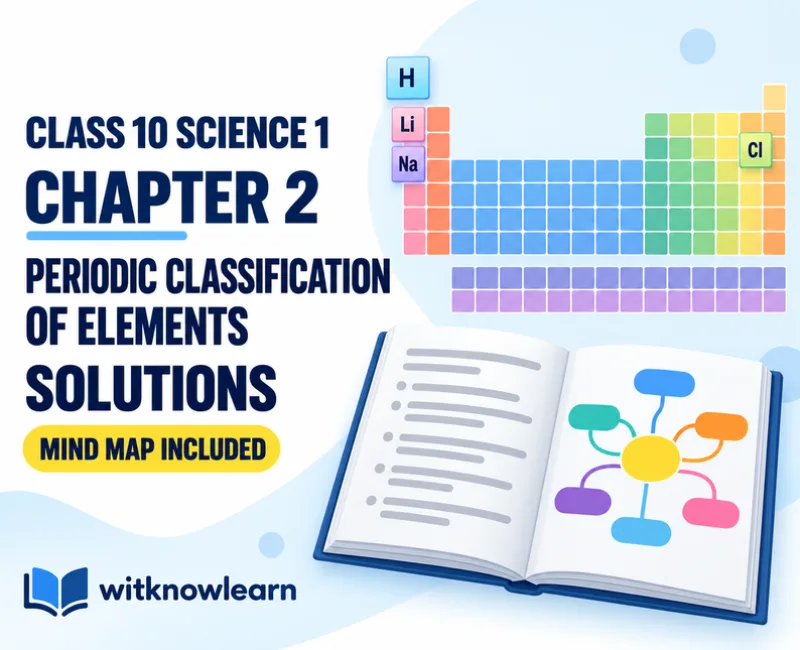
Class 10 Science 1 Chapter 2 Periodic Classification of Elements Solutions
Learn how scientists organised elements and how the modern periodic table helps us predict their properties. Use these Maharashtra Board Chapter 2 solutions to understand the textbook questions, revise periodic trends and review the mind map on the last page of the PDF.
What Will You Learn in This Chapter?
Elements have different properties, but their properties show useful patterns. Scientists used these patterns to arrange elements into groups. This chapter explains how their ideas developed and why the modern periodic table is more useful for studying elements.
Early Classification
Explore Dobereiner’s triads and Newlands’ Law of Octaves, including the limitations of these arrangements.
Periodic Tables
Compare Mendeleev’s table with the modern periodic table and understand the role of atomic number.
Periodic Trends
Study how valency, atomic size and metallic character change across periods and down groups.
Topics Covered in the Chapter 2 Solutions
Dobereiner’s Triads
Dobereiner placed certain elements with similar chemical properties in groups of three. Students learn to test whether the atomic mass of the middle element is approximately the average of the other two.
Newlands’ Law of Octaves
Newlands arranged elements in increasing order of atomic mass and observed a repetition of properties. The solutions help students explain both his observation and its limitations.
Mendeleev’s Periodic Table
Learn why Mendeleev left spaces for elements yet to be discovered. Compare the merits of his table with difficulties involving isotopes, hydrogen and the order of some elements.
Modern Periodic Table
Understand how elements are arranged by increasing atomic number. Identify periods, groups and the broad positions of metals, nonmetals and metalloids.
Electronic Configuration and Trends
Relate an element’s electronic configuration to its position. Study the textbook trends in valency, atomic radius and metallic or nonmetallic character.
Important Rules to Remember
- Elements in the same period have the same number of occupied electron shells.
- Elements in the same main group generally have similar valence-electron arrangements and chemical properties.
- Atomic size generally decreases from left to right across a period.
- Atomic size generally increases from top to bottom within a group.
- Metallic character generally decreases across a period and increases down a group.
How to Use These Textbook Solutions
- Attempt the Chapter 2 exercise before checking an answer.
- Refer to the periodic table while identifying a group or period.
- Write an element’s atomic number and electronic configuration before deciding its position or valency.
- Give the reason for a trend, such as an added shell or stronger attraction of the outer electrons.
- Revise the full chapter with the mind map on the final PDF page.
Mind Map on the Last Page
The final page of the Chapter 2 solutions PDF contains a mind map for quick revision of early classification, the modern periodic table, groups, periods and periodic trends.
Frequently Asked Questions
What is the basis of the modern periodic table?
How many groups and periods are there?
What are Dobereiner’s triads?
Why did Mendeleev leave gaps in his table?
Why does atomic size decrease across a period?
Where is the Chapter 2 mind map?
 Download