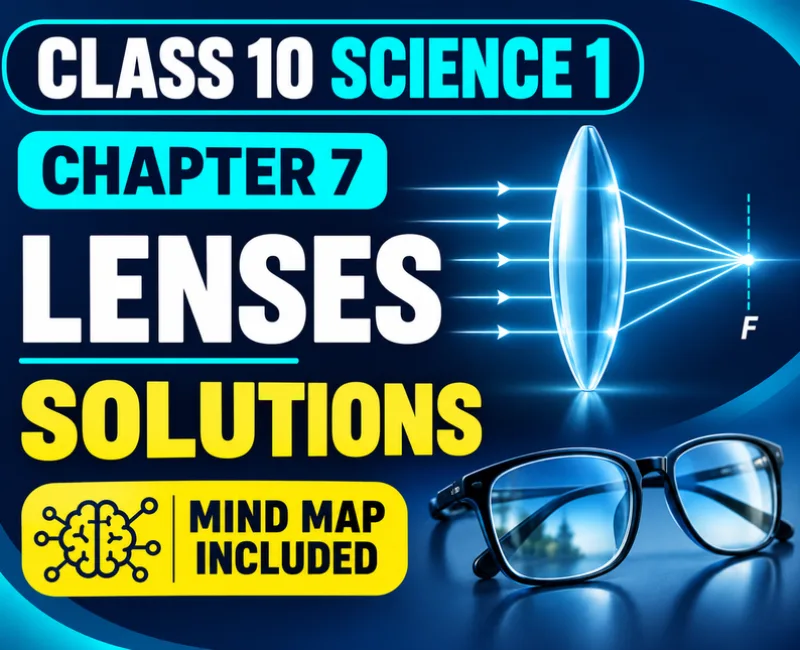
Chapter 7 Lenses Solutions
Study Maharashtra Board Class 10 Science and Technology Part 1 Chapter 7 Lenses with clear textbook solutions. Learn how convex and concave lenses bend light, how images form, and how lenses help the human eye. The solutions PDF also contains a chapter mind map on its final page.
What Is Included in These Class 10 Lenses Solutions?
These Class 10 Science 1 Chapter 7 Lenses solutions help Maharashtra Board students understand convex lenses, concave lenses, their principal focus and focal length, ray diagrams, image formation and the use of lenses in daily life. The chapter also connects these ideas to the human eye and the correction of defects such as myopia and hypermetropia.
A ray diagram is easier to remember when you know what each line represents. For example, rays parallel to the principal axis meet at the focus after passing through a convex lens, while a concave lens spreads them out. Begin each diagram with the principal axis, lens, optical centre and focus. Then follow the rays to decide whether the image is real or virtual, upright or inverted, and magnified or diminished.
Class 10 Science 1 Chapter 7: Main Topics
Convex Lens
A convex lens is thicker in the middle and can bring parallel rays together. See how changing the position of an object changes its image.
Concave Lens
A concave lens is thinner in the middle and spreads parallel rays apart. Learn where its virtual image appears in a ray diagram.
The Human Eye
Connect focusing on the retina with eyesight, accommodation and the lenses used to correct common vision defects.
Important Lens Terms and Formulae
In these relationships, f is focal length, u is object distance and v is image distance. Power is measured in dioptres (D). Before substituting values, write the sign of each distance according to the sign convention. Keeping units and signs clear is especially helpful in numerical questions.
Ray Diagrams and Image Formation
Draw at least two standard rays from the top of the object to locate an image. A ray parallel to the principal axis passes through the focus after a convex lens. A ray through the optical centre travels approximately straight. Their meeting point, or the meeting point of their backward extensions, tells you where the image is formed.
Real and Virtual Images
A real image is formed where light rays actually meet and can generally be obtained on a screen. A virtual image appears where rays seem to come from and cannot be caught on a screen. A magnifying glass gives a virtual, enlarged image when the object is between a convex lens and its focus.
Human Eye and Vision Defects
The eye lens focuses light on the retina. In myopia, distant objects are blurred because their image forms in front of the retina; a concave lens helps correct this. In hypermetropia, nearby objects are blurred because their image would form behind the retina; a convex lens helps bring it forward.
How to Study Chapter 7 Lenses Solutions
- Read the textbook question and identify the type of lens before checking its solution.
- Draw the principal axis, optical centre and focal points neatly.
- Trace two standard rays to locate the image and describe its nature.
- For numericals, write the formula, apply the sign convention and include units.
- Use the final-page mind map to review lens types, image formation and vision defects.
Revise Chapter 7 with the Mind Map
The Lenses mind map is placed on the last page of the solutions PDF. After reading the answers, use it to connect convex and concave lenses, ray paths, image characteristics and eyesight. Try to explain a real-life example, such as a magnifying glass or spectacles, for each relevant branch.
Frequently Asked Questions
Select a question to read a short explanation with an example.
What is the difference between a convex and a concave lens?
Can a convex lens form a virtual image?
What kind of image does a concave lens form?
What is focal length?
Which lens is used to correct myopia?
Which lens is used to correct hypermetropia?
Where is the Chapter 7 mind map?
 Download