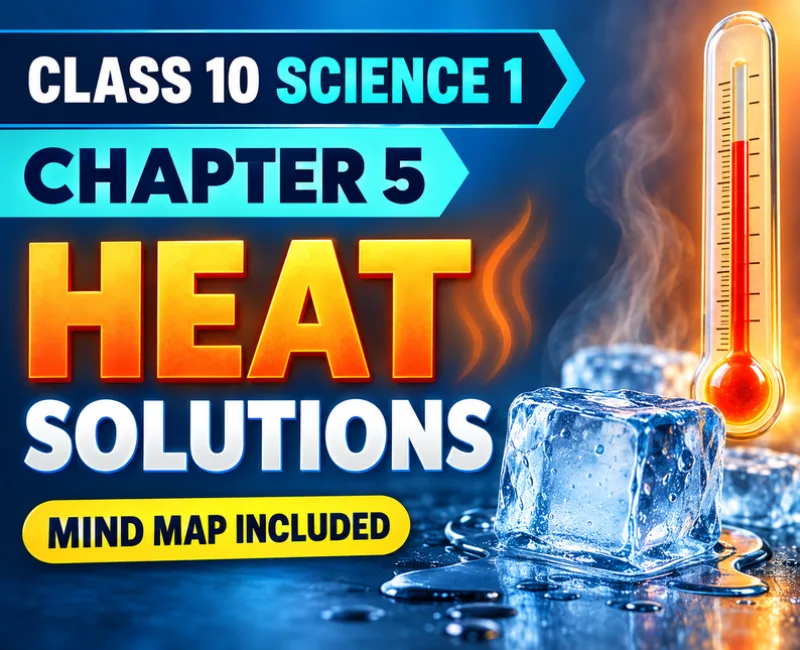
Chapter 5Heat Solutions
Explore latent heat, specific heat capacity, anomalous behaviour of water, regelation, humidity and dew point through clear textbook solutions. The solutions PDF includes a mind map on its final page.
What Is Covered in Heat?
Use these chapter solutions to understand the reasoning behind important answers. The following ideas form the foundation of this chapter.
Heat and temperature
Separate energy transferred from the temperature used to describe how hot an object is.
Changes of state
Explain why melting and boiling can occur without a rise in temperature.
Water and humidity
Connect anomalous expansion, dew point and condensation with everyday observations.
Key Heat Concepts
Latent heat
During melting or boiling, energy changes the state of matter while its temperature remains constant.
Anomalous behaviour of water
Water reaches its highest density near 4°C. This helps explain why ice forms at the surface of a lake.
Specific heat capacity and dew point
Compare how substances warm up, then relate air temperature and water vapour to condensation.
What Is Included in the Solutions PDF?
How to Study This Chapter
- Read the question and attempt an answer before opening the solution.
- Compare the scientific reasoning and correct any missing key terms.
- Practise relevant diagrams, equations or examples from the textbook.
- Use the mind map on the last page of the PDF for a final recap.
Revise Chapter 5 with the Mind Map
The final page of the PDF brings the main Heat ideas together. Try to explain each branch aloud after working through the solutions.
Frequently Asked Questions
Select a question to view a brief explanation and example.
Why does ice at 0°C cool a drink more than water at 0°C?
Why does temperature remain constant while ice melts?
Why do lakes freeze at the surface first?
What is dew point?
What is specific heat capacity?
Where is the mind map?
 Download