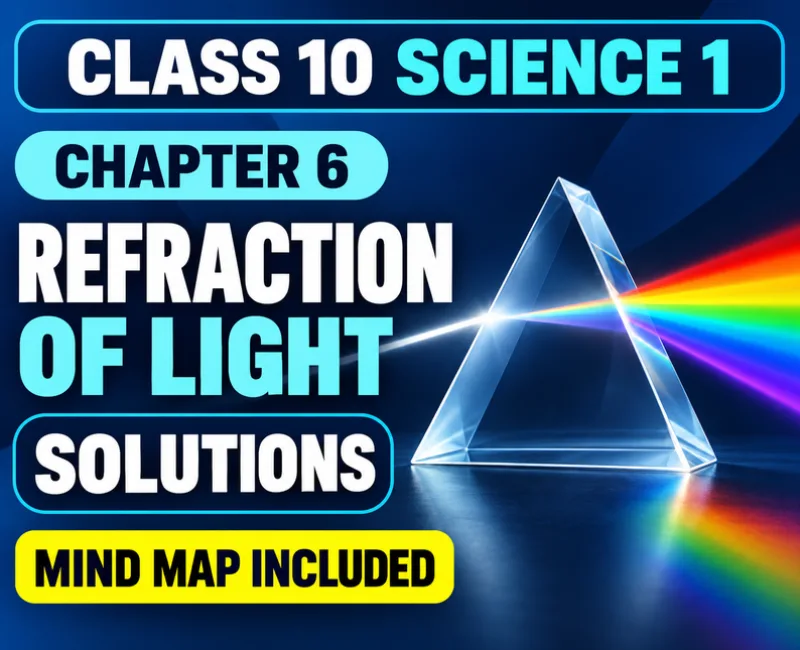
Chapter 6 Refraction of Light Solutions
Study Class 10 Science and Technology Part 1 Chapter 6 Refraction of Light with clear Maharashtra Board textbook solutions. Understand how light bends, learn the laws of refraction and refractive index, and connect dispersion to familiar sights such as a rainbow. A chapter mind map is included on the last page of the PDF.
What Is Included in These Refraction of Light Solutions?
These Maharashtra Board Class 10 Science 1 Chapter 6 solutions cover the central ideas in the Refraction of Light chapter: the change in direction of light at the boundary of two transparent media, the laws of refraction, refractive index, dispersion of white light and effects of refraction in everyday life. The explanations show why an answer is correct, so students can use the ideas in a new question instead of memorising a single sentence.
For example, a pencil partly immersed in water appears bent at the surface. The pencil has not changed shape; light coming from its submerged part changes direction as it passes into air. Once you understand that path, questions about apparent depth, a glass slab and atmospheric refraction become easier to approach.
Class 10 Science 1 Chapter 6: Main Topics
Refraction of Light
Follow a ray as it travels from air into water or glass. Compare the incident ray, refracted ray and normal to see how its path changes.
Refractive Index
Connect the speed of light in a medium to its refractive index, and understand why light bends differently in different substances.
Dispersion
Explore why a prism or raindrop separates white light into colours and how this helps explain the formation of a rainbow.
Important Terms and Relationships
The angle of incidence i and angle of refraction r are measured from the normal, not from the surface. When light enters a medium in which it travels more slowly, the ray bends towards the normal. When it enters a medium in which it travels faster, it bends away from the normal.
Laws of Refraction
The incident ray, refracted ray and normal at the point of incidence lie in the same plane. For the same two media, the ratio of the sines of the angles remains constant. Draw the boundary and normal first; this prevents a common mistake when measuring angles.
Glass Slab and Apparent Position
A ray passing through a rectangular glass slab bends on entering and bends again on leaving. The emerging ray is parallel to the incident ray but shifted sideways. Refraction also explains why the bottom of a clear pool may appear shallower than it really is.
Dispersion and Rainbow
Different colours bend by different amounts when white light passes through a prism. Raindrops can also refract, disperse and internally reflect sunlight. A rainbow is therefore a useful real-life example of more than one optical effect working together.
How to Study the Chapter 6 Solutions
- Read each Maharashtra Board textbook question and try to answer it first.
- For a ray diagram, draw the surface and a normal before marking the light ray.
- Check whether the ray should bend towards or away from the normal.
- Compare your explanation with the solution and correct missing scientific terms.
- Revise refraction, refractive index and dispersion using the mind map on the PDF’s last page.
Chapter 6 Mind Map for Quick Revision
The Refraction of Light mind map is placed on the last page of the solutions PDF. Use it after studying the answers to connect the laws of refraction, refractive index, glass slab diagrams and dispersion in one overview. Then close the PDF and try to explain each branch aloud.
Frequently Asked Questions
Select a question to read a short explanation with an example.
What is refraction of light?
Why does a pencil look bent in a glass of water?
What is refractive index?
Why does light bend towards the normal when it enters glass from air?
Why does white light split into colours in a prism?
How is a rainbow formed?
Where is the Chapter 6 mind map?
 Download