NCERT Class 10 Maths • Chapter 4
Quadratic Equations Class 10 Worksheet with Online Quiz
Solve, investigate and justify. This Quadratic Equations Class 10 worksheet combines a 20-question quiz with 50 questions across 10 interactive revision sets and five extra practice questions.
Quadratic Equations Online Quiz for Class 10
Question 1 of 20 • Core reasoning • Answered 0/20
The equation (x + 4)² = 3x + 22 has two real roots. Find the difference between the larger and smaller roots.
Quadratic Equations Online Games for Class 10
Five questions per set. Move from factor construction to graph interpretation and mathematical reasoning.
1. Factorisation Workshop
Build factors and check both coefficients. Enter fractions using a slash.
Solve by factorisation. Enter the roots in increasing order.
x² − 10x + 21 = 0
2. Discriminant Investigation
Calculate, classify and investigate the effect of scaling an equation.
Calculate D and the number of distinct real roots.
x² − 4x + 1 = 0
3. Quadratic Formula Builder
Assemble signed components before simplifying. The final task requires an exact simplified answer.
Fill the raw quadratic-formula components x = (A ± √B) divided by C. Use A = −b, B = D and C = 2a.
x² − 2x − 4 = 0
x = A ± √BC
4. Graph and Root Explorer
Connect crossings, touching points and vertical shifts with the algebra.
Read the x-intercepts and enter them in increasing order.
y = x² − x − 12
5. Build and Repair a Proof
Tap the reasoning cards in a valid order. Undo allows you to revise the sequence.
Arrange the steps to solve by completing the square.
x² − 12x + 32 = 0
Quadratic Equations HOTS Online Activities
Explore parameters, dimensions, speed, excluded roots and counterexamples. Each set progresses from easy to HOTS.
6. Parameter and Degeneracy Detective
A zero discriminant is not enough if the equation stops being quadratic.
Find k for equal roots.
x² − 14x + k = 0
7. Dimension and Path Designer
Form the equation from the diagram and reject dimensions that do not fit the situation.
A rectangle has area 70 m² and length 3 m greater than its width. Find both dimensions.
8. Journey and Speed Investigator
Use time = distance divided by speed. Keep the positive-speed and upstream restrictions.
A 72 km journey takes one hour less when speed increases by 6 km/h. Find the original speed.
9. Root Validity and Lost Solutions
A root of a transformed equation must still satisfy the original equation and its domain.
A student divides the equation by x and reports only x = 6. Which valid root was lost?
x(x − 6) = 0
10. Invent a Counterexample
Construct your own equations. Different valid answers are accepted.
Choose an integer c so x² + c = 0 has no real roots.
x² + c = 0
Use integer coefficients from −20 to 20.
Quadratic Equations Class 10 Worksheet Guide
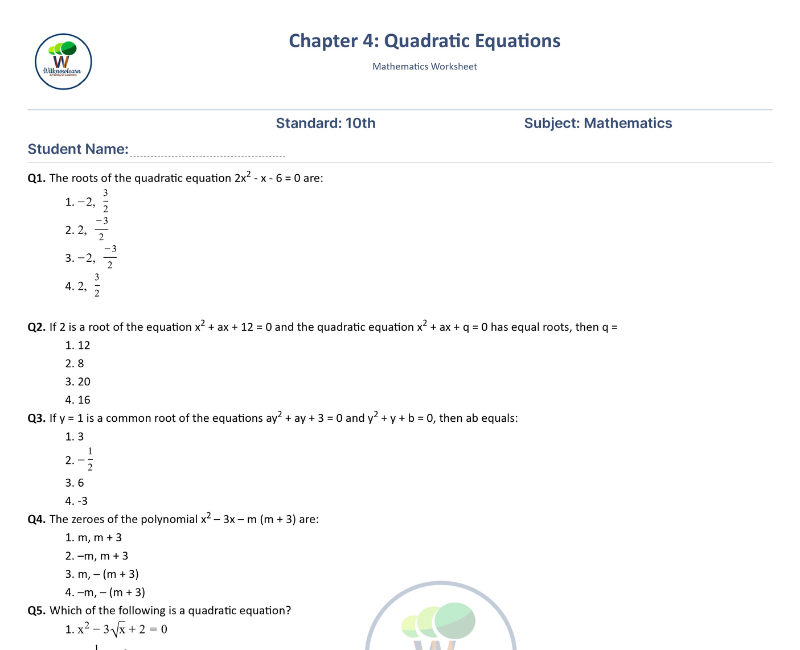
Use the existing worksheet download option on this page for written practice. The online questions add immediate checking, graph investigations and progressively harder tasks.
In NCERT Class 10 Maths Chapter 4, begin by simplifying an equation into standard form. Identify the coefficients with their signs, then select a suitable method. Factorisation is efficient when factors are accessible; the quadratic formula provides a systematic approach when they are less obvious.
This quadratic equations worksheet with answers includes discriminant calculations, repeated roots, unknown coefficients and application-based problems. The final question of each activity asks you to extend the method, examine a condition or explain why a tempting conclusion fails.
For Class 10 quadratic equations word problems, define the unknown quantity and its restrictions before forming an equation. A negative length or speed may satisfy the algebra but fail the original situation. In rational equations, record excluded denominator values before multiplying.
The questions here are original practice tasks. They are not presented as previous year board questions. Use the separate notes and mind map for concept revision, then return to this worksheet to test your methods independently.
Quadratic Equations Formulas and Root Conditions
Standard form: ax² + bx + c = 0, with a ≠ 0
Discriminant: D = b² − 4ac
Quadratic formula: x = −b ± √D 2a
- D > 0: two distinct real roots.
- D = 0: equal real roots, counted as one distinct value.
- D < 0: no real roots.
For integer coefficients, a positive non-square discriminant gives irrational roots. A positive perfect-square discriminant gives rational roots.
Quadratic Equations Class 10 Extra Practice
Mixed Quadratic Equations Revision
Five extra questions covering roots, discriminants, parameters and exact answers.
Solve the equation and enter the roots in increasing order.
3x² − 14x + 8 = 0
Quadratic Equations Revision Tips for Students
- Simplify both sides before identifying the degree.
- Check that the coefficient of x² is non-zero.
- Use signed values of a, b and c in the formula.
- Place the entire numerator over 2a.
- Keep both signs when taking a square root.
- Avoid dividing by x when x could be zero.
- Check roots in the original equation and against contextual restrictions.
- For parameter questions, check that the equation remains quadratic.
Quadratic Equations Tips for Parent and Teacher
- Ask students to explain their method choice before calculating.
- Use graphs to connect the discriminant with real roots.
- Discuss why an algebraic root may be rejected in a word problem.
- Use the counterexample set to challenge unsupported generalisations.
Quadratic Equations Class 10 FAQs
How do I identify a quadratic equation after simplification?
Move all terms to one side and combine like terms. The highest remaining power must be 2, with a non-zero coefficient. An expression containing squared terms may become linear if those terms cancel.
When should I use factorisation or the quadratic formula?
Use factorisation when suitable factors are easy to find. Use the formula when factorisation is less straightforward or the question specifically requires it. Check the discriminant before looking for real roots.
What does the discriminant tell us?
It identifies the nature of the real roots. A positive discriminant gives two distinct real roots, zero gives equal real roots, and a negative discriminant gives no real roots.
How do I find a parameter for equal roots?
Set the discriminant equal to zero and solve the resulting equation. Then check that the chosen parameter does not make the coefficient of x² zero.
Can a quadratic equation have a zero root?
Yes. When the constant term is zero, factor out x rather than dividing by it. Dividing by x can remove a valid zero root.
Does a positive discriminant always give rational roots?
No. For integer coefficients, a positive discriminant must be a perfect square to give rational roots. A positive non-square discriminant gives irrational roots.
Why are some roots rejected in word problems?
A root must satisfy the equation and the original conditions. Negative dimensions, invalid ages or excluded denominator values are examples of answers that may need rejection.
Does a repeated root mean two distinct x-intercepts?
No. A repeated real root corresponds to one distinct x-intercept where the quadratic graph touches the x-axis.
Which Quadratic Equations Class 10 important questions should I practise?
Practise standard form, factorisation, the quadratic formula, discriminant conditions, parameters and word problems. Include error analysis and questions that ask you to justify a conclusion.
Can students practise several questions in the same activity?
Yes. Each game and activity contains five questions with Previous Question and Next Question controls. Entries are retained while moving within the set.
Continue with the Quadratic Equations Online Quiz for Class 10
Complete a revision set, explain your corrected method and return to the quiz. Check the reasoning behind an answer rather than memorising its position.
 Download