NCERT Class 10 Maths • Chapter 5
Arithmetic Progression Class 10 Worksheet with Online Quiz
Explore terms, totals and patterns through a 20-question online quiz, 10 interactive revision sets with five questions each and five extra practice questions.
Arithmetic Progression Online Quiz for Class 10
Question 1 of 20 • Core reasoning • Answered 0/20
An AP has first term 7 and common difference −3. Find its 14th term.
Arithmetic Progression Online Games for Class 10
Five questions in each set: two easy, two average and one HOTS challenge.
1. Term Navigation Lab
Move between a term formula, a position and a threshold.
Find the 11th term when a = 9 and d = 4.
2. Reconstruct the AP
Use two pieces of information to recover the hidden progression.
The 3rd term is 16 and the 8th is 41. Find a and d.
3. Sum and Term-Count Workshop
Calculate totals and investigate whether one total can have two positions.
Find S₈ for a = 5 and d = 2.
4. Selected-Term Explorer
An equally spaced selection of AP terms forms another AP.
From 2, 9, 16, … select terms at positions 2, 4, 6, … . Find the selected sequence’s first term and common difference.
5. Build an AP Argument
Tap the reasoning cards in order. Use Undo to revise your proof.
Arrange the four steps that derive the AP sum formula.
Arithmetic Progression HOTS Online Activities
Investigate term positions, plans, arrangements, sum formulas and counterexamples.
6. Membership and Common-Term Detective
Check whole-number positions and investigate the overlap of two APs.
Which term of 0, 6, 12, … equals 84?
7. Savings and Budget Planner
Separate one payment from a running total and compare competing plans.
A weekly saving starts at ₹20 and rises by ₹5 each week. Find the total saved in six weeks.
8. Rows and Structure Designer
Model rows, tiers and consecutive blocks using AP totals.
There are 9 rows with 14 seats in the first and 2 more in each following row. Find the capacity.
9. Decode the Sum Formula
Recover individual terms and reconstruct an AP from totals.
Given Sₙ = 2n² + 7n, find the first term and common difference.
Sₙ = 2n² + 7n
10. Invent an AP Counterexample
Construct your own progressions. Different valid answers are accepted.
Construct a non-zero constant AP. Enter its first term and common difference.
Use integers from −20 to 20.
Arithmetic Progression Class 10 Worksheet Guide
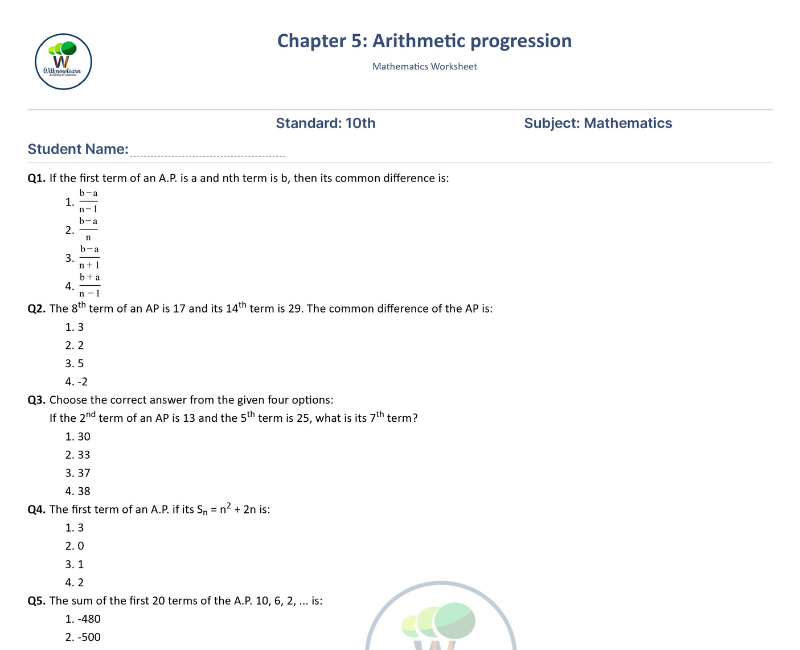
Use the existing worksheet download option on this page for written practice. This Arithmetic Progression Class 10 worksheet adds interactive questions that help you distinguish a term, its position and a total.
In NCERT Class 10 Maths Chapter 5, the fixed change between consecutive terms is the common difference. It may be positive, negative or zero. Before applying a formula, identify whether the problem asks for one term or the sum of several terms.
The AP worksheet questions cover nth terms, missing information, arithmetic means, finite progressions and sums. The revision sets also explore selected terms, common terms of two progressions and recovering an AP from its sums.
For arithmetic progression word problems, interpret the first value and the repeated increase carefully. The amount deposited in one week is different from the total deposited over several weeks. Likewise, the seats in the last row are not the seating capacity of the entire hall.
HOTS questions require more than substitution. You may need to reject a non-integer term position, examine two possible term counts or construct a counterexample. Explain these decisions in your notebook before checking the online answer.
The additional questions are original practice tasks, not a collection presented as previous year board questions. Use the linked notes and mind map for revision, then return to this worksheet for independent practice.
Arithmetic Progression Formulas and Common Errors
nth term: aₙ = a + (n − 1)d
Sum: Sₙ = n[2a + (n − 1)d] 2
First and last terms known: Sₙ = n(a + l) 2
For n ≥ 2: aₙ = Sₙ − Sₙ₋₁. Check a₁ separately using S₁.
- Use n − 1 differences to move from the first term to the nth term.
- A term position must be a positive integer.
- For a finite AP, check that the position is within its length.
- For d = 0, every term equals the first term.
Arithmetic Progression Class 10 Extra Practice
Mixed AP Revision
Five additional questions for independent practice.
The 8th term is 33 and the 15th is 68. Find a and d.
Arithmetic Progression Revision Tips for Students
- Check consecutive differences before calling a sequence an AP.
- Record the signs of the first term and common difference.
- Distinguish a term value from its position.
- Use the sum formula for totals, not the nth-term formula.
- Do not round a fractional position to make a number belong to an AP.
- Subtract two term equations to eliminate the first term.
- Use differences of consecutive sums to recover individual terms.
- Check units, counts and restrictions in application questions.
Arithmetic Progression Tips for Parent and Teacher
- Ask whether the required answer is a term, position or total.
- Use row diagrams to separate a final-row value from overall capacity.
- Discuss why a sum may occur at two different term counts.
- Ask students to justify the final HOTS answer in each set.
Arithmetic Progression Class 10 FAQs
How do I check whether a sequence is an arithmetic progression?
Subtract each term from the next. The differences must be the same throughout the sequence. An increasing pattern is not automatically an AP.
Can the common difference be negative or zero?
Yes. A negative difference produces a decreasing AP. A zero difference produces a constant AP.
Why does the nth-term formula use n − 1?
There are n − 1 steps from the first term to the nth term. Each step adds one common difference.
What is the difference between aₙ and Sₙ?
aₙ represents one term at position n. Sₙ represents the total of the first n terms. Identify which quantity the question asks for before selecting a formula.
How do I check whether a number belongs to an AP?
Set the nth-term expression equal to that number. Its position must be a positive integer. For a finite AP, also check that the position does not exceed the number of terms.
How do I find the first term and common difference from two terms?
Write an equation for each known term. Subtract them to find the common difference, then substitute back to recover the first term.
How do I find a term when the sum formula is given?
For n at least 2, subtract the sum of the first n − 1 terms from the sum of the first n terms. Find the first term separately from S₁.
Can the same partial sum occur at two different term counts?
Yes. If later terms become negative, a running total can increase and then decrease. Solve the sum equation and check all positive integer term counts.
How are arithmetic means inserted between two numbers?
If m means are inserted, there are m + 1 equal gaps between the endpoints. Divide the endpoint difference by m + 1 to find the common difference.
Which Arithmetic Progression Class 10 HOTS questions should I practise?
Include common terms, parameter conditions, sums of selected blocks, recovering an AP from totals and questions about whether information is sufficient. Explain restrictions and rejected answers.
Continue with the Arithmetic Progression Online Quiz for Class 10
Complete a five-question revision set, explain your corrections and return to the online quiz to check your progress.
 Download