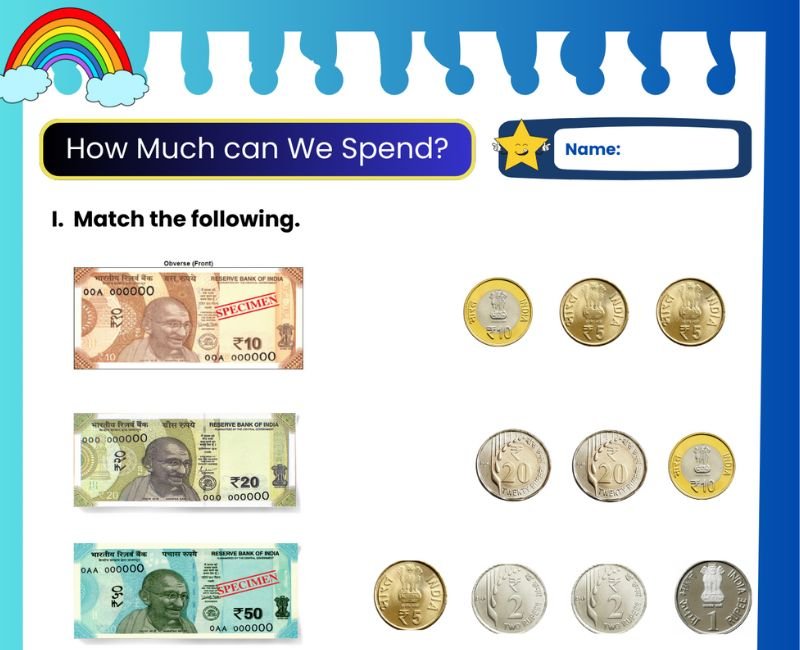
How Much Can We Spend Class 1 Worksheet
Explore money through simple shopping situations with this How Much Can We Spend Class 1 worksheet. Use it alongside NCERT Class 1 Maths Chapter 12 - How Much Can We Spend? (Money) in the Joyful Mathematics textbook.
Children practise reading coin and note values, adding amounts and making the same total in different ways. Play-money activities help connect familiar counting with everyday purchases. The original practice questions with answers below provide additional examples alongside the worksheet available on this page.
Recognise Money by Its Value
Show labelled play-money coins and notes. Ask children to read the number that tells the value. Explain that Rs. means rupees. A coin labelled Rs. 5 represents five rupees, while a note labelled Rs. 10 represents ten rupees.
Focus on the printed value rather than judging by colour or size. Currency designs can differ, so colour alone is not a reliable way to identify an amount.
Start with a small selection of values that children can read comfortably. Ask them to match a play-money piece with a price card and explain the amount in words.
Count the Amount, Not Just the Coins
Three coins do not always represent three rupees. A Rs. 5 coin and two Rs. 2 coins have a total value of Rs. 9, even though there are only three coins.
Rs. 5 + Rs. 2 + Rs. 2 = Rs. 9
Point to each value while adding. Begin with coins of the same value, then introduce mixed values. Children can use drawings or counters to check a total before answering.
Compare five Rs. 1 coins with one Rs. 5 coin. Both represent five rupees. This helps distinguish the number of money pieces from the amount they represent.
Make the Same Amount in Different Ways
Invite children to build Rs. 10 using labelled play money. They might choose one Rs. 10 note, two Rs. 5 coins or five Rs. 2 coins.
Ask them to add the values to check each combination. The number of pieces changes, but the total amount remains ten rupees.
For a smaller challenge, ask for two ways to make Rs. 6. One possibility is Rs. 5 + Rs. 1; another is Rs. 2 + Rs. 2 + Rs. 2. Accept any combination that uses the available play money and adds to the required total.
Read Price Tags and Decide What You Can Buy
Create a pretend shop with clearly labelled prices. For this activity, a pencil costs Rs. 4, an eraser costs Rs. 3 and a toy costs Rs. 12. These are practice prices, not actual market prices.
A child with Rs. 10 can buy the pencil and eraser together because their total cost is Rs. 7. The toy costs more than the amount available, so it cannot be bought with that money alone.
Ask children to compare the total price with the money they have. Buying several items requires adding their prices before deciding whether there is enough money.
Find How Much More Is Needed or Left
If an item costs Rs. 9 and a child has Rs. 6, three more rupees are needed. Show the difference using play money or count on from six to nine.
If a child starts with Rs. 10 and spends Rs. 4, six rupees remain: 10 - 4 = 6. Build the starting amount, remove the amount spent and check what is left.
Keep the story clear. "Money left" means the amount remaining after spending. "Money needed" means the extra amount required to reach a price. Encourage children to explain which quantity they are finding.
Original Money Practice Questions with Answers
Use these additional questions orally or in a notebook. All prices are provided for practice.
- What is the total of Rs. 5 and Rs. 2?
- What is the value of three Rs. 2 coins?
- How many Rs. 1 coins make Rs. 5?
- Do two Rs. 5 coins have the same value as one Rs. 10 note?
- Write one way to make Rs. 6 using Rs. 5 and Rs. 1 coins.
- A pencil costs Rs. 4 and an eraser costs Rs. 3. Find their total price.
- You have Rs. 10. Can you buy an item costing Rs. 12?
- An item costs Rs. 9. You have Rs. 6. How much more do you need?
- You have Rs. 10 and spend Rs. 4. How much remains?
- Which amount is greater: Rs. 8 or Rs. 5?
Show Practice Answers
1. Rs. 7
2. Rs. 6
3. Five coins
4. Yes; both equal Rs. 10
5. Rs. 5 + Rs. 1
6. Rs. 7
7. No
8. Rs. 3
9. Rs. 6
10. Rs. 8
How to Use the Class 1 Chapter 12 Worksheet
Use the worksheet download option on this page alongside the NCERT textbook. Read instructions aloud when needed and ask children to identify each money value before calculating.
Set up a pretend shop with paper price tags and play money. Take turns being the buyer and seller. Ask children to show the total price, choose a matching payment and explain whether they have enough.
Begin with one item, then move to two-item purchases and simple differences. The answers above apply to the original examples on this page; picture-based worksheet answers depend on the values and prices actually shown. Open-ended amount-making questions may have several correct combinations.
More NCERT Class 1 Maths Worksheets
Choose another chapter-based Joyful Mathematics resource.
Chapter 5: How Many?Revisit single digit addition and subtraction. Chapter 6: Vegetable Farm
Practise addition and subtraction up to 20. Chapter 11: How Many Times?
Explore equal groups and repeated addition. Chapter 13: So Many Toys
Count and compare collections in data-handling activities.
Browse General and NCERT Grade 1 Maths Practice
Explore All Class 1 Maths WorksheetsFind general topic resources and NCERT chapter worksheets for further practice.
How Much Can We Spend Class 1 FAQs
Which chapter is How Much Can We Spend in Class 1 Maths?
How Much Can We Spend? is Chapter 12 of NCERT Joyful Mathematics. It introduces early money concepts.
What does Rs. mean?
Rs. is an abbreviation for rupees. Rs. 5 means five rupees.
How do children find the total value of coins?
Read each value and add the amounts. Count the value of the coins, not only how many coins there are.
Can the same amount be made in different ways?
Yes. Rs. 10 can be represented by one Rs. 10 note, two Rs. 5 coins or five Rs. 2 coins.
How do I teach whether there is enough money?
Compare the total price with the available amount. The money must equal or exceed the price.
How can children find how much more money is needed?
Find the difference between the price and the amount available. For a Rs. 9 item with Rs. 6 available, Rs. 3 more is needed.
Are the shopping prices on this page real prices?
No. They are clearly stated practice prices for the learning activities.
Are answers available for the practice questions?
Yes. Expand Show Practice Answers to check the ten original examples on this page.
 Download