Class 3 Mathematics · NCERT Maths Mela Chapter 11
Filling and Lifting Class 3 Maths Worksheet NCERT with Quiz and Activities
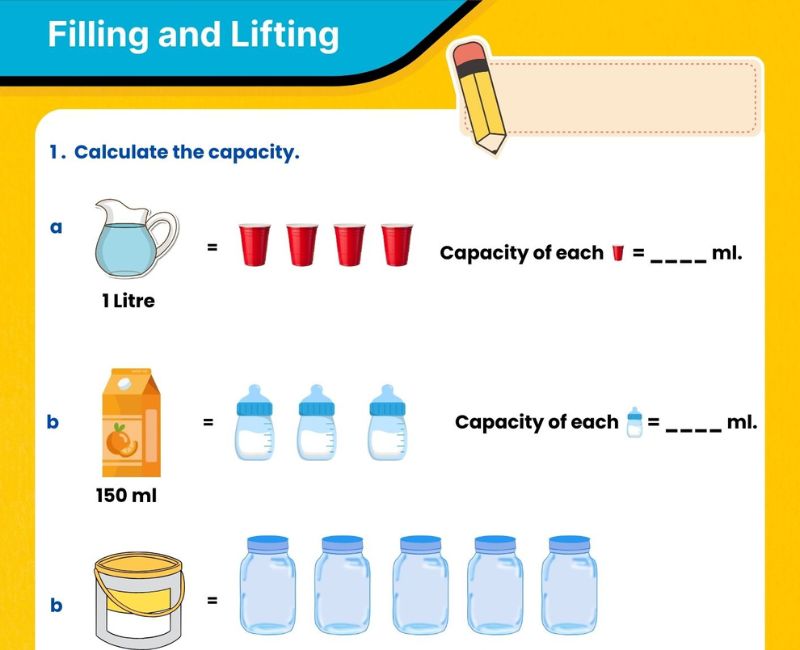
Compare how much vessels hold, count pours, learn the litre with its half and quarter, compare weights on a pan balance and learn the kilogram. Learn Class 3 Maths Chapter 11 from the NCERT Maths Mela book, then use the Filling and Lifting Class 3 worksheet and play the Filling and Lifting Class 3 quiz and Filling and Lifting Class 3 activities online.
Filling and Lifting Class 3 Online Quiz
All three glasses are the same size. Which glass holds the most milk?
Filling and Lifting Class 3 Activities
Read the idea, try the lab, then tap Games, Workshops or Challenges to play.
Explore the Filling and Lifting Class 3 worksheet for NCERT Maths Mela Chapter 11 with a free online quiz and online activities. Use the Litre Jug lab to pour quarter litre cups, find the glass that holds the most, pour and count, judge if a vessel holds more or less than 1 litre, balance objects with erasers and solve the tricky balls puzzle. Every activity is a game you can tap or type.
Litre Jug lab
Pour quarter litre cups into the measuring jugs. See the amount in quarter litres, half litres and litres. The same idea works for kilograms.
one and a half litres
2 quarter litres make a half litre. 4 quarter litres make one litre. 6 quarter litres are 1 litre and 2 quarters.
Most or Least
Game 1 of 5Goal: Tap the glass that holds the most or the least.
How to play: Read the task. Tap a glass. Press Check.
Round 1 of 4: All the glasses are the same size. Tap the glass that holds the most milk.
Practice sheet
Type your answers in the boxes. For word answers write in small letters. Press Check when you finish.
ALitres
BCounting and balancing
CKilograms
DThink and answer
Filling and Lifting Class 3 Complete Guide
This guide supports the Filling and Lifting Class 3 maths worksheet on this page. It covers Class 3 Maths Chapter 11 from the NCERT Maths Mela book, which is part of the latest NCERT syllabus for CBSE schools. Topics include comparing how much different vessels hold, the litre, the half litre and the quarter litre, comparing weights with a pan balance, the kilogram, the half kilogram and the quarter kilogram. Use it with the printable Filling and Lifting worksheets for Class 3, the Filling and Lifting Class 3 quiz and the 15 Filling and Lifting Class 3 activities above.
Introduction to NCERT Class 3 Maths Chapter 11 Filling and Lifting
Book: Maths Mela, the NCERT Mathematics textbook for Class 3 (Grade 3). Chapter: 11, Filling and Lifting. Board: CBSE and other schools that follow NCERT. This chapter has two big ideas. Filling is about capacity, which means how much a vessel can hold. Lifting is about weight, which means how heavy or light something is. Children compare vessels by pouring, learn the litre with its half and quarter, compare weights by feeling and with a pan balance, and learn the kilogram with its half and quarter.
What is there in the chapter?
- A juice challenge that shows a bigger glass needs fewer glasses to drink the same juice
- Comparing milk in glasses of different shapes by pouring it into three glasses of the same size
- Guessing how many small bowls fill a glass and how many glasses fill a bottle, then checking by pouring
- Filling a bowl with ladles and glasses with a jug, and sharing lemonade
- Why milkmen use a measuring cup, and the 1 litre bottle
- Deciding if a vessel holds more than, less than or exactly 1 litre, and a half litre and a quarter litre
- Holding things to feel which is heavier and which is lighter
- Weighing with coins, erasers and a matchbox filled with sand on a pan balance
- A weight hunt for school bags, and finding things that are 1 kilogram
- Half kilogram and quarter kilogram packets
- Tricky balls: finding the heavy ball among 3, and finding the heaviest and lightest among 3 balls
NCERT Class 3 learning objectives for this chapter
These objectives are written from the content of the chapter. They are not copied from the book.
- To compare how much two or more vessels hold, using pouring
- To understand that a bigger vessel needs fewer pours and a smaller vessel needs more pours for the same amount
- To know that the amount of water stays the same when it is poured from one vessel to another
- To know the litre as a unit for liquids and to use half litre and quarter litre
- To compare weights by holding and with a pan balance
- To weigh with simple units such as erasers, coins and a matchbox
- To know the kilogram as a unit of weight and to use half kilogram and quarter kilogram
- To use reasoning to find a heavy ball with a pan balance
Learning outcomes
After this chapter and the practice on this page a Class 3 child should be able to:
- say which of several glasses holds the most or the least
- estimate and count how many small vessels fill a bigger vessel
- say whether a vessel holds more than, less than or exactly 1 litre
- say that 2 half litres or 4 quarter litres make 1 litre
- tell which of two objects is heavier from a pan balance
- say how many erasers or coins balance an object
- say that 2 half kilograms or 4 quarter kilograms make 1 kilogram
- find the heavy ball among 3 balls with one weighing
Filling and Lifting Class 3 resources on this page
- Filling and Lifting Class 3 worksheet: a printable NCERT style worksheet on capacity, litres, weight and kilograms.
- Filling and Lifting Class 3 quiz: a free 20-question online quiz with easy, average and thinking questions, picture questions and instant marks with a reason for every answer.
- Filling and Lifting Class 3 activities: 15 free online activities, made of 5 games, 5 workshops and 5 challenges, with marks and a comment after the challenges.
- Practice sheet: 16 questions you can type and check, with a Show answers button.
What is Class 3 Maths Chapter 11 Filling and Lifting?
Chapter 11 of the NCERT Class 3 Maths book Maths Mela is called Filling and Lifting. It is about capacity and weight. Capacity is how much a vessel can hold and it is measured in litres. Weight is how heavy something is and it is measured in kilograms. Children first compare by looking, pouring and holding, and then use standard units.
Which glass holds more?
Glasses come in different shapes, so it is hard to tell by looking which holds more. To compare, pour the milk from each glass into glasses of the same size. The one with the highest level holds the most milk. The one with the lowest level holds the least. The same idea works for finding how many small bowls fill a glass. First guess, then pour and count.
| Question | How to find out |
|---|---|
| Which glass holds the most? | Pour each into a same-sized glass and compare the levels. |
| How many bowls fill a glass? | Guess, then pour bowl after bowl and count. |
| Which vessel is better for sharing lemonade? | A jug, because one jug fills many glasses. |
Bigger vessel, fewer pours
In the juice challenge a child can drink 6 small glasses but not 6 big glasses. A bigger glass holds more juice, so fewer glasses are needed for the same amount. A smaller vessel needs more pours. A ladle needs many pours to fill a glass and a glass needs many pours to fill a jug. In both cases the amount of water stays the same. If one jug fills 6 glasses then 3 jugs fill 6 + 6 + 6 = 18 glasses.
The litre
A milkman pours milk with a measuring cup that holds 1 litre. The litre is a standard unit for liquids, so everyone gets the same amount. A 1 litre bottle can be used to find out how much other vessels hold. A glass holds less than 1 litre. A bucket holds more than 1 litre. A jug that holds exactly 1 litre fills the 1 litre bottle exactly.
Half litre and quarter litre
A half litre is half of 1 litre. A quarter litre is half of a half litre, so it is one fourth of a litre. 2 half litres make 1 litre. 4 quarter litres make 1 litre. 2 quarter litres make a half litre. A mug may hold a half litre and a glass may hold a quarter litre.
| Amount | In quarter litres | In half litres |
|---|---|---|
| Quarter litre | 1 | half of one |
| Half litre | 2 | 1 |
| One litre | 4 | 2 |
| One and a half litres | 6 | 3 |
| Two litres | 8 | 4 |
Heavy or light?
A child holds 3 textbooks in one hand and a pencil box in the other. The hand with the books goes lower because the books are heavier. To compare two things, hold them in both hands or place them on the two pans of a pan balance. The pan of the heavier thing goes down. If both pans stay level the two things weigh the same.
Weighing with erasers, coins and a matchbox
With a pan balance we can weigh by counting how many coins or erasers balance an object. A pencil may balance 3 erasers and a spoon may balance 5. The object that needs more erasers is heavier. For slightly heavier objects a matchbox filled with sand makes a bigger weight. Children guess how many matchboxes an object needs, then check. They then list the objects from the lightest to the heaviest.
| Object | Balances | Which is heavier? |
|---|---|---|
| Pencil | 3 erasers | The spoon (5 erasers) |
| Spoon | 5 erasers | The pencil box (7 erasers) |
| Ping pong ball | 2 erasers | The lightest of these |
The kilogram, half kilogram and quarter kilogram
The kilogram is the standard unit for weight. Many packets of salt, sugar or flour at home have 1 kg written on them. Holding a 1 kilogram packet helps us guess which things are heavier or lighter than 1 kilogram. Half a kilogram is half of 1 kilogram and a quarter kilogram is half of a half kilogram. 2 half kilograms make 1 kilogram and 4 quarter kilograms make 1 kilogram. On a balance, two half kilogram packets of dal balance a 1 kilogram packet.
Tricky balls
There are 3 balls that look the same. One is heavier and the other two weigh the same. You can find the heavy ball with only one weighing. Put one ball on each pan and keep the third ball out. If the pans stay level, the ball left out is heavy. If one pan goes down, the ball on that pan is heavy. In another puzzle there are 3 balls of different weights, red, orange and green. Weigh two of them, then weigh the heavier one against the third ball, to find the heaviest and the lightest.
Types of questions to practise
Questions on this chapter ask children to pick the glass that holds the most or the least, count pours, say if a vessel holds more or less than 1 litre, use half litre and quarter litre, read a pan balance, count erasers, use kilograms and solve ball puzzles. The online quiz on this page mixes choice questions, true or false questions, picture questions and typed answers, and the practice sheet has 16 typed answers.
Solved examples
Common mistakes
| Mistake | Correction |
|---|---|
| Choosing the taller glass as the one that holds more | Compare by pouring into same-sized glasses. A tall thin glass may hold less than a short wide one. |
| Thinking the amount of water changes when it is poured | The amount stays the same in every vessel. |
| Saying more pours are needed for a bigger vessel used for pouring | A bigger vessel needs fewer pours. |
| Saying 2 quarter litres make 1 litre | 4 quarter litres make 1 litre. 2 quarter litres make a half litre. |
| Thinking the lighter object makes its pan go down | The heavier object makes its pan go down. |
| Mixing litre and kilogram | The litre is for how much a vessel holds. The kilogram is for weight. |
| Saying a quarter kilogram is more than a half kilogram | A quarter kilogram is half of a half kilogram, so it is less. |
| Weighing all 3 balls one by one to find the heavy ball | Weigh just 2 balls once. Level pans mean the third ball is heavy. |
Capacity and weight in daily life
We use litres for milk, oil, water and juice and kilograms for rice, sugar, vegetables and fruit. Ask your child to find a 1 litre bottle and a 1 kilogram packet at home. Ask which things in the kitchen hold more than 1 litre, which weigh less than 1 kilogram and how many glasses a jug of juice can fill.
What your child learns from the Filling and Lifting worksheet
- Comparing how much vessels hold
- Counting pours with bigger and smaller vessels
- The litre, half litre and quarter litre
- Comparing weights with a pan balance
- Weighing with erasers and coins
- The kilogram, half kilogram and quarter kilogram
- Reasoning with the tricky balls puzzle
- Choosing the right unit for liquids and for weight
Tips for parents and teachers
Let your child pour water between a small bowl, a glass and a bottle and guess before pouring. Mark a 1 litre bottle and see how many glasses it fills. Make a simple balance with a ruler and two cups and weigh small things against erasers. Keep a 1 kilogram packet of salt for your child to hold and compare. Play the three balls puzzle with real balls.
Related Maths Worksheets
- Measurement of Weight Worksheet Class 3
- Measurement Long and Short Worksheet Class 3
- Fun at Class Party Worksheet Class 3
- Mental Maths Worksheet Class 3
- Double Century Worksheet Class 3
- Fun with Shapes Worksheet Class 3
- Raksha Bandhan Worksheet Class 3
- Fair Share Worksheet Class 3
- House of Hundreds II Worksheet Class 3
- Play with Patterns Worksheet Class 3
- Data Handling Worksheet Class 3
- Fractions Worksheet Class 3
Frequently Asked Questions
What is Class 3 Maths Chapter 11 Filling and Lifting?
It is the eleventh chapter of the NCERT Class 3 Maths book Maths Mela. Children compare how much vessels hold, learn the litre, half litre and quarter litre, compare weights with a pan balance and learn the kilogram, half kilogram and quarter kilogram.
How do I find which glass holds the most?
Pour the contents of each glass into glasses of the same size. The glass that gives the highest level held the most. The one that gives the lowest level held the least.
Why does a bigger glass need fewer pours?
A bigger glass holds more water each time, so fewer glasses are needed to move the same amount of water.
Does the amount of water change when I pour it into another vessel?
No. The amount of water stays the same. Only the shape of the water and its level change.
What is a litre?
A litre is a standard unit for how much a vessel holds. Milkmen use a measuring cup of 1 litre, and a 1 litre bottle can be used to check other vessels.
How many quarter litres make a litre?
4 quarter litres make 1 litre. 2 quarter litres make a half litre, and 2 half litres make 1 litre.
How does a pan balance show which object is heavier?
The pan with the heavier object goes down. If both pans stay level the two objects weigh the same.
What is a kilogram?
A kilogram is a standard unit of weight. A packet of salt or sugar labelled 1 kg is a good measuring tool for guessing other weights.
How many half kilograms and quarter kilograms make 1 kilogram?
2 half kilograms make 1 kilogram. 4 quarter kilograms make 1 kilogram.
How can I find the heavy ball among 3 balls with one weighing?
Put one ball on each pan and keep the third ball out. If the pans stay level the third ball is heavy. If one pan goes down, the ball on that pan is heavy.
Does this page have Filling and Lifting Class 3 questions and answers?
Yes. The online quiz shows the right answer and the reason after you finish, and the practice sheet has a Show answers button. The printable worksheet is the PDF download for this chapter.
What is included on this page?
This page has a free 20-question Filling and Lifting Class 3 online quiz with instant marks, 15 online activities made of 5 games, 5 workshops and 5 challenges, a Litre Jug lab, a 16-question practice sheet and a complete guide with solved examples.
 Download