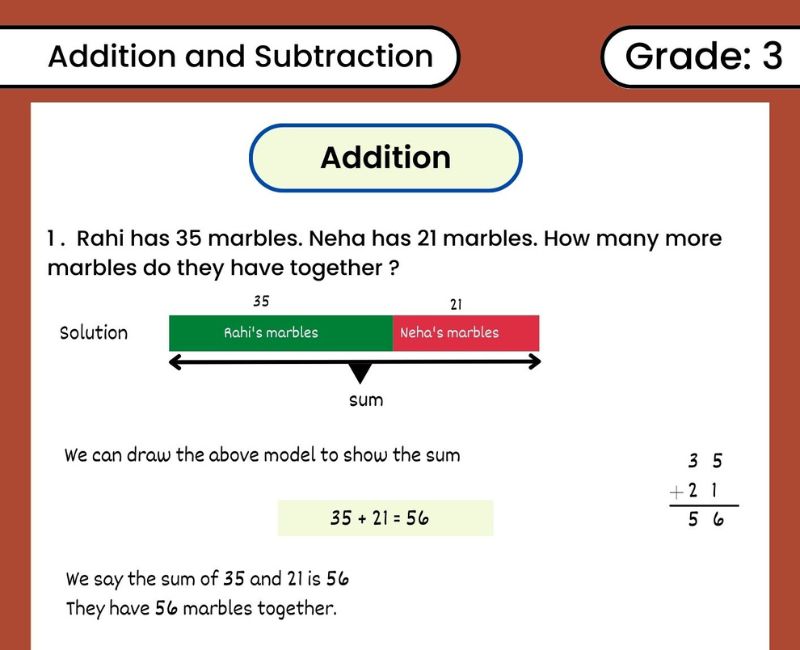
Addition and Subtraction Word Problems Worksheet for Class 3
Read the story. Choose a model. Solve and explain your answer.
Explore WitKnowLearn’s addition and subtraction word problems worksheet for Class 3 with online quiz and online activities. Practise two-digit and three-digit story sums, regrouping, money problems, comparisons, missing numbers and two-step questions. Use part–whole models, a number line and everyday situations to explain each answer.
0 of 20 answered
1. A basket has 24 red apples and 15 green apples. How many apples are there altogether?
You can return to any question and change your answer.
Choose the Operation
Learning goal: Choose an operation from the relationship in the story.
- Read one story at a time.
- Choose Add or Subtract. Explain the relationship to yourself.
There are 35 paper boats. Another 18 are made. Find the new total.
Read the situation, then investigate.
Four Maths Discoveries
Learning goal: Understand useful facts about calculations and units.
- Open all four discovery cards.
- Give a new example for each idea.
Units matter
A count of books is different from an amount of money. Finish the answer with the unit the question asks for.
Regrouping keeps the value
One ten can be exchanged for ten ones. The way a number is written changes, but its value does not.
Estimates help you check
An approximate total can reveal a large error, but it is not the exact answer. For 198 + 103, about 200 + 100 gives about 300.
More does not always mean add
If Sam has 25 cards, which is 6 more than Jo has, Jo has 25 − 6 = 19. Identify whose amount is unknown.
Read the situation, then investigate.
Addition and Subtraction Word Problems for Class 3 Meaning Methods and Examples
What is a word problem?
A word problem describes a mathematical situation using a short story. To solve it, identify the facts, decide what is unknown and choose a calculation that matches the relationship. The answer should include the correct unit, such as books, metres or rupees.
This Class 3 addition and subtraction worksheet develops one-step and two-step problem solving with two-digit and three-digit numbers. It includes addition story sums, subtraction word problems, money change, comparison questions, missing parts and regrouping. Understanding the situation matters more than looking for a single clue word.
Addition: combine or increase
Addition joins parts to find a whole or finds a new amount after an increase. In 146 + 123 = 269, the two addends are 146 and 123. Their sum is 269.
Example: A class collects 146 blue bottle caps and 123 white bottle caps. Altogether there are 146 + 123 = 269 bottle caps.
Subtraction: remove compare or find a part
Subtraction can find what remains, the difference between amounts or a missing part of a known whole. In 275 − 138 = 137, 137 is the difference.
Example: A shop has 275 pencils and sells 138. It has 275 − 138 = 137 pencils left.
Common types of addition and subtraction word problems
| Situation | What is unknown? | Example calculation |
|---|---|---|
| Join two groups | The whole | 82 + 47 = 129 |
| Take away | The amount left | 93 − 28 = 65 |
| Compare | How much more or fewer | 146 − 118 = 28 |
| Complete a target | The missing part | 150 − 96 = 54 |
| Find the starting amount | The amount before removal | 84 left + 29 given away = 113 |
| Two changes | The final amount | 250 + 65 − 40 = 275 |
A clear method: read plan solve check
- Read: Find what happened and what the question asks. Keep the units.
- Plan: Draw parts, a comparison bar or a number line. Choose the operation from the relationship.
- Solve: Calculate carefully. Align hundreds, tens and ones when using columns.
- Check: Use an inverse calculation or a sensible estimate. Write an answer sentence.
Regrouping in three-digit addition
For 268 + 157, the ones give 8 + 7 = 15. Write 5 ones and carry 1 ten. The tens give 1 + 6 + 5 = 12 tens. Write 2 tens and carry 1 hundred. The hundreds give 1 + 2 + 1 = 4. The sum is 425. A carried digit has place value: it is not an extra one added anywhere.
Regrouping in subtraction
For 352 − 176, regroup one ten so there are 12 ones. The ones give 12 − 6 = 6. There are now 4 tens; regroup one hundred to make 14 tens. Then 14 − 7 = 7 tens and 2 − 1 = 1 hundred. The difference is 176. Check: 176 + 176 = 352.
Worked two-step money problem
A child has ₹300 and buys a book for ₹125 and a game for ₹95. How much money remains?
Step 1: Total cost = 125 + 95 = ₹220.
Step 2: Money left = 300 − 220 = ₹80.
Check: ₹220 spent + ₹80 left = ₹300.
Why a keyword alone can mislead
Consider: “Nina has 45 cards. Nina has 8 more cards than Ali. How many cards does Ali have?” Nina has the larger amount. Ali has 45 − 8 = 37 cards. Although the story contains more, subtraction finds the smaller unknown amount. Read whose amount is known and whose amount is required.
Common mistakes and corrections
| Mistake | Correction |
|---|---|
| Add every number in the story | Use only information needed for the question |
| Use “more” as an automatic instruction to add | Identify the larger amount, smaller amount and difference |
| Subtract the smaller digit from the larger in each column | Keep the subtraction order and regroup when needed |
| Forget a carried ten | Track hundreds, tens and ones carefully |
| Stop after the first calculation in a two-step problem | Compare the intermediate result with the question |
| Write only a number | Include the unit and a sentence that answers the question |
Practice questions with explanations
A box has 148 clips and another has 126. How many are there together?
148 + 126 = 274 clips. The problem joins two groups, so addition finds the whole.
There are 240 seats and 175 are occupied. How many are empty?
240 − 175 = 65 empty seats. Occupied seats are a known part of the total.
After spending ₹68 a child has ₹92 left. What was the starting amount?
68 + 92 = ₹160. The original amount includes both what was spent and what remains.
How can subtraction check 156 + 134 = 290?
Subtract either part from the whole: 290 − 134 = 156 or 290 − 156 = 134.
The separate online quiz awards one mark per correct answer, giving a score out of 20. Learning games and practical activities use different examples to develop models, reasoning and explanation.
Frequently Asked Questions
What are addition and subtraction word problems?
They are short stories that use addition or subtraction to find an unknown amount, such as a total, a remainder, a difference or a missing part.
How do you choose between addition and subtraction?
Identify the relationship. Join known parts to find a whole using addition. Use subtraction to find a remainder, a missing part or the difference between two amounts.
Does the word more always mean addition?
No. If one person has 8 more than another and the larger amount is known, subtract 8 to find the smaller amount. Read the whole story.
What are two-step word problems?
They require two calculations to answer the final question. For example, add two prices and then subtract their total from the money available.
What does how many more mean?
It asks for the difference between two amounts. Subtract the smaller amount from the larger amount when finding that difference.
How do you find a missing addend?
Subtract the known part from the total. For example, in 64 + a missing number = 100, the missing number is 100 − 64 = 36.
What is regrouping in addition?
Regrouping exchanges ten units of one place for one unit of the next place. For example, 14 ones become 1 ten and 4 ones.
Why do we regroup in subtraction?
Regrouping rewrites a number with the same value so subtraction can be completed in each place. One ten can be exchanged for ten ones.
How can children use bar models?
Draw parts that join into a whole or two bars for amounts being compared. Label known values and mark the unknown part before calculating.
How do you calculate money change?
Subtract the total cost from the money paid. If there are two purchases, add their costs first unless another valid method is clearer.
How can an answer be checked?
Use the inverse operation, estimate the likely size, and check that the answer matches the story and its units.
Should every number in a word problem be used?
No. Some information may be unnecessary. Choose the facts that answer the question and explain why any extra number is not needed.
Content references
Original questions and activity examples. The translator opens an external service; its availability and output depend on that service.
 Download