Explore My World: Look, Match, Sort and Draw! 🌱🐘🌈
20 EVS questions and 10 interactive games. Sort foods, park vehicles, build a plant and explore everyday pictures!
📝 EVS Picture Quiz for LKG
⏱ Time Left: 20:00
Question 1 of 20 • Answered: 0/20
Which body part helps us see?
Question navigation
🎮 EVS Online Games for LKG
1. 🔎 Explore Everyday Pictures
Tap a picture card to reveal its name.
Choose a card
Ready to play!
2. 🧺 Fruit and Vegetable Baskets
Select a food card, then its everyday food group.
Ready to play!
3. 🚗 Transport Garage
Select a vehicle, then its road, water or air group.
Ready to play!
4. 🃏 Animal Picture Memory
Reveal two cards. Find four identical animal pairs.
Find four pairs.
5. 👀 Match Body Parts and Jobs
Select a body part, then its matching job.
Ready to play!
🧠 EVS Online Activities for Junior KG
6. 🎒 Pack a Drawing Bag
Select a notebook, pencil and crayons for drawing. Tap again to change a choice.
Ready to play!
7. 🌱 Build a Flowering Plant
Add roots, stem, leaves and a flower. Tap a part again to remove it.
Ready to play!
8. 🌦️ Pack for Weather
Sort items for these two pretend weather scenes.
Ready to play!
9. 💧 Turn Off Unused Taps
Tap each running tap after the pretend washing is finished.
Ready to play!
10. 🎨 Draw on a Nature Guide
Draw leaf veins, trace an outline or make your own plant on the blank board. Use the red pen.
Ready to play!
📄 14 Pages EVS Activity Worksheet for LKG
Use the existing download option on this page for the printable worksheet. The online activities above provide additional practice with familiar EVS themes.
📖 Read the LKG EVS activity learning guide
An EVS activity worksheet for LKG helps children notice, name and talk about the world around them. LKG is also known as Junior KG or JR KG. Begin with objects and experiences the child already knows, then use pictures and practical tasks to introduce new vocabulary.
The online practice brings together body parts, food names, animals, transport, school objects, plants, weather and water use. These are additional learning activities rather than a page-by-page reproduction of the downloadable PDF. An adult can read the short prompts and name each picture before asking the child to sort or match it.
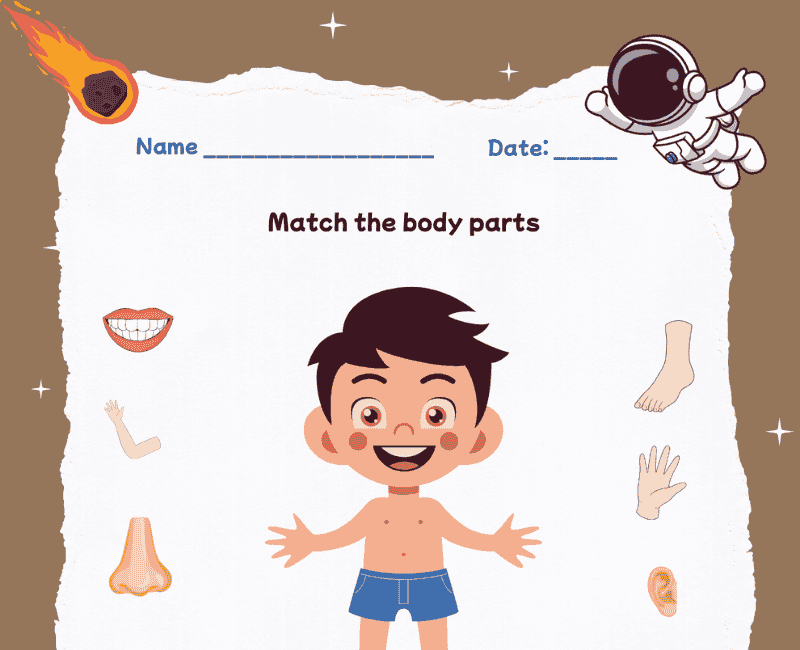
Body-part matching connects familiar words with everyday actions: eyes help us see, ears help us hear, the nose helps us smell and hands help us hold things. Children can point, gesture or select a picture to show understanding. Adapt the activity to the child's experiences and ways of communicating.
Use familiar fruit and vegetable names in food sorting. Apple, banana and grapes belong to the everyday fruit group, while carrot, potato and onion belong to the everyday vegetable group in this activity. The task uses common kitchen categories. Ask children to describe an object before choosing its group.
Transport pictures introduce road, water and air travel. A bus and bicycle travel on roads, a boat and ship travel on water, and an aeroplane and helicopter fly through the air. Connect these examples to journeys the child knows, without assuming every child has used each vehicle.
Observe a real plant alongside the digital construction. Add roots, stem, leaves and a flower, then point out corresponding parts on a suitable flowering plant. Roots usually grow in soil for the potted-plant example. Different plants have different shapes, and not every plant will have flowers visible at the time of observation.
Weather tasks use two clearly labelled pretend scenes. Umbrellas and raincoats are useful for rain; sun hats and sunshades belong to the sunny scene. Talk about the weather where the child lives rather than treating a picture as a rule for every season or country.
The twenty-question quiz checks recognition and simple reasoning. The ten hands-on tasks include sorting, memory, matching, collecting items, construction and nature drawing. Keep each session manageable, praise careful observation and let children explain their choices. Use printable practice and conversations about everyday experiences to revisit what they have learned.
💬 EVS Activity Worksheet FAQs
😊 What does EVS mean for LKG children?
EVS means Environmental Studies. Early activities help children observe familiar people, objects, plants, animals and everyday surroundings.
😊 How can I teach EVS at home?
Use real objects and short conversations. Name a fruit, observe a leaf, match a vehicle picture or talk about the weather outside.
😊 Which body parts should young children learn first?
Begin with familiar parts such as eyes, ears, nose, hands and feet. Connect each word with a simple action and adapt practice to the child.
😊 How do I teach fruit and vegetable names?
Show a familiar food or clear picture, say its name and invite the child to point or match. Use everyday kitchen groups for early sorting.
😊 What animal activities work for LKG?
Try picture naming, identical-pair memory and noticing features such as a trunk, ears or legs. Use familiar animals before adding new ones.
😊 How can I explain road, water and air transport?
Use toy vehicles or picture cards. Match a bus to a road, a boat to water and an aeroplane to air travel.
😊 Which plant parts can I introduce?
Start with roots, stem, leaves and a flower on a suitable flowering-plant example. Look at a real plant and discuss the parts that are visible.
😊 How do I teach weather through activities?
Observe the weather outside and sort picture items for clearly described scenes. Local weather and seasons can differ from worksheet illustrations.
😊 Does a child need to read every EVS label independently?
No. An adult can read aloud and name the pictures. Children can show understanding by pointing, matching, sorting or explaining in familiar language.
😊 How can I download the 14-page EVS worksheet?
Use the existing download option on this page. Combine the printable resource with the separate online quiz and activities.
 Download