My Amazing Body: Learn, Play & Explore! 🌈
Can you find your nose, match the senses, and build a funny face?
👇 Your quiz and games are just below. Scroll down to play!
For little learners: a grown-up can read aloud and help you tap.
🌟 Parts of the Body Quiz
20 questions: 5 easy, 7 average, and 8 thinking challenges. Each correct answer earns 1 mark. No negative marking.
Read together. The 20-minute timer starts with the first answer or navigation tap.
Answered: 0/20
1. Which body part helps us see?
🎮 Choose a Body Activity
Tap an activity below. One game opens at a time.
1. Tap & Name My Body 🧒
Tap a body part on the picture, or choose its name beside the character.
2. Picture–Word Match 🔗
Choose a picture, then match its body-part word.
3. Body-Part Memory 🧩
Find each picture and its matching word.
4. Five Senses Baskets 🧺
Choose an experience card, then put it in the correct sense basket.
5. Build a Face 🙂
Tap a feature button to add it to the face. You can also tap its slot in the picture.
6. Trace Body Words 🖍️
Choose a word. Trace the pale guide with the red pen.
7. Trace & Decorate a Hand 🖐️
Trace the outline, then draw lines or patterns inside the hand.
8. Move, Point & Play 🎈
Turn a card to reveal an action. Try it comfortably, or point to the body part instead.
9. Handwashing Steps Train 🧼
Build the routine: wet, soap and rub, rinse, then dry.
10. Pack the Body-Care Kit 🎒
Choose a care item, then send it to the matching body-part station.
📖 About this Parts of the Body Worksheet for Nursery
Discover familiar body parts
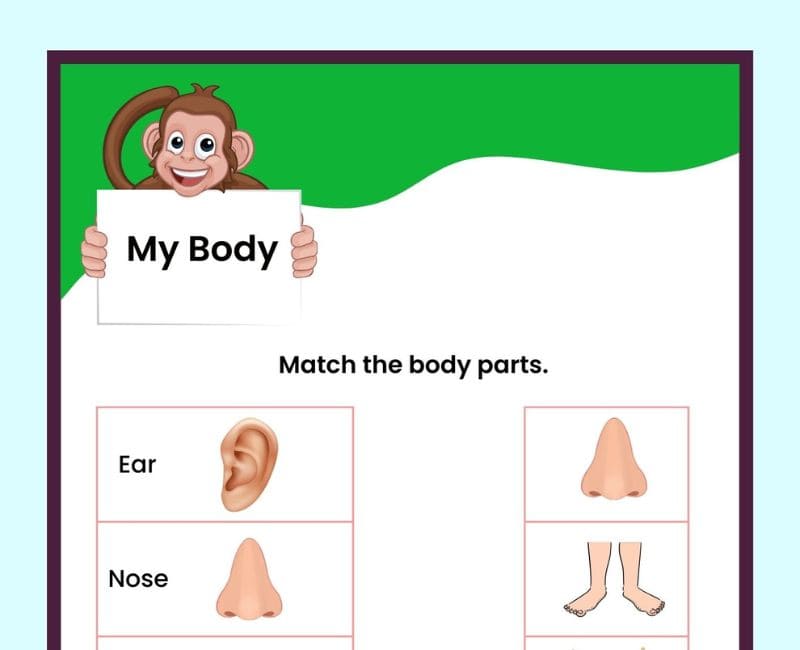
This parts of the body worksheet for nursery gives young children a simple way to name the head, eyes, ears, nose, mouth, hands, legs, and feet. Begin with familiar words: point to a body part on a picture, say its name, and invite your child to point to their own body if they wish. Short conversations work better than memorising a long list.
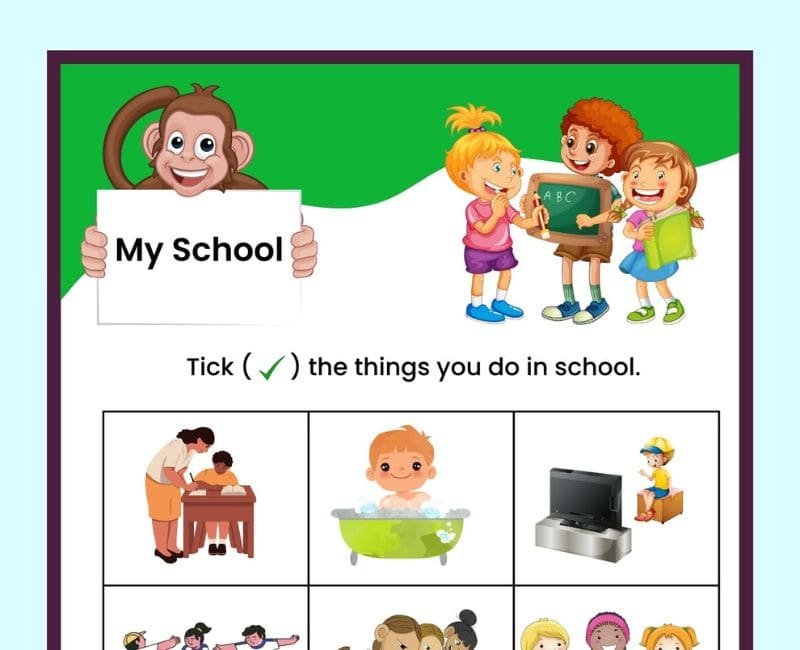
Use the printable worksheet available on this page alongside the online games. A my body worksheet for nursery can support picture matching, naming, colouring, and adult-guided speaking. Children who are still learning to write can point, tap, or draw while a grown-up helps with the words.
Explore body parts through play
The ten interactive activities include a clickable body picture, picture-word matching, memory pairs, and a five-senses sorting game. Children can assemble a face, trace short body-part words, and draw over a hand outline with one red pen. Movement cards, a handwashing sequence, and a body-care kit add practical ways to use the vocabulary.
The body parts activities for preschool focus on visible body parts and familiar actions. Eyes help us see, ears help us hear, the nose helps us smell, the tongue helps us taste, and skin helps us feel touch. Hands are useful for exploring textures, but touch is felt through skin across the body. Keep examples familiar: looking at a picture, hearing a bell, or feeling a soft cloth.
How to use this nursery EVS activity
Read the instructions aloud and demonstrate one tap before inviting the child to try. Play “point and name”, use a mirror to notice facial features, or follow a movement card together. Children can stay seated and adapt actions to what feels comfortable. Recognise that bodies and abilities differ; naming a picture does not require a child to perform a particular movement.
The 20-question quiz includes 5 easy questions, 7 average questions, and 8 harder thinking questions suited to nursery learning. The challenges use simple situations, matching ideas, and choosing actions in the right order. They do not require advanced anatomy. After submission, the page shows marks out of 20 and explanations for every question.
Continue the topic with our Cleanliness and Hygiene Worksheet. Pair the body picture with the Introduce Myself Worksheet, or explore familiar people with the Family Tree Worksheet.
For your 2026 nursery EVS practice, choose two or three activities per session and revisit the words during everyday routines. A simple “Which part helps you hear that sound?” keeps the learning connected to the child's experience.
🌈 More Nursery EVS to Explore
💬 Frequently Asked Questions
Which body parts should nursery children learn first?
Start with familiar visible parts such as the head, eyes, ears, nose, mouth, hands, legs, and feet. Introduce a few words at a time using pictures and everyday actions.
How can I teach body parts without expecting writing?
Use pointing, matching pictures, naming aloud, drawing, and simple movement prompts. A grown-up can read the labels and help the child respond.
What are the five senses in simple words?
The five familiar senses are seeing, hearing, smelling, tasting, and touch. Link them to eyes, ears, nose, tongue, and skin using everyday examples.
Are hands the only body part that can feel touch?
No. Skin across the body helps us feel touch. Hands are often used to explore objects, which makes them a familiar example for young children.
Where can I download the nursery body parts worksheet PDF?
Use the worksheet download button on this WitKnowLearn page. The quiz and interactive activities provide additional practice alongside the printable resource.
Are the harder questions suitable for nursery?
Yes. They use familiar situations and simple reasoning, such as matching two senses to an activity or putting a routine in order. A grown-up should read them aloud.
Can the tracing games work on a phone?
The tracing boards support touch and mouse input. Choose a word or a hand guide, draw with the red pen, and use Undo or Clear to try again.
Can my child adapt the movement games?
Yes. A child can point to the picture, describe an action, or do a comfortable version while seated. The movement cards are not scored.
 Download