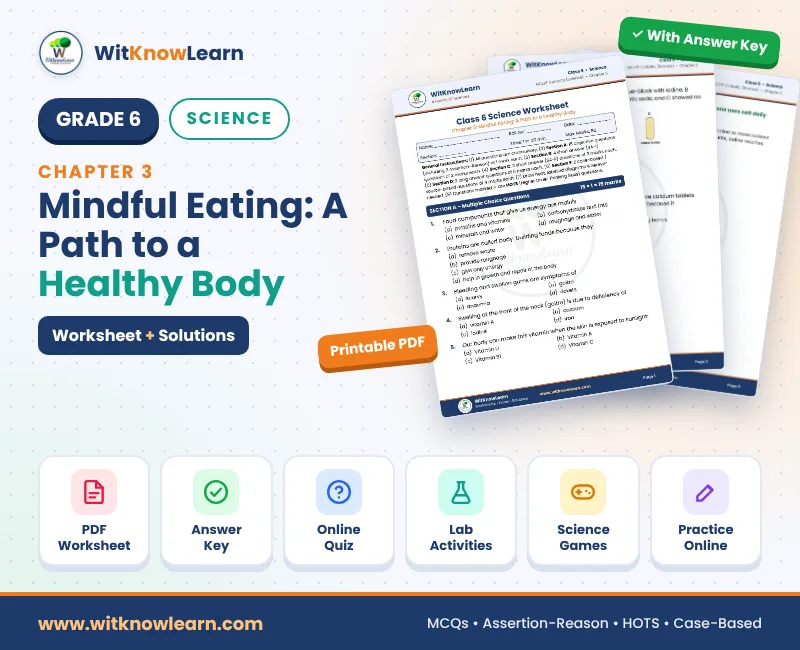
Class 6 Science · Mindful Eating Worksheet
Mindful Eating Class 6 Worksheet with Online Quiz and Games
Which nutrient is hiding in a potato, a dal or a groundnut? Take the online quiz, test food samples in the Food Test Lab, build balanced plates, match deficiency diseases in hands-on activities and try three science experiments in the Virtual Lab.
Flip the cards and try the Food Test Lab, then tap the Games, Labs, Challenges or Virtual Lab button.
Mindful Eating Class 6 Online Quiz
20 questions · tap an answer to move on · full review at the end
Flip the cards, try the Food Test Lab, then play the games, do the labs and take the challenges. Earn up to 3 stars in every activity.
Fact cards: tap a card to flip it
Food Test Lab
Three food samples to test with your hands. Drag the right test onto the sample, read the colour or the mark it gives, then press Check. A wrong choice shows what goes wrong, so you can try again.
Challenge marks: 0 / 15 (0 of 5 challenges done)
Finish all 5 challenges to see your comment.
Virtual Lab: do real experiments step by step
Practice sheet
Mindful Eating Class 6 Activities
Test food samples with your own hands in the Food Test Lab, sort nutrients, build a balanced plate, read a food label with a magnifier, match deficiency diseases, then test for starch and fat and survey the class tiffin in the Virtual Lab. Earn up to 3 stars in every activity.
🍽️Why we eat what we eat
Every region of India has its own meals, from idli and sambar in the south to litti chokha in Bihar and thukpa in the hills. The things we put into a dish are its ingredients, and each ingredient brings something the body needs. Food gives us energy to work and play, material to grow and repair the body, and protection against disease.
🥗The components of food
Food is made of nutrients. Carbohydrates and fats give energy, and fat gives more energy than any other nutrient. Proteins are body building nutrients that help growth and repair, and they come from pulses, milk, curd, paneer, eggs, fish and meat. Vitamins and minerals are needed in small amounts but they protect the body, so they are called protective nutrients. Along with these, food must give water and roughage. Roughage, or dietary fibre, is not a nutrient at all, yet it adds bulk and helps the body get rid of undigested food.
🧪Testing food in the classroom
Simple tests show which nutrient a food contains. Two drops of iodine solution turn a food blue black if it has starch. A little caustic soda followed by drops of copper sulphate solution gives a violet colour if the food has protein. Rubbing a food on paper and letting the paper dry leaves a patch that is still translucent if the food has fat. A wet mark that dries away is only water, which is why the paper must be allowed to dry before the result is read.
⚖️A balanced diet
No single food has every nutrient, so a meal must be put together with care. A balanced diet gives carbohydrates, proteins, fats, vitamins, minerals, water and roughage in the right amounts. A plate of roti, dal, a green vegetable, curd and a salad or fruit is balanced, while a plate of only rice, or only chips and a cold drink, is not. Cooking matters too. Vegetables should be washed before they are cut, not after, and cooked for a short time, because vitamins dissolve in water and are destroyed by long heating.
⚠️When a nutrient is missing
If a nutrient is short for a long time, the body shows it as a deficiency disease. A lack of vitamin C causes scurvy, with bleeding gums and wounds that heal slowly. A lack of iodine causes goitre, a swelling at the front of the neck, which is why we use iodised salt. A lack of iron causes anaemia, with tiredness and pale skin, and a lack of vitamin A causes night blindness. Vitamin D, which the body makes when sunlight falls on the skin, is needed before calcium can be used for strong bones.
🌾Millets, food miles and eating mindfully
Millets such as ragi, bajra and jowar are called nutri cereals because they are rich in fibre, minerals and protein. The distance a food travels from the farm to our plate is called its food miles, and food grown nearby is usually fresher and uses less fuel to reach us. Mindful eating means taking only as much as you can finish, eating slowly, enjoying the food and wasting nothing, because food that is thrown away wastes the water, the soil and the work that went into growing it.
This Mindful Eating worksheet for Class 6 brings the chapter to life on WitKnowLearn with an online quiz, online activities and interactive games. Students test samples, sort nutrients, build balanced plates and read labels with their own hands, then try three science experiments in the Virtual Lab.
Mindful Eating Class 6 Science Guide
Mindful Eating, A Path to a Healthy Body, is a key chapter of Class 6 Science. It covers the variety of food we eat, the components of food, the tests for starch, protein and fat, a balanced diet, deficiency diseases, millets, food miles and the habit of eating without waste. This guide explains each idea clearly for Class 6 students, parents and teachers. It goes with the Mindful Eating Class 6 worksheet on WitKnowLearn, which also has an online quiz, online activities, interactive games and a Virtual Lab on the same page.
What is there in this topic
- Food variety, ingredients and why we eat
- Carbohydrates, proteins, fats, vitamins, minerals, water and roughage
- Tests for starch, protein and fat
- Balanced diet and healthy cooking habits
- Deficiency diseases such as scurvy, goitre, anaemia and night blindness
- Millets, food miles and mindful eating
Learning objectives
- Name the components of food and say what each one does.
- Carry out and explain the tests for starch, protein and fat.
- Judge whether a meal is balanced and correct it if it is not.
- Link each deficiency disease with the nutrient that is missing.
- Explain food miles, nutri cereals and mindful eating.
Learning outcomes
After this page a student can look at a plate of food, name the nutrients it supplies, say what is missing and suggest what to add.
Key rules of this chapter
| Idea | Statement |
|---|---|
| Carbohydrates | The main energy giving nutrient, found in cereals, potato and sugar |
| Fats | Give the most energy per gram, found in oil, ghee, butter and nuts |
| Proteins | Body building nutrients, found in pulses, milk, eggs, fish and meat |
| Vitamins and minerals | Protective nutrients needed in small amounts |
| Roughage | Fibre that adds bulk and helps remove undigested food |
| Starch test | Iodine solution gives a blue black colour |
| Protein test | Caustic soda with copper sulphate gives a violet colour |
| Fat test | An oily patch stays on paper after it dries |
| Balanced diet | All the nutrients, water and roughage in the right amounts |
More about the topic
Worked example 1: naming the nutrient. A boiled potato turns blue black with iodine, so it contains starch, which is a carbohydrate and gives energy.
Worked example 2: reading a fat test. A groundnut leaves a patch on paper that is still translucent after drying, so it contains fat. A slice of apple leaves a wet mark that disappears, so it does not.
Worked example 3: fixing a meal. A tiffin of two parathas and pickle gives carbohydrates and fat only. Adding curd and a fruit supplies protein and protective nutrients and makes it balanced.
Worked example 4: calcium and sunlight. A child is given calcium tablets with vitamin D syrup, because the body cannot use calcium for bones unless vitamin D is present, and sunlight on the skin helps the body make it.
Worked example 5: saving the nutrients. Vegetables washed after cutting and boiled for a long time lose vitamins into the water. Washing before cutting and cooking lightly keeps them.
Key words
| Term | Meaning |
|---|---|
| Nutrient | A component of food that the body uses |
| Balanced diet | A diet that gives every nutrient in the right amount |
| Deficiency disease | An illness caused by a nutrient missing for a long time |
| Scurvy | Bleeding gums and slow healing from a lack of vitamin C |
| Goitre | A swelling of the neck from a lack of iodine |
| Anaemia | Tiredness and pale skin from a lack of iron |
| Nutri cereals | Millets such as ragi, bajra and jowar |
| Food miles | The distance food travels from the farm to the plate |
Common mistakes
| Mistake | Correct |
|---|---|
| Calling roughage a nutrient | Roughage is not a nutrient, but the body needs it to remove undigested food. |
| Reading a wet mark as fat | Only a patch that stays after the paper dries shows fat. |
| Saying a full stomach means a balanced meal | Energy rich food can fill the stomach and still leave out proteins and protective nutrients. |
| Mixing up scurvy and goitre | Scurvy comes from a lack of vitamin C, goitre from a lack of iodine. |
| Washing vegetables after cutting them | Wash before cutting, or vitamins and minerals are lost in the water. |
Daily life
Iodised salt in the kitchen prevents goitre, lemon and amla in the meal prevent scurvy, and millets in the roti bring fibre and minerals. Reading the label on a packet tells you how much salt and sugar it holds, and buying from a nearby farm cuts food miles.
Tips for parents and teachers
- Do the iodine test at home with rice, potato and sugar.
- Ask the child to name the nutrient groups in one day's meals.
- Keep a fruit or a salad in the tiffin to complete it.
- Read a food label together and find the salt and sugar.
- Let students retry the challenges to earn 3 stars.
Class 6 Science NCERT Solutions Chapter Wise
- The Wonderful World of Science Class 6 Solutions
- Diversity in the Living World Class 6 Solutions
- Mindful Eating Class 6 Solutions
- Exploring Magnets Class 6 Solutions
- Measurement of Length and Motion Class 6 Solutions
- Materials Around Us Class 6 Solutions
- Temperature and its Measurement Class 6 Solutions
- A Journey through States of Water Class 6 Solutions
- Methods of Separation Class 6 Solutions
- Living Creatures Class 6 Solutions
- Natures Treasures Class 6 Solutions
- Beyond Earth Class 6 Solutions
Frequently Asked Questions
 Download