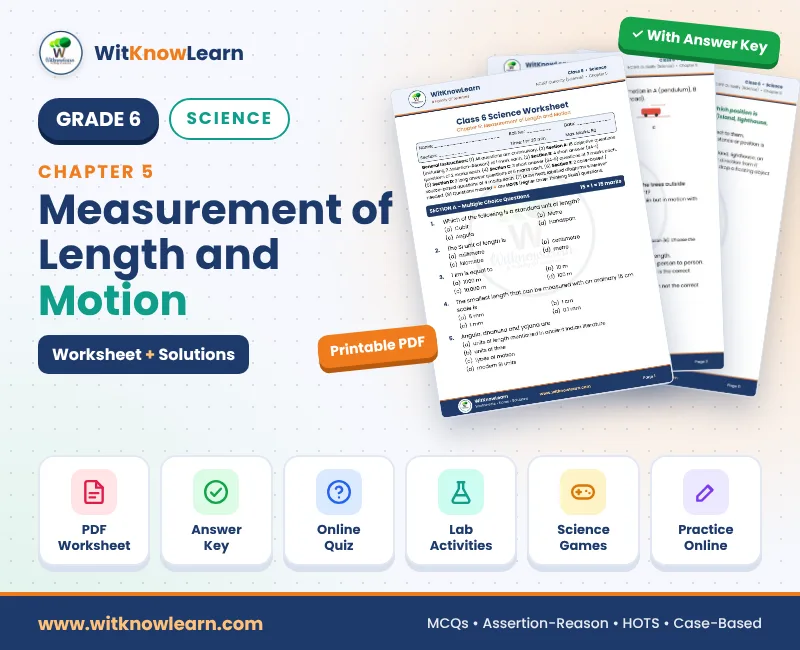
Class 6 Science · Measurement of Length and Motion Worksheet
Measurement of Length and Motion Class 6 Worksheet with Quiz and Games
How long is a pencil on a broken scale, and how do you measure a curve? Take the online quiz, work the Measuring Lab, read scales with sliders, name kinds of motion and try three science experiments in the Virtual Lab.
Flip the cards and try the Measuring Lab, then tap the Games, Labs, Challenges or Virtual Lab button.
Measurement of Length and Motion Class 6 Online Quiz
20 questions · tap an answer to move on · full review at the end
Flip the cards, try the Measuring Lab, then play the games, do the labs and take the challenges. Earn up to 3 stars in every activity.
Fact cards: tap a card to flip it
Measuring Lab
Three measuring problems to solve with your hands. Drag the method that gives a correct length onto the picture, read why the others fail, then press Check. A wrong choice shows what goes wrong, so you can try again.
Challenge marks: 0 / 15 (0 of 5 challenges done)
Finish all 5 challenges to see your comment.
Virtual Lab: do real experiments step by step
Practice sheet
Measurement of Length and Motion Class 6 Activities
Choose the method that gives a correct length in the Measuring Lab, pick units, read a scale with a slider, change units, name kinds of motion, hunt for measuring mistakes with a magnifier, then use a broken scale, measure a curve with thread and watch three motions in the Virtual Lab. Earn up to 3 stars in every activity.
📏Why we need standard units
Before measuring tapes, people measured with their own bodies, using a handspan, a cubit or a footstep. Ancient Indian texts mention units such as angula, dhanusa and yojana. The trouble is that a handspan is not the same for two people, so the same desk gives two different answers. A standard unit has the same value for everybody, so results can be compared and repeated anywhere.
🔢The metre and its family
The metre is the SI unit of length. Smaller and larger lengths use units built on it: 1 m = 100 cm, 1 cm = 10 mm and 1 km = 1000 m. We choose the unit that suits the size of the thing being measured, so the thickness of a coin is written in millimetres, the length of a pencil in centimetres, the height of a room in metres and the distance between two towns in kilometres.
👁️Measuring carefully
A measurement must be taken with care. The scale should touch the object, and the eye must be exactly vertically above the mark, because looking from one side makes the mark appear shifted. This mistake is called an error of parallax. If the beginning of the scale is broken, the measurement still works: read both ends and subtract the smaller reading from the larger one. The smallest length a school scale can measure is one millimetre.
🧶Curved lines
A straight scale cannot follow a curve. To measure a curved line, lay a thread along it, mark where the curve begins and ends, then straighten the thread against the scale. The straight distance between the two ends of a curve is always shorter than the curve itself, because a straight line is the shortest path between two points.
🚶Rest and motion
An object is in motion when its position changes with respect to a chosen reference point, and it is at rest when its position does not change. A position only has meaning when the reference point is stated, which is why we say that a bus moves away from the bus stop.
🔄Kinds of motion
Rectilinear motion is motion along a straight line, such as a car on a straight road or a march past. Circular motion goes round and round a centre, such as the blades of a ceiling fan or a stone whirled on a string. Oscillatory motion is a to and fro motion about one position, such as a child on a swing or the pendulum of a wall clock. A motion that repeats itself in equal intervals of time is also called periodic. One object can show more than one motion at the same time: the wheel of a moving cycle turns in circles while the cycle itself travels in a straight line.
This Measurement of Length and Motion worksheet for Class 6 brings the chapter to life on WitKnowLearn with an online quiz, online activities and interactive games. Students read scales, change units, measure curves and name motions with their own hands, then try three science experiments in the Virtual Lab.
Measurement of Length and Motion Class 6 Science Guide
Measurement of Length and Motion is a key chapter of Class 6 Science. It covers body based and standard units, the metre and its family, correct use of a scale, measuring curved lines with a thread, rest and motion, the reference point and the three kinds of motion. This guide explains each idea clearly for Class 6 students, parents and teachers. It goes with the Measurement of Length and Motion Class 6 worksheet on WitKnowLearn, which also has an online quiz, online activities, interactive games and a Virtual Lab on the same page.
What is there in this topic
- Why body based units such as handspan and cubit were given up
- The metre, centimetre, millimetre and kilometre
- Correct use of a scale and the error of parallax
- Measuring with a broken scale and measuring curved lines
- Rest, motion and the reference point
- Rectilinear, circular and oscillatory motion
Learning objectives
- Explain why standard units are needed.
- Choose a suitable unit for a given length.
- Measure a length correctly, even with a broken scale.
- Measure a curved line with a thread.
- Name the kind of motion shown by an everyday object.
Learning outcomes
After this page a student can measure any object in the classroom, write the result with the right unit, and name the motion of anything that moves around them.
Key rules of this chapter
| Idea | Statement |
|---|---|
| Standard unit | A unit with the same value for everyone, such as the metre |
| SI unit of length | The metre |
| Unit changes | 1 m = 100 cm, 1 cm = 10 mm, 1 km = 1000 m |
| Eye position | Exactly vertically above the mark, to avoid parallax |
| Broken scale | Length is the larger reading minus the smaller reading |
| Curved line | Measured with a thread, then straightened on a scale |
| Motion | A change of position with respect to a reference point |
| Kinds of motion | Rectilinear, circular and oscillatory |
More about the topic
Worked example 1: broken scale. A pencil lies from the 2.0 cm mark to the 9.2 cm mark. Its length is 9.2 cm minus 2.0 cm, that is 7.2 cm.
Worked example 2: changing units. 250 cm in metres is 250 divided by 100, which is 2.5 m. 3 cm in millimetres is 3 multiplied by 10, which is 30 mm.
Worked example 3: curved edge. A thread laid along the curved edge of a plate measures 18.5 cm when straightened, while the straight distance between its ends is less, because a straight line is the shortest path.
Worked example 4: two motions at once. A moving bicycle shows rectilinear motion as a whole, while each wheel shows circular motion.
Worked example 5: periodic motion. A clock pendulum takes the same time for each swing, so its motion is oscillatory and also periodic.
Key words
| Term | Meaning |
|---|---|
| Measurement | Comparing an unknown quantity with a known unit |
| Parallax | The shift in a reading when the eye is not straight above the mark |
| Reference point | The point with respect to which a position is described |
| Rectilinear motion | Motion along a straight line |
| Circular motion | Motion round and round a centre |
| Oscillatory motion | To and fro motion about one position |
| Periodic motion | Motion that repeats itself in equal intervals of time |
Common mistakes
| Mistake | Correct |
|---|---|
| Reading only the far end on a broken scale | Subtract the first reading from the second. |
| Reading a scale from the side | Keep the eye exactly vertically above the mark. |
| Using a straight scale on a curve | Use a thread and then straighten it against the scale. |
| Writing a length without a unit | A number alone means nothing. Always write cm, m or km. |
| Calling a fan blade oscillatory | A fan blade moves round a centre, so its motion is circular. |
Daily life
A tailor measures cloth in metres, a carpenter marks wood in millimetres, road signs give distances in kilometres and a doctor records height in centimetres. Trains, clocks, swings and fans give everyday examples of the three kinds of motion.
Tips for parents and teachers
- Measure the same table with a handspan and with a scale, and compare.
- Keep a thread handy for measuring curved edges at home.
- Ask the child to say the unit along with every number.
- Name the motion of three moving things on the way to school.
- Let students retry the challenges to earn 3 stars.
Class 6 Science NCERT Solutions Chapter Wise
- The Wonderful World of Science Class 6 Solutions
- Diversity in the Living World Class 6 Solutions
- Mindful Eating Class 6 Solutions
- Exploring Magnets Class 6 Solutions
- Measurement of Length and Motion Class 6 Solutions
- Materials Around Us Class 6 Solutions
- Temperature and its Measurement Class 6 Solutions
- A Journey through States of Water Class 6 Solutions
- Methods of Separation Class 6 Solutions
- Living Creatures Class 6 Solutions
- Natures Treasures Class 6 Solutions
- Beyond Earth Class 6 Solutions
Frequently Asked Questions
 Download