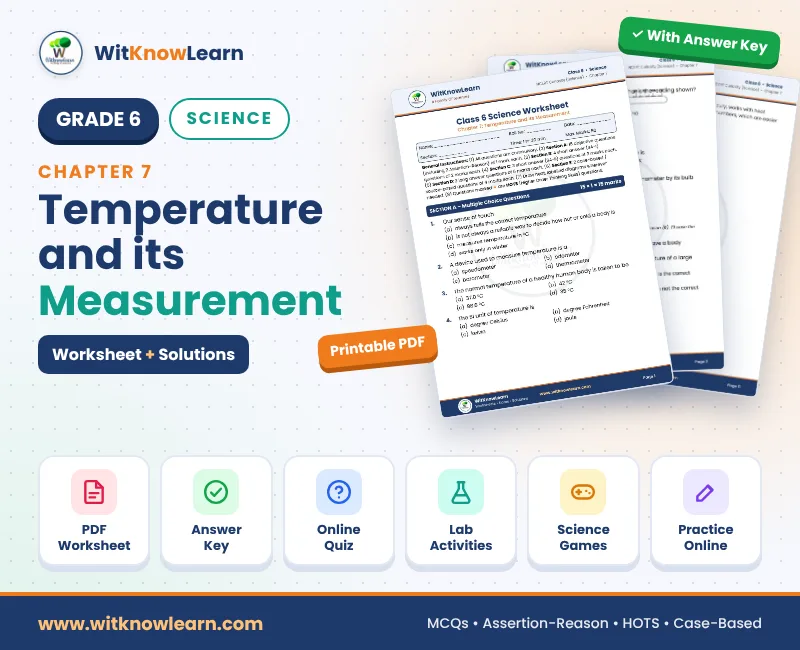
Class 6 Science · Temperature and its Measurement Worksheet
Temperature and its Measurement Class 6 Worksheet with Quiz and Games
Why can a hand never say how hot the water is? Take the online quiz, run the Thermometer Lab, slide the liquid thread to set readings, follow the flow of heat and try three science experiments in the Virtual Lab.
Flip the cards and try the Thermometer Lab, then tap the Games, Labs, Challenges or Virtual Lab button.
Temperature and its Measurement Class 6 Online Quiz
20 questions · tap an answer to move on · full review at the end
Flip the cards, try the Thermometer Lab, then play the games, do the labs and take the challenges. Earn up to 3 stars in every activity.
Fact cards: tap a card to flip it
Thermometer Lab
Three measuring problems to solve with your hands. Drag the right thermometer or method onto the picture, read why the others give wrong readings, then press Check. A wrong choice shows what goes wrong, so you can try again.
Challenge marks: 0 / 15 (0 of 5 challenges done)
Finish all 5 challenges to see your comment.
Virtual Lab: do real experiments step by step
Practice sheet
Temperature and its Measurement Class 6 Activities
Choose the right instrument in the Thermometer Lab, slide the liquid thread to set readings, sort clinical and laboratory features, follow the flow of heat, hunt for mistakes with a magnifier, then test the sense of touch, measure body temperature and watch heat flow in the Virtual Lab. Earn up to 3 stars in every activity.
✋Hot, cold and why touch is not enough
We say that tea is hot and ice is cold, but how hot is hot? Hold one hand in cold water and the other in warm water, then dip both into the same bowl of lukewarm water. The same water feels warm to one hand and cool to the other. Our sense of touch can only compare, so it cannot measure. For a number we need an instrument.
🌡️Temperature and the thermometer
Temperature tells us how hot or how cold a body is, and it is measured with a thermometer. In India temperature is usually written in degree Celsius, with the symbol °C. Three values are worth remembering: pure ice melts at 0 °C, pure water boils at 100 °C and a healthy human body is about 37 °C.
🧪Clinical and laboratory thermometers
A clinical thermometer is made for the human body. Its range runs only from about 35 °C to 42 °C, and its tube has a narrow bend called a kink that stops the reading from falling on its own before it is read. A laboratory thermometer has a much wider range, usually from about minus 10 °C to 110 °C, and has no kink, so it is used for water, air and other things but never put in the mouth. Many homes now use digital thermometers, which are safer because they hold no mercury.
👁️Reading a thermometer correctly
A thermometer must be left in place long enough to reach the temperature of the thing being measured, which is why it is kept under the tongue for about a minute. The reading is taken with the eye level with the end of the liquid thread, because looking from above or below shifts the apparent value. The bulb should not be held in the fingers while reading, since the heat of the hand changes the reading.
🤒Fever
Because the normal body temperature is about 37 °C, a reading well above it, such as 39 °C, shows fever. A clinical thermometer is washed before and after use, held by the end away from the bulb, and never used if the bulb is cracked.
➡️How heat moves
Heat always flows from a hotter body to a colder body, and it keeps flowing until the two reach the same temperature. A cup of hot milk in a cool room loses heat to the room and cools down. An ice cube in a glass of juice takes heat from the juice, so the juice becomes cold. This simple rule explains cooling, warming and why a thermometer works at all.
This Temperature and its Measurement worksheet for Class 6 brings the chapter to life on WitKnowLearn with an online quiz, online activities and interactive games. Students set thermometer readings, sort features and follow heat with their own hands, then try three science experiments in the Virtual Lab.
Temperature and its Measurement Class 6 Science Guide
Temperature and its Measurement is a key chapter of Class 6 Science. It covers why touch cannot measure temperature, the thermometer and the degree Celsius, clinical and laboratory thermometers, the correct way to take a reading, fever, and the flow of heat from hotter to colder bodies. This guide explains each idea clearly for Class 6 students, parents and teachers. It goes with the Temperature and its Measurement Class 6 worksheet on WitKnowLearn, which also has an online quiz, online activities, interactive games and a Virtual Lab on the same page.
What is there in this topic
- Why the sense of touch cannot measure temperature
- Temperature, the thermometer and the degree Celsius
- Clinical, laboratory and digital thermometers
- Taking a reading correctly and avoiding parallax
- Normal body temperature and fever
- The flow of heat from a hotter body to a colder one
Learning objectives
- Explain why an instrument is needed instead of touch.
- Choose the right thermometer for a given job.
- Take and record a reading correctly.
- Recognise a fever from a reading.
- State the direction in which heat flows and use it to explain cooling.
Learning outcomes
After this page a student can pick the correct thermometer for any everyday task, use it safely, read it without error and explain what the reading means.
Key rules of this chapter
| Idea | Statement |
|---|---|
| Temperature | A measure of how hot or how cold a body is |
| Unit | Degree Celsius, written °C |
| Body temperature | About 37 °C in a healthy person |
| Melting and boiling | Ice melts at 0 °C and water boils at 100 °C |
| Clinical thermometer | Range about 35 °C to 42 °C, with a kink |
| Laboratory thermometer | Range about −10 °C to 110 °C, with no kink |
| Reading a thermometer | Eye level with the end of the liquid thread |
| Flow of heat | Always from a hotter body to a colder body |
More about the topic
Worked example 1: the three bowl test. A hand from cold water finds lukewarm water warm, while a hand from warm water finds the same water cool. Touch compares, it does not measure.
Worked example 2: choosing the thermometer. Hot water in a beaker needs a laboratory thermometer, because a clinical one stops at about 42 °C and could burst.
Worked example 3: the kink. The narrow bend in a clinical thermometer holds the liquid in place so that the reading can be read after the thermometer is taken out.
Worked example 4: is it fever? A reading of 39.5 °C is well above the normal 37 °C, so the person has fever.
Worked example 5: cooling milk. Hot milk in a cool room cools because heat flows out of it into the surroundings, and it stops cooling when both are at the same temperature.
Key words
| Term | Meaning |
|---|---|
| Thermometer | An instrument that measures temperature |
| Kink | The narrow bend in a clinical thermometer that holds the reading |
| Parallax | The error caused when the eye is not level with the reading |
| Fever | A body temperature well above the normal 37 °C |
| Digital thermometer | A thermometer that shows the reading as numbers and holds no mercury |
| Heat | The energy that flows from a hotter body to a colder one |
Common mistakes
| Mistake | Correct |
|---|---|
| Trusting the hand to judge temperature | Touch only compares. A thermometer gives a number. |
| Using a clinical thermometer for hot water | Its range ends near 42 °C. Use a laboratory thermometer. |
| Reading the thermometer from above or below | Keep the eye level with the end of the liquid thread. |
| Holding the bulb while reading | The warmth of the hand changes the reading. Hold the top end. |
| Saying cold flows into a hot body | Heat flows out of the hotter body into the colder one. |
Daily life
A nurse checks fever with a clinical thermometer, a weather report gives the day's temperature in degree Celsius, a cook watches the temperature of oil or milk, and a refrigerator and an air conditioner both work by moving heat from one place to another.
Tips for parents and teachers
- Try the three bowl test at home with comfortably warm water.
- Keep a digital thermometer and let the child read it.
- Compare the day's temperature on a weather app with how the day feels.
- Ask which way heat flowed whenever something cools or warms.
- Let students retry the challenges to earn 3 stars.
Class 6 Science NCERT Solutions Chapter Wise
- The Wonderful World of Science Class 6 Solutions
- Diversity in the Living World Class 6 Solutions
- Mindful Eating Class 6 Solutions
- Exploring Magnets Class 6 Solutions
- Measurement of Length and Motion Class 6 Solutions
- Materials Around Us Class 6 Solutions
- Temperature and its Measurement Class 6 Solutions
- A Journey through States of Water Class 6 Solutions
- Methods of Separation Class 6 Solutions
- Living Creatures Class 6 Solutions
- Natures Treasures Class 6 Solutions
- Beyond Earth Class 6 Solutions
Frequently Asked Questions
 Download