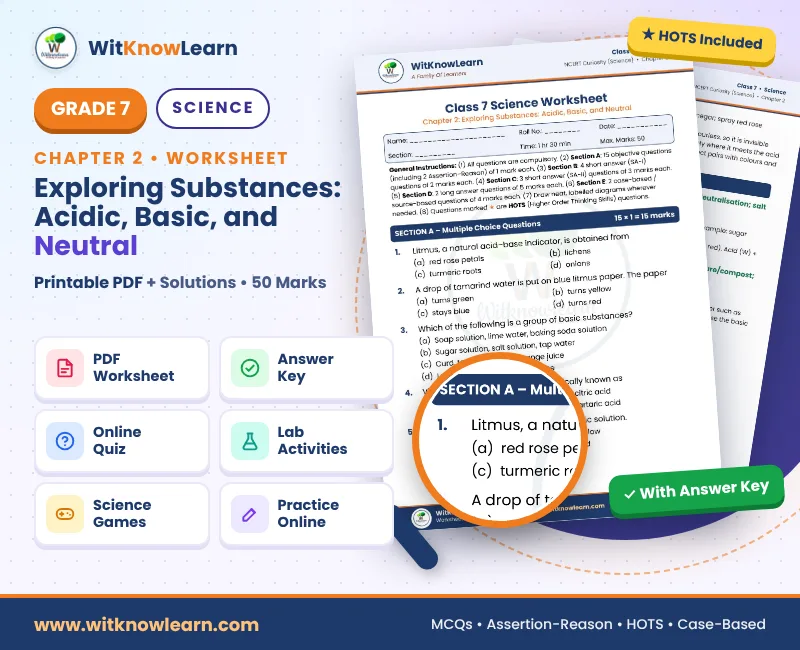
Exploring Substances Acidic Basic and Neutral Class 7 Science Worksheet with Quiz and Activities
In this chapter: acidic, basic and neutral substances, litmus and turmeric paper, olfactory indicators and neutralisation. Test six liquids yourself and mix an acid with a base until it turns neutral. On WitKnowLearn you get the Exploring Substances Acidic Basic and Neutral Class 7 online quiz, online activities and interactive games, a indicator lab, a virtual lab and a worksheet-style practice sheet for Class 7 Science.
Exploring Substances Acidic Basic and Neutral Class 7 Online Quiz
Includes assertion and reason, case study and higher order thinking questions. Tap an answer and the next question comes up.
Exploring Substances Acidic Basic and Neutral Class 7 Activities
👆 Tap a tab to switch: Learn, Games, Labs, Challenges, Virtual Lab and Practice sheet
Exploring Substances Acidic Basic and Neutral: testing what is sour and what is soapy
A short read for Class 7 before you play. These notes cover Exploring Substances Acidic Basic and Neutral: indicators, litmus and turmeric paper, and neutralisation in daily life.
🍋 Acids, bases and neutral substances
Some substances taste sour, such as lemon juice and curd, and are called acidic. Others taste bitter and feel soapy, such as soap and lime water, and are called basic. Water and sugar solution are neither, so they are neutral.
🧫 Indicators tell them apart
Tasting an unknown substance is never safe, so we use indicators. Litmus comes from lichens and turns red with an acid and blue with a base. Turmeric paper turns reddish brown only with a base, and onion and vanilla work by their smell.
⚖ Neutralisation
When an acid and a base are mixed in the right amounts they cancel each other out, forming salt and water and giving out heat. Antacids, lime on acidic soil and treated factory waste all depend on this.
Exploring Substances Acidic Basic and Neutral Class 7 Science Activities
Follow every step on the Discovery Trail. Earn up to 3 stars in every activity.
This page covers Exploring Substances Acidic Basic and Neutral: indicators, litmus and turmeric paper, and neutralisation in daily life for Class 7 science. It covers acidic, basic and neutral substances, natural indicators such as litmus, turmeric and china rose, olfactory indicators, and neutralisation with its uses in daily life.
The activities are pitched at Class 7 level. Drag a dropper onto litmus and turmeric papers to test six everyday liquids, and add acid and base drop by drop until the mixture turns exactly neutral. Explore more Class 7 science worksheets on WitKnowLearn after this chapter.
Key ideas and facts to know
| Substance | Blue litmus | Red litmus |
|---|---|---|
| Acidic, such as lemon juice | turns red | stays red |
| Basic, such as lime water | stays blue | turns blue |
| Neutral, such as water | stays blue | stays red |
How to use this page
- Flip the six cards and try the Indicator Lab in the Learn tab.
- Play the five games and do the hands-on labs, where you drag and move things, to see each idea at work.
- Finish the five challenges to collect up to 15 points.
- Run the virtual experiment, fill in its observation table and choose the conclusion the evidence supports.
- Take the online quiz, with assertion and reason and case study questions, and fill in the practice sheet.
Worked examples
It is basic, because only a base changes both of these papers in that way.
An antacid is basic, so it neutralises the extra acid and forms salt and water.
This Exploring Substances Acidic Basic and Neutral worksheet for Class 7 science gives you online activities and interactive games that make the chapter clear. Every activity has a goal, a hint and a short fact, so students learn while they enjoy.
Complete Guide: Class 7 Science Exploring Substances Acidic Basic and Neutral
This guide is for Class 7 students, parents and teachers. It covers Exploring Substances Acidic Basic and Neutral: indicators, litmus and turmeric paper, and neutralisation in daily life for Class 7 science and shows how to use the quiz, labs and games on this page.
Introduction to Exploring Substances Acidic Basic and Neutral
This chapter of NCERT Curiosity shows how a scientist tells substances apart safely, using indicators rather than taste, and what happens when an acid meets a base.
What is there in this chapter
- Acidic, basic and neutral substances
- Why tasting is not a test
- Litmus as a natural indicator
- Turmeric and china rose indicators
- Olfactory indicators
- Neutralisation and its uses
Learning objectives
- Classify everyday substances as acidic, basic or neutral.
- Use litmus and turmeric paper correctly to test a liquid.
- Explain what an olfactory indicator is.
- Describe neutralisation and name what it forms.
- Reason with assertions and case studies.
Learning outcomes
- I can test a liquid with litmus and turmeric paper.
- I can classify a substance from its colour changes.
- I can explain neutralisation with an example.
Exploring Substances Acidic Basic and Neutral Class 7 resources on this page
| Resource | What it gives |
|---|---|
| Online quiz | Assertion and reason, case study and higher order thinking questions with a full review |
| Flip cards | 6 picture cards with one-line rules |
| Indicator Lab | A hands-on lab with 3 rounds |
| Games | 5 interactive games |
| Labs | Interactive labs where you drag, move and watch what happens |
| Virtual Lab | Three hands-on experiments: test unknown liquids with litmus and turmeric, sort kitchen liquids with red rose extract, and neutralise lemon juice with lime water |
| Challenges | 5 challenges, 15 points in all |
| Practice sheet | A worksheet-style sheet with 16 questions, name and date lines and a live score |
Key facts
| Idea | Rule |
|---|---|
| Litmus source | lichens |
| Acid test | blue litmus turns red |
| Base test | red litmus turns blue |
| Neutralisation | salt, water and heat |
Types of questions you may see
- Classifying substances
- Indicator colour change questions
- Neutralisation questions
- Assertion and reason and case study questions
Solved examples
She can only find out whether a liquid is basic, because turmeric paper stays yellow for both acidic and neutral liquids.
Lime is basic, so it neutralises the extra acid and makes the soil fit for crops.
Common mistakes
| Mistake | Correct idea |
|---|---|
| Saying acids turn red litmus blue | Acids turn blue litmus red |
| Expecting turmeric paper to change with an acid | It changes only with a base |
| Tasting a substance to test it | Always use an indicator instead |
Exploring Substances Acidic Basic and Neutral in daily life
Acids and bases appear in lemon and curd in the kitchen, in soap and cleaners, in antacid tablets, in lime spread on acidic farm soil and in the treatment of factory waste before it reaches a river.
Tips for parents and teachers
- Make turmeric paper at home with your child and test soap solution and lemon juice on it.
- Talk about why an antacid is taken after a heavy meal.
- Practise one assertion and one case study each week.
Exploring Substances Acidic Basic and Neutral Class 7 FAQs
What are acidic substances?
Substances that taste sour and turn blue litmus red, such as lemon juice, tamarind water, curd and vinegar.
What are basic substances?
Substances that taste bitter, feel soapy and turn red litmus blue, such as soap solution, lime water and antacids.
What are neutral substances?
Substances that are neither acidic nor basic and change neither litmus paper, such as water, sugar solution and salt solution.
What is an indicator?
A substance that shows by a change of colour or smell whether something is acidic or basic.
Where does litmus come from?
Litmus is obtained from lichens and is used as red paper, blue paper or a solution.
How do you make turmeric paper?
Mix turmeric powder with a little water into a paste, spread it on a sheet of blotting paper and let it dry.
What does turmeric paper show?
It turns reddish brown with a basic substance and stays yellow with acidic and neutral substances, so it detects only bases.
What is an olfactory indicator?
An indicator such as onion or vanilla whose smell changes with an acid or a base, so it is detected by the nose.
What is neutralisation?
The reaction in which an acid and a base cancel each other out, forming salt and water and giving out heat.
Why does an antacid relieve acidity?
An antacid is basic, so it neutralises the extra acid in the stomach.
Why is lime added to acidic soil?
Lime is basic and neutralises the extra acid so that crops can grow well.
Why should an unknown substance never be tasted?
It may be harmful. An indicator gives the answer safely.
Which book is this chapter from?
It is Chapter 2 of Curiosity, the NCERT Class 7 Science textbook of the new syllabus.
What can students do on this page?
Students can take an online quiz with assertion and reason and case study questions, play five games, try five online activities, finish five challenges, run the Indicator Lab, run one full virtual experiment with its own observation table, and fill in a 16-question practice sheet with a Show answers button.
 Download