Class 7 Science · Curiosity Chapter 1 Worksheet
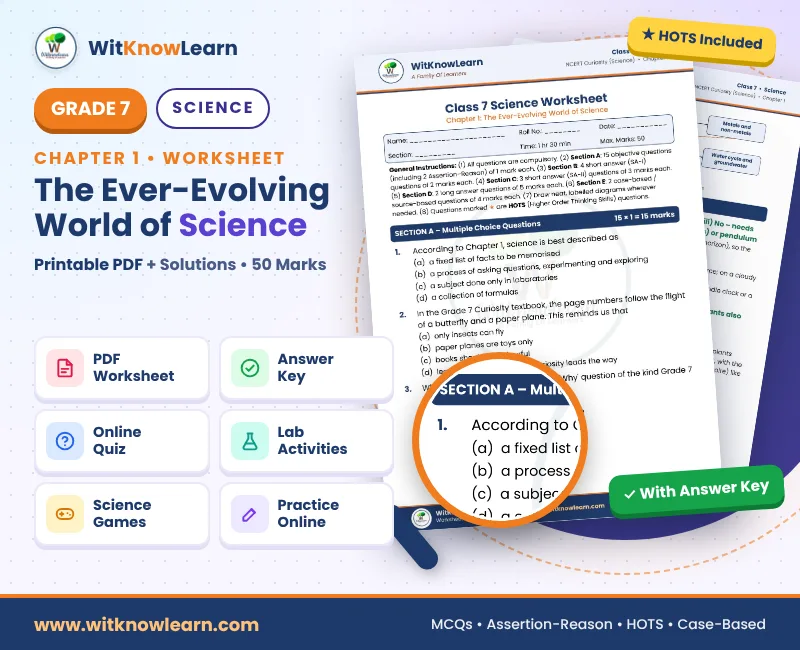
The Ever Evolving World of Science Class 7 Worksheet with Online Quiz
Can a surprising result be more useful than an expected one? Take the online quiz, solve three cases in the Investigation Lab, move the sun on the shadow clock, sort changes and fair tests, and try three science experiments in the Virtual Lab.
Flip the cards and try the Investigation Lab, then tap the Games, Labs, Challenges or Virtual Lab button.
The Ever Evolving World of Science Class 7 Online Quiz
20 questions · tap an answer to move on · full review at the end
Flip the cards, try the Investigation Lab, then play the games, do the labs and take the challenges. Earn up to 3 stars in every activity.
Fact cards: tap a card to flip it
Investigation Lab
Three investigations to plan with your hands. Drag the step a careful scientist would take onto the picture, read why the weak steps fail, then press Check. A wrong choice shows what goes wrong, so you can try again.
Challenge marks: 0 / 15 (0 of 5 challenges done)
Finish all 5 challenges to see your comment.
Virtual Lab: do real experiments step by step
Practice sheet
The Ever Evolving World of Science Class 7 Activities
Choose the step a real scientist would take in the Investigation Lab, sort questions by area of science, slide the sun across the sky on the shadow clock, sort changes, spot fair tests, then make a shadow clock, test conductors and check reversible changes in the Virtual Lab. Earn up to 3 stars in every activity.
❓Science is a way of asking
Science is not a fixed list of facts to memorise. It is a process of asking questions, making predictions, testing them and changing our ideas when the evidence says so. That is why the chapter calls it an ever evolving world. Every answer opens new questions, and scientists keep checking, repeating and improving what they know.
⚖️Fair tests and honest results
A good question can be tested: something can be changed and something can be measured. In a fair test only one thing is changed and everything else is kept the same, so the result can be trusted. A result that does not match the prediction is not a failure. Rohan's seed that sprouted in the dark leads to a new idea, that seeds use stored food to sprout. Results must be recorded honestly, even when they surprise us.
🍋From sour fruits to new substances
Why are some fruits sour, and why does a turmeric stain turn red with soap? These questions lead to acidic, basic and neutral substances. Why does iron rust while gold stays bright? That leads to metals and non metals. Some changes, like melting ice, can be reversed, while others, like burning paper or cooking an egg, form new substances and cannot. Breaking a rock cannot be undone either, yet no new substance forms, which shows that the two ideas are not the same.
💡Electricity, heat and light
A bulb glows only when a closed circuit joins it to a cell through materials that let electricity pass, such as copper. Heat always flows from a hotter body to a colder one, which explains why ice melts in warm water and why the sun's heat drives the water cycle. A stick in the sun casts a shadow that is long in the morning, shortest at noon and long again in the evening, always pointing away from the sun.
🌍Time, the earth and the sky
Long before clocks, people told the time from shadows. The changing shadow comes from the rotation of the earth, which also gives day and night, while the earth's journey around the sun and the moon's journey around the earth give years, months and the phases of the moon. These ideas return in Measurement of Time and Motion and in Earth, Moon and the Sun.
🌿Life processes and responsibility
Plants and animals carry out life processes: they take in food, breathe, grow and remove wastes, and blood circulation carries food and oxygen around the body. The chapter ends with a reminder that science brings responsibility. Discoveries can help or harm people and nature, so they must be used with care, and the different areas of science are connected, with a question in one area often leading to a discovery in another.
This The Ever Evolving World of Science worksheet for Class 7 brings the chapter to life on WitKnowLearn with an online quiz, online activities and interactive games. Students plan fair tests, move the sun on a shadow clock and sort changes with their own hands, then try three science experiments in the Virtual Lab.
The Ever Evolving World of Science Class 7 Science Guide
The Ever Evolving World of Science is the opening chapter of Class 7 Science in the NCERT Curiosity book. It shows science as a process of asking questions, predicting, testing fairly and revising ideas, and it previews every topic of the year: acids and bases, electricity, metals and non metals, changes, heat, time and motion, life processes, light and the earth and sky. This guide explains each idea clearly for Class 7 students, parents and teachers. It goes with The Ever Evolving World of Science Class 7 worksheet on WitKnowLearn, which also has an online quiz, online activities, interactive games and a Virtual Lab on the same page.
What is there in this topic
- Science as a process of questioning, predicting, testing and revising
- Testable questions and fair tests
- Reversible and irreversible changes, and new substances
- Heat flow, the water cycle and electric circuits
- Shadows, time and the movements of the earth
- Life processes, connected sciences and responsibility
Learning objectives
- Frame a testable question and a prediction.
- Plan a fair test that changes only one thing.
- Respond to an unexpected result in a scientific way.
- Link everyday observations to the chapters of Class 7 Science.
- Explain why science must be used responsibly.
Learning outcomes
After this page a student can look at an everyday observation, turn it into a testable question, design a fair test for it and say which area of science it belongs to.
Key rules of this chapter
| Idea | Statement |
|---|---|
| Testable question | Has something to change and something to measure |
| Fair test | Changes only one thing and keeps the rest the same |
| Unexpected result | Is repeated and turned into a new question |
| Reversible change | Can be undone, such as melting or freezing |
| Irreversible change | Cannot be undone, such as burning or cooking |
| Heat flow | Always from a hotter body to a colder one |
| Shadow | Longest when the sun is low, shortest at noon, opposite the sun |
| Conductor | A material such as copper that lets electricity pass |
More about the topic
Worked example 1: a fair test. To test which material lets a bulb glow, keep the same cell, bulb and wires and change only the material in the gap.
Worked example 2: a surprising seed. A seed sprouts in the dark. Instead of rejecting the result, repeat it and ask why. The answer is that the seed uses food stored inside it.
Worked example 3: sorting changes. Melting wax can be reversed. Burning paper forms new substances. Breaking a rock cannot be undone but forms no new substance.
Worked example 4: reading shadows. A shadow pointing west in the morning means the sun is in the east, and a very short shadow means the sun is high, close to noon.
Worked example 5: connected sciences. Asking how plants make food leads from biology to the energy carried by sunlight, which belongs to physics.
Key words
| Term | Meaning |
|---|---|
| Prediction | A reasoned guess about what will happen, which can be tested |
| Evidence | Observations and measurements that support or reject an idea |
| Fair test | An experiment in which only one factor is changed |
| Irreversible change | A change that cannot be undone |
| Circuit | A complete path along which electricity flows |
| Rotation | The spinning of the earth on its axis |
Common mistakes
| Mistake | Correct |
|---|---|
| Thinking science is a fixed set of facts | Science keeps evolving as new evidence is found. |
| Changing several things in one test | Change only one thing so that the result can be trusted. |
| Ignoring a result that does not match the prediction | Repeat it and ask a new question. |
| Saying every irreversible change forms a new substance | Breaking a rock cannot be undone, yet forms no new substance. |
| Saying cold flows into warm things | Heat flows out of the warmer body into the colder one. |
Daily life
A cook notices that a turmeric stain changes colour with soap, a farmer reads the time from shadows, an electrician checks which wire lets current pass, and a family chooses which changes in the kitchen can be undone. Each everyday question is the start of a Class 7 chapter.
Tips for parents and teachers
- Ask the child to turn one everyday observation into a testable question each day.
- Measure a stick's shadow at three times of day together.
- Discuss what to do when a result surprises everyone.
- Sort kitchen changes into reversible and irreversible.
- Let students retry the challenges to earn 3 stars.
Related Class 7 Science Links
- All Class 7 Science Worksheets
- Revise: The Wonderful World of Science Class 6 Solutions
- Revise: Measurement of Length and Motion Class 6 Solutions
- Revise: Temperature and its Measurement Class 6 Solutions
- Revise: Beyond Earth Class 6 Solutions
- Class 6 Science Worksheets
- Exploration Class 9 Science Worksheet
- Data Handling Worksheet Class 7
- Matter in Our Surroundings Worksheet Class 9
Frequently Asked Questions
 Download