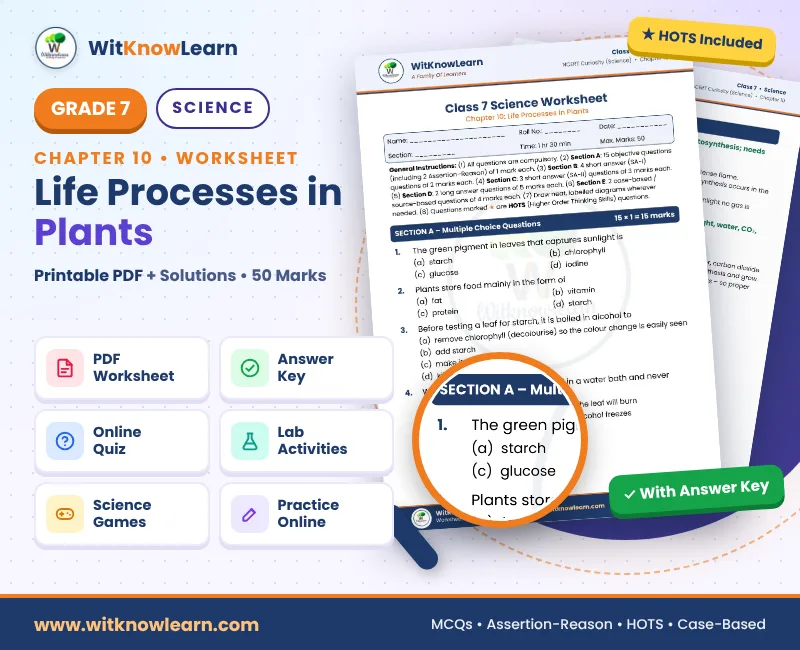
Class 7 Science · Curiosity Chapter 10 Worksheet
Life Processes in Plants Class 7 Worksheet with Online Quiz and Games
How do we prove a leaf needs carbon dioxide to make food? Take the online quiz, test like a botanist in the Green Leaf Lab, set the photosynthesis bench with sliders and try three science experiments in the Virtual Lab.
Flip the cards and try the Green Leaf Lab, then tap the Games, Labs, Challenges or Virtual Lab button.
Life Processes in Plants Class 7 Online Quiz
20 questions · tap an answer to move on · full review at the end
Flip the cards, try the Green Leaf Lab, then play the games, do the labs and take the challenges. Earn up to 3 stars in every activity.
Fact cards: tap a card to flip it
Green Leaf Lab
Three plant experiments to plan with your hands. Drag the step or explanation that really tests photosynthesis onto the picture, read why weak choices mislead, then press Check. A wrong choice shows what goes wrong, so you can try again.
Challenge marks: 0 / 15 (0 of 5 challenges done)
Finish all 5 challenges to see your comment.
Virtual Lab: do real experiments step by step
Practice sheet
Life Processes in Plants Class 7 Activities
Test like a botanist in the Green Leaf Lab, sort the inputs and outputs of photosynthesis, set light, carbon dioxide and water on the photosynthesis bench, find stomata, then test variegated leaves, prove the need for carbon dioxide and watch water climb a stem in the Virtual Lab. Earn up to 3 stars in every activity.
🌿Leaves are food factories
Green plants make their own food by photosynthesis. In the leaves, the green pigment chlorophyll traps the energy of sunlight and uses it to combine carbon dioxide from the air with water from the soil: carbon dioxide + water → glucose + oxygen. Broad, flat leaves catch plenty of light and air, which is why leaves are called the food factories of plants.
🔵Testing a leaf for starch
Glucose is turned into starch for storage. To test a leaf, boil it in water, warm it in alcohol to remove the chlorophyll, and add iodine, which turns starch blue black. Alcohol catches fire easily, so it is always warmed in a water bath, never on a flame. Before an experiment, the plant is kept in the dark for two days to destarch it.
🧪Proving what is needed
A variegated leaf with green and white patches turns blue black only where it was green, which shows that chlorophyll is needed. Part of a destarched leaf sealed in a bottle with caustic soda, which absorbs carbon dioxide, makes no starch, which shows that carbon dioxide is needed. A plant kept in the dark makes none, which shows that light is needed. The oxygen given out relights a glowing splinter.
⚪Stomata and gases
The surface of a leaf, especially the underside, carries tiny pores called stomata. They let carbon dioxide in and oxygen and water vapour out. In bright light green parts give out more oxygen than they use, so water plants in sunlight release bubbles of oxygen.
⬆️Transport in plants
Water and minerals travel from the roots to the leaves through tubes called xylem. A celery stalk in red ink shows them as thin red lines. Food made in the leaves travels to other parts through the phloem and may be stored as starch in roots, stems, tubers and seeds, which is why a potato slice turns blue black with iodine.
⚡Plants respire too
Plants also respire, breaking down glucose with oxygen to release energy, in every living part including the roots, day and night. In the light, photosynthesis runs faster than respiration. In the dark only respiration continues. Since all food chains start with green plants, photosynthesis supplies the food and oxygen that almost all life on earth depends on.
This Life Processes in Plants worksheet for Class 7 brings the chapter to life on WitKnowLearn with an online quiz, online activities and interactive games. Students set up photosynthesis experiments, test leaves and trace water with their own hands, then try three science experiments in the Virtual Lab.
Life Processes in Plants Class 7 Science Guide
Life Processes in Plants is Chapter 10 of Class 7 Science in the NCERT Curiosity book. It covers photosynthesis, chlorophyll, the leaf starch test, experiments that show the need for light, chlorophyll and carbon dioxide, stomata, transport through xylem and phloem, and respiration in plants. This guide explains each idea clearly for Class 7 students, parents and teachers. It goes with the Life Processes in Plants Class 7 worksheet on WitKnowLearn, which also has an online quiz, online activities, interactive games and a Virtual Lab on the same page.
What is there in this topic
- Photosynthesis and its word equation
- Chlorophyll and the role of leaves
- The leaf starch test and destarching
- Experiments showing the need for light, chlorophyll and carbon dioxide
- Stomata, xylem and phloem
- Respiration in plants
Learning objectives
- Write and explain the word equation for photosynthesis.
- Carry out and explain the leaf starch test safely.
- Design an experiment that removes one condition at a time.
- Describe how water and food are transported in plants.
- Explain why plants respire day and night.
Learning outcomes
After this page a student can plan and explain a fair photosynthesis experiment and trace the journey of water and food through a plant.
Key rules of this chapter
| Idea | Statement |
|---|---|
| Photosynthesis | Carbon dioxide + water → glucose + oxygen, in light with chlorophyll |
| Storage | Glucose is stored as starch |
| Starch test | Iodine turns starch blue black |
| Destarching | Keeping a plant in the dark for two days |
| Caustic soda | Absorbs carbon dioxide |
| Stomata | Pores for gas exchange |
| Xylem | Carries water and minerals up |
| Phloem | Carries food from the leaves |
More about the topic
Worked example 1: the variegated leaf. Only the green areas turn blue black, so chlorophyll is needed
Worked example 2: the caustic soda bottle. The leaf part without carbon dioxide makes no starch
Worked example 3: the dark cupboard. A plant without light makes no new starch
Worked example 4: the celery stalk. Red ink rising in the stalk shows the xylem
Worked example 5: the potato slice. Starch in the tuber came from food made in the leaves
Key words
| Term | Meaning |
|---|---|
| Chlorophyll | The green pigment that traps light |
| Glucose | A simple sugar made in photosynthesis |
| Variegated leaf | A leaf with green and non green patches |
| Stomata | Tiny pores on leaves |
| Xylem | Tubes carrying water upward |
| Phloem | Tubes carrying food |
Common mistakes
| Mistake | Correct |
|---|---|
| Saying plants respire only at night | Plants respire all the time. |
| Heating alcohol on a flame | Always use a water bath. |
| Testing a leaf without destarching | Old starch would spoil the result. |
| Mixing up xylem and phloem | Xylem carries water up, phloem carries food. |
| Saying roots make food | Only green parts carry out photosynthesis. |
Daily life
Vegetable gardens, potted plants by the window, farmers’ fields, aquarium plants giving off bubbles and the potatoes, rice and wheat we eat all show photosynthesis and food storage in plants.
Tips for parents and teachers
- Put a celery stalk in coloured water and watch it overnight.
- Compare a plant kept on a sunny sill with one kept in a dark room.
- Look for bubbles on a water plant in sunlight.
- Test a potato slice and a rice grain with iodine.
- Let students retry the challenges to earn 3 stars.
Related Class 7 Science Links
- All Class 7 Science Worksheets
- Revise: Diversity in the Living World Class 6 Solutions
- Revise: Living Creatures Class 6 Solutions
- Revise: Mindful Eating Class 6 Solutions
- Class 6 Science Worksheets
- The Fundamental Unit of Life Worksheet Class 9
- Improvement in Food Resources Worksheet Class 9
- Data Handling Worksheet Class 7
Frequently Asked Questions
 Download