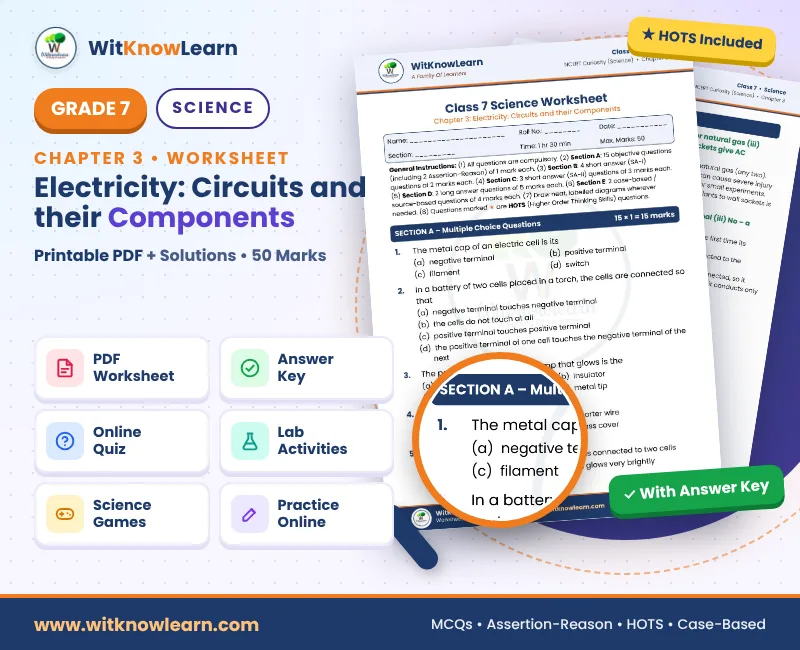
Class 7 Science · Curiosity Chapter 3 Worksheet
Electricity Circuits and their Components Class 7 Worksheet
Why does a torch stay dark with brand new cells? Take the online quiz, fix faults in the Circuit Fault Lab, tap parts on the circuit bench until the lamp glows, test conductors and try three science experiments in the Virtual Lab.
Flip the cards and try the Circuit Fault Lab, then tap the Games, Labs, Challenges or Virtual Lab button.
Electricity Circuits and their Components Class 7 Online Quiz
20 questions · tap an answer to move on · full review at the end
Flip the cards, try the Circuit Fault Lab, then play the games, do the labs and take the challenges. Earn up to 3 stars in every activity.
Fact cards: tap a card to flip it
Circuit Fault Lab
Three faulty circuits to repair with your hands. Drag the fix that will really work onto the picture, read why the other fixes fail, then press Check. A wrong choice shows what goes wrong, so you can try again.
Challenge marks: 0 / 15 (0 of 5 challenges done)
Finish all 5 challenges to see your comment.
Virtual Lab: do real experiments step by step
Practice sheet
Electricity Circuits and their Components Class 7 Activities
Find and fix faults in the Circuit Fault Lab, test materials, tap parts on the circuit bench until the lamp glows, read circuit symbols, spot electrical dangers with a magnifier, then build a conduction tester, repair a torch and make your own switch in the Virtual Lab. Earn up to 3 stars in every activity.
🔋Cells and batteries
An electric cell has a positive terminal (the metal cap) and a negative terminal (the flat metal disc). Two or more cells joined together make a battery, and they must be joined positive to negative so that their pushes add up. A cell placed the wrong way round pushes against the others, which is one of the commonest reasons a torch will not glow. Cells give direct current, which flows in one direction.
💡Lamps and LEDs
An incandescent lamp glows because a thin filament inside it gets very hot when current passes. If the filament breaks, the lamp is fused and the circuit through it is open. An incandescent lamp works whichever way it is joined. An LED is different: it lets current pass in one direction only, so its longer leg must go to the positive terminal. LEDs use far less electricity for the same light.
🔁Circuits and switches
Current flows only around a complete path called a closed circuit. Outside the cell it is taken to flow from the positive terminal through the circuit to the negative terminal. A switch opens or closes the path. In a simple circuit there is only one path, so a switch works wherever it is placed. A safety pin swinging between two drawing pins makes a perfectly good homemade switch.
✏️Circuit diagrams
Scientists draw circuits with symbols. In the cell symbol the longer thin line is positive and the shorter thick line is negative. A switch is drawn open or closed, and an LED symbol carries two small arrows that show it gives out light. Symbols let anyone in the world read the same circuit quickly.
🧷Conductors and insulators
Materials that let electricity pass are conductors, such as copper, aluminium, iron and, surprisingly, graphite in a pencil, which is a non metal. Materials that do not are insulators, such as rubber, plastic, glass, cork and dry wood. A conduction tester is simply a circuit with a gap: if the lamp glows when an object fills the gap, the object conducts. House wires use copper because it conducts very well and costs far less than silver, and they are covered with plastic to keep us safe.
⚠️Electricity and safety
Electricity reaching our homes comes from power stations that use falling water, coal, wind or sunlight, and it is alternating current strong enough to kill. That is why experiments use only torch cells, why we never touch switches with wet hands (ordinary water and our body conduct electricity), and why damaged wires are reported to an adult at once.
This Electricity Circuits and their Components worksheet for Class 7 brings the chapter to life on WitKnowLearn with an online quiz, online activities and interactive games. Students fix circuits, test materials and make switches with their own hands, then try three science experiments in the Virtual Lab.
Electricity Circuits and their Components Class 7 Science Guide
Electricity: Circuits and their Components is Chapter 3 of Class 7 Science in the NCERT Curiosity book. It covers cells and batteries, incandescent lamps and LEDs, closed and open circuits, switches, circuit symbols, conductors and insulators, direct and alternating current and electrical safety. This guide explains each idea clearly for Class 7 students, parents and teachers. It goes with the Electricity Circuits and their Components Class 7 worksheet on WitKnowLearn, which also has an online quiz, online activities, interactive games and a Virtual Lab on the same page.
What is there in this topic
- Terminals of a cell and how a battery is made
- Incandescent lamps, filaments and fused lamps
- LEDs and why they work one way only
- Closed and open circuits and the switch
- Circuit symbols and diagrams
- Conductors, insulators and electrical safety
Learning objectives
- Join cells correctly to make a battery.
- Explain why a lamp or LED fails to glow.
- Draw and read simple circuit diagrams.
- Classify materials as conductors or insulators by testing.
- Follow safety rules when using electricity.
Learning outcomes
After this page a student can find the fault in a torch or simple circuit, fix it, and explain the fix using the ideas of a closed circuit, terminals and conductors.
Key rules of this chapter
| Idea | Statement |
|---|---|
| Battery | Cells joined positive to negative |
| Closed circuit | A complete path, so current flows |
| Open circuit | A break in the path, so no current |
| Fused lamp | A broken filament leaves the circuit open |
| LED | Longer leg to the positive terminal, works one way |
| Current direction | From + through the circuit to − |
| Conductor | Lets electricity pass, such as copper or graphite |
| Insulator | Does not let electricity pass, such as rubber |
More about the topic
Worked example 1: two cells in a torch. The cap of one cell must touch the flat end of the next. One reversed cell cancels the push and the torch stays dark
Worked example 2: the reversed LED. An LED stays dark when its longer leg faces the negative terminal. Swapping the legs makes it glow
Worked example 3: the fused lamp. A lamp that stays dark on a good cell with the switch ON has a broken filament and must be replaced
Worked example 4: pencil lead in a tester. Graphite lights the lamp, showing that some non metals conduct
Worked example 5: moving the switch. In a simple circuit the switch works anywhere, because there is only one path
Key words
| Term | Meaning |
|---|---|
| Terminal | A point on a cell where a wire is connected |
| Filament | The thin wire in a lamp that glows |
| LED | Light emitting diode, which glows when current passes one way |
| Circuit | A closed path for electric current |
| Conduction tester | A circuit with a gap for testing materials |
| Direct current | Current that flows in one direction, as from a cell |
Common mistakes
| Mistake | Correct |
|---|---|
| Joining cells + to + in a torch | Join them + to −, one after another. |
| Connecting an LED either way | The longer leg must go to the positive terminal. |
| Thinking only metals conduct | Graphite is a non metal that conducts. |
| Saying a switch must be next to the cell | In a simple circuit it works anywhere. |
| Thinking water is an insulator | Ordinary water conducts, so wet hands are dangerous. |
Daily life
Torches, remote controls and clocks run on cells, LED bulbs save electricity at home, electricians test wires with conduction testers, and every switch in the house opens and closes a circuit. Safety rules about wet hands and damaged wires protect families every day.
Tips for parents and teachers
- Open an old torch together and trace the path of the current.
- Test household objects with a homemade conduction tester.
- Draw the circuit of one device at home using symbols.
- Discuss the safety rules for every socket in the house.
- Let students retry the challenges to earn 3 stars.
Related Class 7 Science Links
Frequently Asked Questions
 Download