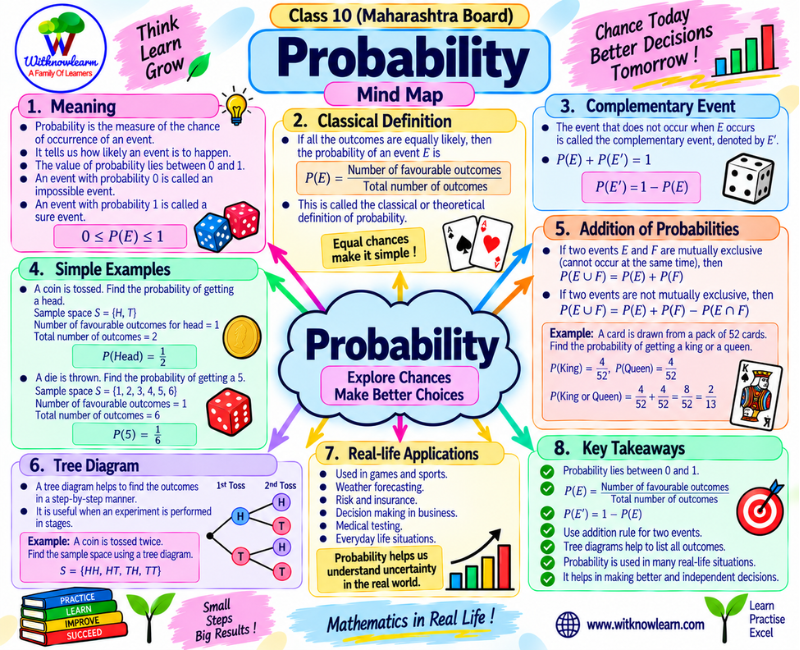
Maharashtra Board Class 10 Maths 1 Chapter 5 Probability Mind Map
The Class 10 Maths 1 Chapter 5 Probability Mind Map presents the important concepts, terms and formulas from the chapter in a simple visual format. It helps Maharashtra State Board students understand probability and revise the complete chapter quickly.
This mind map covers random experiments, outcomes, sample space, events, favourable outcomes, the probability formula, complementary events and different types of probability-based problems.
Topics Covered in the Probability Mind Map
- Meaning of probability
- Random experiments and outcomes
- Sample space
- Events and favourable outcomes
- Equally likely outcomes
- Formula for theoretical probability
- Impossible and certain events
- Complementary events
- Probability using coins, dice and cards
- Application-based probability problems
Benefits of Using This Mind Map
The mind map helps students connect experiments, outcomes, sample spaces and events. The visual arrangement makes it easier to identify the total number of possible outcomes and the number of favourable outcomes.
Students can use this resource to recall the probability formula, organise information correctly and reduce errors while solving questions involving coins, dice, cards and everyday situations.
How to Use This Mind Map
Begin with the experiment and list all possible outcomes. Next, identify the required event and count its favourable outcomes. Use the correct probability formula and check that the final probability lies between 0 and 1.
Related Chapter 5 Study Resources
Practise chapter-based questions using the Class 10 Maths 1 Chapter 5 Probability Worksheet .
Check complete answers and calculation steps using the Maharashtra Board Class 10 Maths 1 Chapter 5 Solutions .
Frequently Asked Questions about the Probability Mind Map
How does this mind map make probability easier to understand?
It visually connects an experiment with its outcomes, sample space and events, helping students understand the steps needed to calculate probability.
What should students identify before using the probability formula?
Students should first identify all possible outcomes and then count the outcomes that satisfy the required event.
How can the mind map help with coin and dice questions?
It reminds students to write a complete sample space before selecting favourable outcomes, which helps prevent missing or repeating an outcome.
How can students check whether their probability answer is reasonable?
The final probability must lie between 0 and 1. A negative value or a value greater than 1 indicates an error in counting or calculation.
What should students do after studying the probability mind map?
Students should solve different types of questions from the Chapter 5 worksheet and compare their methods with the detailed chapter solutions.
 Download