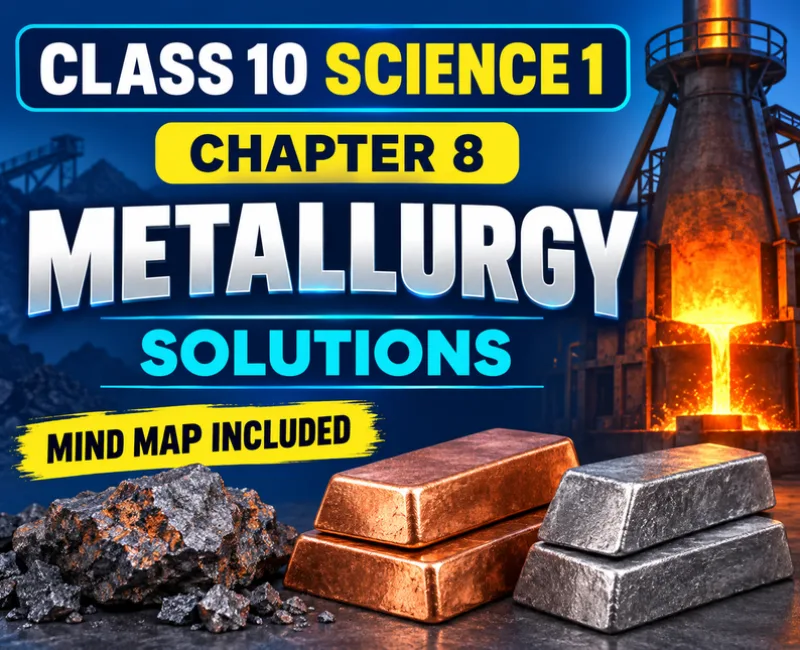
Chapter 8 Metallurgy Solutions
Study Class 10 Science and Technology Part 1 Chapter 8 Metallurgy with clear Maharashtra Board textbook solutions. Understand the properties of metals and nonmetals, distinguish minerals from ores, follow the steps of metal extraction, and learn how corrosion can be prevented. A chapter mind map is included on the final page of the PDF.
What Is Included in These Metallurgy Solutions?
These Maharashtra Board Class 10 Science 1 Chapter 8 solutions cover the physical and chemical properties of metals and nonmetals, ionic compounds, the reactivity of metals, ores and minerals, concentration of ores, extraction, refining, corrosion and protection. Each explanation helps you connect a textbook term with the process it describes. For example, identifying an ore is only the beginning: unwanted material must be separated before the metal can be obtained and purified.
The chapter becomes easier when you connect the extraction method to the metal's reactivity. A highly reactive metal such as aluminium cannot be obtained by simply heating its oxide with carbon; electrolysis is used. Less reactive metals can be obtained by other methods. Use this reasoning whenever a question asks why two metals are extracted differently rather than memorising a list without a reason.
Class 10 Science 1 Chapter 8: Main Topics
Metals and Nonmetals
Compare lustre, conductivity, malleability and reactions. Learn why general properties have exceptions.
Extraction of Metals
Move from a naturally occurring ore through concentration, extraction and refining to a useful metal.
Corrosion and Protection
Find out why iron rusts and how painting or a zinc coating can help protect it.
Key Metallurgy Ideas and Processes
An ore is a mineral from which a metal can be extracted economically. The material around it may contain unwanted substances called gangue. The ore is concentrated before further processing. Depending on the ore and the metal, the extraction may involve heating, reduction or electrolysis. The extracted metal may then need refining to make it suitable for its intended use.
Physical and Chemical Properties
Many metals conduct heat and electricity well, can be shaped into sheets and form positive ions in reactions. Nonmetals often behave differently, but avoid treating every property as an absolute rule. Mercury, for instance, is a metal that is liquid at room temperature. Use the given example in a question to decide which property actually applies.
Ores, Concentration and Extraction
Minerals occur naturally, while an ore must also be economically useful for extraction. Concentration removes much of the unwanted material. The compound containing the metal is then converted so the metal can be separated. Electrolysis is suitable for highly reactive metals because their stable compounds are difficult to reduce using carbon.
Refining and Corrosion Prevention
Extraction may produce an impure metal. Refining increases its purity; pure copper, for example, is valuable for electrical wiring. Corrosion is a separate problem that happens after a metal is in use. Painting a gate blocks moisture and oxygen, while galvanising covers iron with protective zinc.
How to Study Chapter 8 Metallurgy Solutions
- Read each textbook question and identify whether it asks about a property, an ore, extraction or corrosion.
- Follow the sequence from mineral and ore to the final refined metal.
- Relate the choice of extraction method to the metal's reactivity.
- Use a familiar object, such as a gate or copper wire, to explain practical applications.
- Review the mind map on the last page of the PDF and explain each branch aloud.
Revise Metallurgy with the Mind Map
The Chapter 8 mind map appears on the last page of the solutions PDF. Use it to connect the properties of metals, minerals and ores, extraction steps, refining and corrosion prevention. After studying a solution, return to the corresponding mind-map branch for a quick recap.
Frequently Asked Questions
Select a question to read a brief explanation with an example.
What is the difference between a mineral and an ore?
Why is an ore concentrated before extraction?
Why is aluminium extracted by electrolysis?
What is refining in metallurgy?
Why does an iron gate rust outdoors?
How does galvanising protect iron?
Where is the Chapter 8 mind map?
 Download