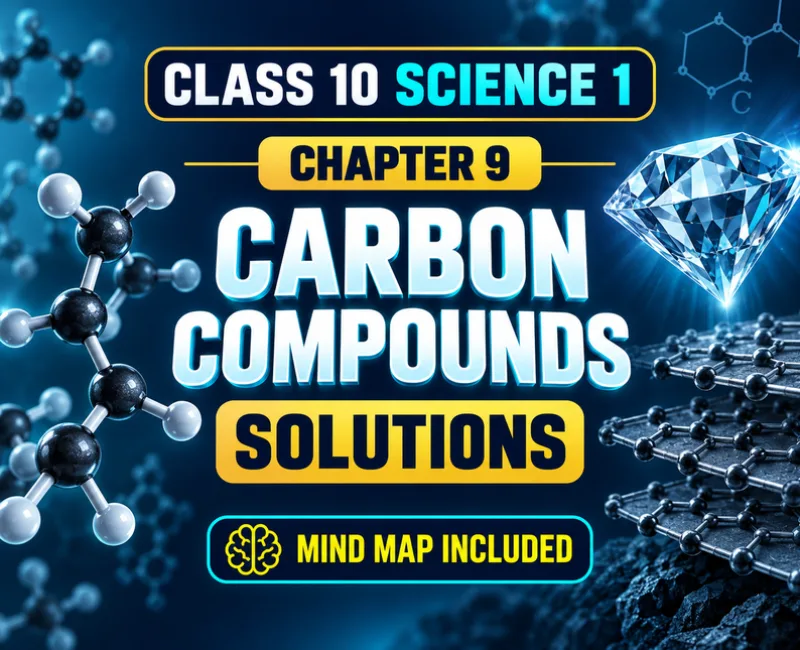
Chapter 9 Carbon Compounds Solutions
Study Maharashtra Board Class 10 Science and Technology Part 1 Chapter 9 Carbon Compounds with clear textbook solutions. Understand covalent bonding, catenation, hydrocarbons, functional groups and everyday carbon-based substances. The solutions PDF also includes a chapter mind map on its final page.
What Is Included in These Carbon Compounds Solutions?
These Class 10 Science 1 Chapter 9 Carbon Compounds solutions cover the key Maharashtra Board textbook ideas in simple steps. Begin with the four bonds a carbon atom can form and the sharing of electrons in covalent bonds. Then follow the way carbon atoms join into chains, branches and rings. This ability, called catenation, helps explain the enormous variety of compounds containing carbon.
The solutions also help you distinguish saturated and unsaturated hydrocarbons, understand functional groups and read simple structures and names. A formula alone does not tell you everything about a substance. For example, ethanol and ethanoic acid both contain carbon, hydrogen and oxygen, but their different functional groups give them different properties. Drawing a structure and marking its bonds or functional group makes these comparisons easier than learning names by memory alone.
Class 10 Science 1 Chapter 9: Main Topics
Covalent Bonding
See how carbon shares electrons to form four bonds, as it does with hydrogen atoms in methane.
Carbon Chains
Explore catenation, straight chains, branched chains and ring structures.
Functional Groups
Identify groups such as –OH and –COOH and relate them to the properties of compounds.
Important Carbon Compounds Concepts
Carbon generally forms covalent bonds by sharing electron pairs. In methane, one carbon atom shares an electron pair with each of four hydrogen atoms. In ethane, the two carbon atoms share a single bond; in ethene they share a double bond. Pay attention to the type of bond because it changes the reactions the compound may undergo.
Covalent Bonds and Catenation
A carbon atom has four valence electrons. Sharing electrons lets it complete its outer shell without forming four separate ions. Strong carbon–carbon bonds allow atoms to join repeatedly, producing chains, branches and rings. This is why carbon can form many more compounds than a short list of formulas might suggest.
Saturated and Unsaturated Hydrocarbons
Hydrocarbons contain only carbon and hydrogen. A saturated hydrocarbon has only single bonds between carbon atoms, such as ethane. An unsaturated hydrocarbon contains at least one double or triple carbon–carbon bond, such as ethene or ethyne. Look at the structure rather than relying on the compound's name alone.
Functional Groups and Reactions
A functional group gives a family of compounds characteristic properties. Ethanol contains the –OH group of an alcohol, while ethanoic acid contains the –COOH group of a carboxylic acid. Chemical reactions such as combustion, addition and oxidation help show how the bonding and groups in a molecule affect its behaviour.
How to Study Chapter 9 Carbon Compounds Solutions
- Draw each structure and count the bonds made by every carbon atom.
- Check whether adjacent carbon atoms have single, double or triple bonds.
- Identify any functional group before naming or comparing compounds.
- Explain the reaction in words before learning its equation.
- Use the mind map on the PDF's final page to revise bonding, hydrocarbons and functional groups together.
Revise Chapter 9 with the Mind Map
The Carbon Compounds mind map is on the last page of the solutions PDF. After reading the textbook answers, trace how covalent bonding leads to chains and rings, then branch into hydrocarbons and functional groups. Try drawing one example for each branch without looking at the PDF.
Frequently Asked Questions
Select a question to read a short explanation with an example.
Why does carbon form so many different compounds?
What is a covalent bond in a carbon compound?
What is catenation?
How are saturated and unsaturated hydrocarbons different?
What is a functional group?
Why is diamond different from graphite if both contain carbon?
Where is the Chapter 9 mind map?
 Download