Applied History
Complete Textbook Exercise Solutions
Detailed answers • Heritage chart • Preservation ideas • Map project • Mind map
Study Class 10 History Chapter 3: Applied History with complete Maharashtra State Board textbook solutions. This chapter explains how knowledge of the past can be useful in the present. It connects historical research with science, the arts, management, museums, archives and heritage conservation. The answers follow the textbook exercise and explain each topic in clear language.
We can use history when making decisions about a historic building, organising a museum, preserving old documents or studying how a technology developed. In each case, evidence about the past helps us understand what exists today and how to care for it. This practical use of historical knowledge is the central idea of applied history.
All textbook exercise questions are answered in order. The PDF includes correct options, the corrected wrong pair, short notes on Applied History and Archives, a completed cultural heritage chart, answers with reasons, detailed answers, at least ten ways to preserve historical sources, an India heritage map project and a final-page chapter mind map.
What is applied history?
Applied History uses historical knowledge and methods to address practical needs in present and future society. It is also called Public History because it connects the study of history with people and places outside the classroom. Its work can be seen in museums, archives, heritage sites, exhibitions, conservation projects and public education.
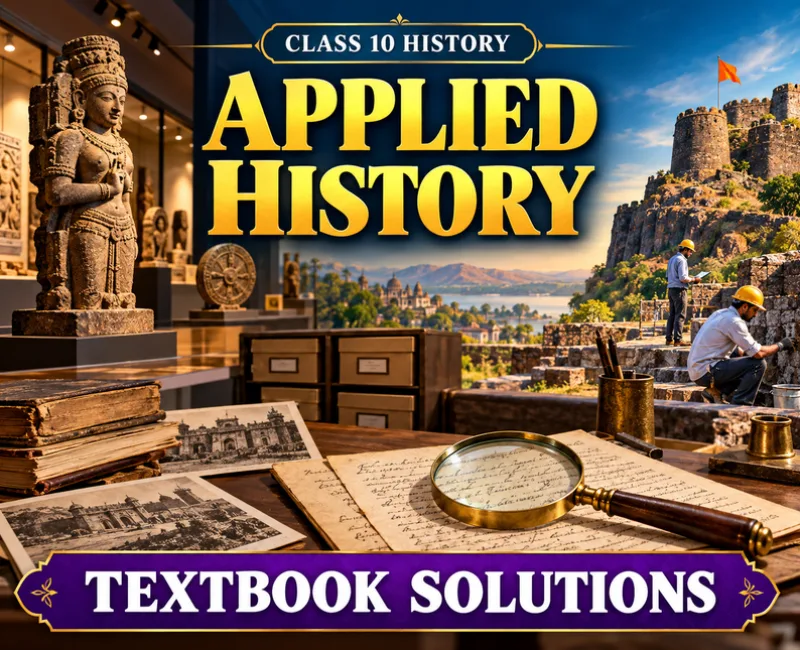
For example, before repairing an old fort, specialists study its original structure, building materials and earlier repairs. Their historical research helps them decide how to protect the fort without unnecessarily changing its character. A museum similarly uses research to identify objects, explain their context and display them responsibly for visitors.
Applied history can also support planning. An old photograph, map or administrative record may show how a town expanded and how a building was used over time. Such information can help a community understand the value of a site before deciding what should happen to it.
Museums, archives and historical evidence
Museums
A museum collects, cares for, studies and displays objects of historical, artistic, scientific or cultural value. An old sculpture, for example, can tell visitors about the material, artistic style and beliefs of the society that produced it. According to the chapter exercise, the earliest known museum was discovered at Ur.
Archives
An archive systematically collects and preserves records for study. Its holdings may include letters, government papers, maps, photographs, manuscripts, films and sound recordings. The National Archives of India is in New Delhi. A researcher might use an old map and an official record from an archive to study the growth of a city.
Preservation requires more than placing an object in a cupboard. Records must be identified and catalogued. Fragile documents need suitable storage, and digital copies can help protect the information they contain. Researchers must also know where an item came from and what period it belongs to. Without that context, even an interesting object may tell us very little.
Tangible and intangible cultural heritage
Tangible heritage has a physical form. Buildings, sculptures, paintings, manuscripts and artefacts are examples. You can see and handle a manuscript, although careful handling may be necessary to prevent damage. Intangible heritage includes practices and knowledge passed from one generation to another, such as oral traditions, performing arts, traditional skills, customs and festival rituals.
Consider a traditional performance. Its costumes and instruments are tangible objects, while the songs, movements and skills needed to perform it are intangible heritage. Protecting only the instruments would not preserve the living tradition. The completed concept chart in the PDF separates these two forms and provides examples for each.
In the chapter’s wrong-pair question, Ramman is incorrectly matched with West Bengal. Ramman is a religious festival and ritual theatre of the Garhwal region of Uttarakhand. Learning the correct location and form is more useful than remembering only that the original pair was wrong.
Why does applied history matter in other subjects?
Science and technology
A scientific discovery builds on earlier observations, experiments and ideas. Studying the history of science shows how explanations changed and how instruments developed. The history of technology also reveals how inventions affected work, transport, communication and everyday life. For example, tracing the development of printing helps us understand changes in education and the spread of knowledge.
Arts
Paintings, architecture, theatre, dance and music develop within particular social and cultural settings. Historical research helps us understand an artwork’s materials, style, meaning and changes over time. For example, studying the period in which a temple sculpture was made can help explain its symbols and artistic techniques.
Management studies
Organisations and systems of work also have histories. Studying earlier decisions, markets, working conditions and responses to difficulties can help people evaluate present choices. For example, a museum planning visitor access can learn from how similar institutions balanced public access with the protection of fragile objects.
Heritage conservation and UNESCO
Heritage may have value to a local community, a country and people across the world. UNESCO announces the World Heritage List, which recognises cultural and natural sites assessed for outstanding universal value. Recognition creates awareness and encourages protection, planning and cooperation. A place still needs careful management after it is listed: visitors, pollution and unsuitable construction can all affect its condition.
The detailed solutions explain practical ways to preserve sources of history. These include regular maintenance of sites, legal protection, suitable storage for documents and objects, digitisation, cataloguing, pollution control and recording oral traditions. Schools and local communities can help through awareness programmes and responsible visits.
Heritage projects should also consider people living near a site. Local residents may hold knowledge about its traditions and may contribute as guides, craftspeople or caretakers. A good project protects the heritage while respecting the community and supporting responsible local livelihoods.
India heritage map project and chapter mind map
The PDF includes a numbered India map and a legend of cultural and natural heritage sites. Use it as a model when marking sites on an outline map. Check each location carefully and use separate colours for cultural and natural heritage.
The final-page mind map connects Applied History with research fields, museums, archives, cultural heritage, conservation and public participation. Read the detailed answers first, then use the map for quick revision.
Frequently asked questions
These questions answer common student doubts about Applied History and give examples to make each idea easier to understand.
What is Applied History in simple words?
Applied History means using knowledge and methods from history for practical purposes today. For example, studying a building’s old plans before restoring it is an application of history.
Why is Applied History also called Public History?
It is called Public History because it brings historical knowledge into public life. Museums, heritage walks, archives and exhibitions allow people outside academic research to learn from and participate in history.
What is an archive, and how is it different from a museum?
An archive primarily preserves records such as documents, letters, maps and photographs for study. A museum collects and displays objects for research, education and public viewing. For example, a historic letter may be preserved in an archive, while an ancient sculpture may be displayed in a museum.
Where is the National Archives of India?
The National Archives of India is in New Delhi. It preserves important records that researchers can use to study India’s history. This location is also the answer to a correct-option question in the textbook exercise.
Where was the earliest known museum discovered?
According to the chapter exercise, it was discovered during excavations at Ur in Mesopotamia. Remember the city name when preparing the correct-option question.
What is the difference between tangible and intangible heritage?
Tangible heritage has a physical form, such as a monument or manuscript. Intangible heritage consists of practices and knowledge, such as songs, traditional skills and rituals. In a traditional dance, the instruments are tangible, while the knowledge of how to perform the dance is intangible.
How can we connect Applied History with our present life?
It helps us interpret our heritage, understand how present systems developed and make informed decisions. For example, historical research can help a community preserve an old market building while deciding how people can continue to use the area.
Why is it important to study the history of technology?
It shows how inventions developed from earlier knowledge and how they changed society. Studying the history of printing, for example, helps us understand changes in book production, education and communication.
Why does UNESCO announce the World Heritage List?
The list recognises cultural and natural sites of outstanding universal value and encourages their protection. Recognition can increase awareness, but governments and communities must still manage and conserve the sites responsibly.
How can students help preserve sources of history?
Students can follow site rules, avoid touching or damaging fragile objects, report vandalism, learn about local heritage and help record oral traditions with appropriate permission. For example, a school project could document a local craft through interviews and photographs.
What should a heritage project achieve?
It should document and protect the site, plan for its maintenance, educate visitors and involve local people. A fort conservation project, for example, can combine careful repairs with informative signs and opportunities for trained local guides.
 Download