History of Indian Arts
Complete Textbook Exercise Solutions
Short notes • Temple architecture table • Warli observation • Projects • Mind map
Study Class 10 History Chapter 4: History of Indian Arts with complete Maharashtra State Board textbook solutions. This chapter explores painting, sculpture, architecture, folk traditions and performing arts. It also explains how artistic creations help us understand the beliefs, skills and everyday lives of people in different periods.
The solutions follow the textbook exercise in order. Each answer is written in clear language so you can understand the idea before practising it for an examination. The booklet includes a completed temple architecture table, a Warli painting observation, both chapter projects and a final-page mind map.
Correct options and the corrected wrong pair; short notes on art, Hemadpanti temples and Maratha painting; answers with reasons about the art market and Chitrakathi; a completed temple-style table; detailed answers on folk painting, Islamic architecture and careers; a Warli observation; two project models; and a chapter mind map.
What does the history of art tell us?
Art allows people to express ideas, feelings, experiences and knowledge. A painting or sculpture may be beautiful, but it can also be a source of historical information. Clothing shown in a painting, materials used in a building and activities represented in a folk artwork can give us clues about the society that created them.
For example, a Warli painting may show farming, animals, houses and a community dance. It tells us something about the relationship between people, work and nature. A temple can reveal the skills of builders and sculptors, as well as the religious and artistic traditions of its period. Historians examine such creations carefully instead of treating them only as decoration.
Visual arts, performing arts, folk arts and classical arts
Visual arts
Visual arts are primarily experienced through sight. Painting, sculpture and architecture are examples. This is why painting and sculpting are visual arts in the textbook’s correct-option question.
Performing arts
Music, dance and theatre are performed before an audience. They involve skills that can be taught and passed from one generation to the next. A dance performance, for example, brings together movement, rhythm, costume and expression.
Folk art grows from the shared life and traditions of a community. Classical art generally follows established rules and requires prolonged training. These categories describe different traditions; they do not mean that one form is more valuable than another. Both can preserve important knowledge about culture and history.
Indian painting traditions
Early and folk paintings
Rock paintings show that people created visual images long before modern paints and paper. They represented human figures, animals and activities using available natural colours. Later folk styles developed in different regions. Such paintings often show local surroundings, occupations, beliefs and community celebrations.
Warli painting
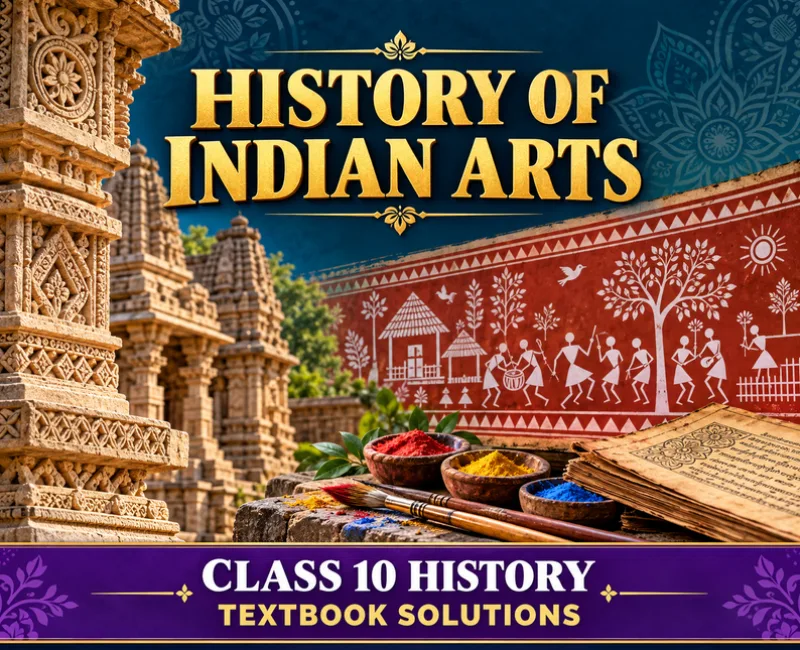
Warli painting is an important tradition associated with Maharashtra. White figures are painted on an earthen or red-ochre background. Circles, triangles and lines are used to form people, animals, trees and houses. A human body is often drawn as two triangles joined at their tips. Scenes may show farming, rituals and the circular tarpa dance.
The textbook asks you to observe a Warli painting and write about nature, human figures, occupations and houses. The PDF answers each of these four parts separately and includes a study diagram. This makes it easier to organise an observation answer instead of writing a general paragraph about the painting.
Maratha style of painting
The Maratha style includes murals and miniature paintings. Its images can provide information about dress, customs, domestic life and social practices. This is why paintings can serve as visual sources for a historian as well as works of art.
Chitrakathi
The Chitrakathi tradition uses painted pictures, storytelling, music and performance to narrate stories. Preserving it means protecting both the pictures and the skills of the artists who bring them to life. If the performance tradition disappears, recording only the pictures cannot fully preserve the art.
Temple architecture made easier
The completed table in the PDF compares three temple traditions. Nagara is a principal North Indian style recognised by a curving tower or shikhara. Dravida is a principal South Indian style whose tower above the sanctum is tiered and pyramidal. Large complexes may also have monumental gateway towers.
Hemadpanti temples are associated with medieval Maharashtra. Their features include a star-shaped ground plan, zigzag outer walls and dressed stones fitted together without mortar. The changing angles of the walls produce a striking pattern of light and shadow. When preparing the short note, remember the plan, the stone construction and an example such as Gondeshwar Temple at Sinnar.
The Mathura school rose during the Kushana period. This is the answer to the second correct-option question. Keep this fact separate from the temple-style table: the Mathura school concerns sculpture, while Nagara, Dravida and Hemadpanti describe architectural traditions studied in the chapter.
Islamic architecture and Indian craftsmanship
Islamic architecture in India developed through interaction among different building traditions and local skills. Features discussed in the solution include arches, domes, minarets, courtyards, geometric designs and calligraphy. Indian materials and craftsmanship gave monuments their own regional character.
The Qutub Minar is at Mehrauli near Delhi, the Taj Mahal is at Agra, and Gol Gumbaz is at Vijayapura. These examples can support a detailed answer. In the textbook’s wrong-pair question, Chhatrapati Shivaji Maharaj Terminus belongs with Mumbai, not Delhi.
Why is art history useful today?
An art-history expert can study an artwork’s materials, style, origin and earlier ownership to help determine whether it is genuine. This matters in museums and the art market, where a copy may look similar to an older original. Art history is also useful for conservation: before repairing a mural or sculpture, specialists need to understand how it was made.
The chapter describes opportunities in research, teaching, museums, heritage management, design, photography and other creative fields. For example, a museum curator researches objects and plans how they will be presented, while a conservator works to protect them from damage. Applied arts connect creativity with practical uses such as communication and product design.
Both projects and the chapter mind map
The PDF contains a reference table for a project on World Heritage Sites in India. It also provides questions and a model structure for interviewing a sculptor or image maker. When interviewing an artist, ask permission before taking photographs and record the materials, tools and stages of their work accurately.
The final-page mind map connects visual arts, performing arts, painting traditions, architecture and careers. Study the detailed answers first, then use the mind map to revise the chapter.
Frequently asked questions
These questions address common doubts about Indian arts and the chapter exercise. Each answer includes a reason or example to help you write beyond a one-word response.
Why are painting and sculpting called visual arts?
They create works experienced mainly through sight. We look at a painting’s colours and forms or a sculpture’s shape and details. Music and dance, by comparison, are performing arts because they are presented through a performance.
During which period did the Mathura school rise?
The Mathura school rose during the Kushana period. Remember this as the answer to the chapter’s correct-option question about the development of Indian sculpture.
Who helped popularise Warli painting?
Jivya Somya Mashe played a major role in popularising Warli painting. This Maharashtra folk tradition uses simple white geometric forms on an earthen background to represent community life and nature.
How are human figures drawn in Warli painting?
A figure commonly uses a circle for the head, two triangles joined at their tips for the body and lines for the arms and legs. Several such figures may form a circle in a tarpa dance scene. The simple shapes still show movement clearly.
What should I write when observing a Warli painting?
Organise your answer under the four requested points: nature, human figures, occupations and houses. Mention trees and animals under nature; geometric figures under people; farming or dancing under activities; and simple huts or village spaces under houses. Describe what is actually visible in the given illustration.
What are the main features of Hemadpanti temples?
They are known for a star-shaped plan, zigzag outer walls and dressed stones joined without mortar. Gondeshwar Temple at Sinnar is an example. These features help distinguish Hemadpanti architecture from the Nagara and Dravida styles in the chapter table.
What is the difference between Nagara and Dravida temple styles?
Nagara is a principal North Indian style with a curving shikhara. Dravida is a principal South Indian style with a tiered, pyramidal tower above the sanctum. Compare the shape of the tower when identifying the styles.
Why should the Chitrakathi tradition be preserved?
Chitrakathi combines painted pictures with storytelling and performance skills. If artists stop practising it, the songs, methods of using the pictures and knowledge passed between generations may be lost. Documentation, teaching and support for practising artists can help it continue.
Why does the art market need an art-history expert?
An expert can examine an object’s style, materials, age, origin and records of ownership. This helps distinguish an authentic work from a later copy and supports a more informed assessment of its value.
What are examples of Islamic architecture in India?
The Qutub Minar near Delhi, the Taj Mahal at Agra and Gol Gumbaz at Vijayapura are examples discussed in the chapter solution. Their features include combinations of domes, arches, minarets, ornament and skilled local craftsmanship.
Where is Chhatrapati Shivaji Maharaj Terminus?
It is in Mumbai. Pairing it with Delhi is the mistake in the textbook exercise. Qutub Minar is at Mehrauli near Delhi, which may be why the locations are confused.
 Download