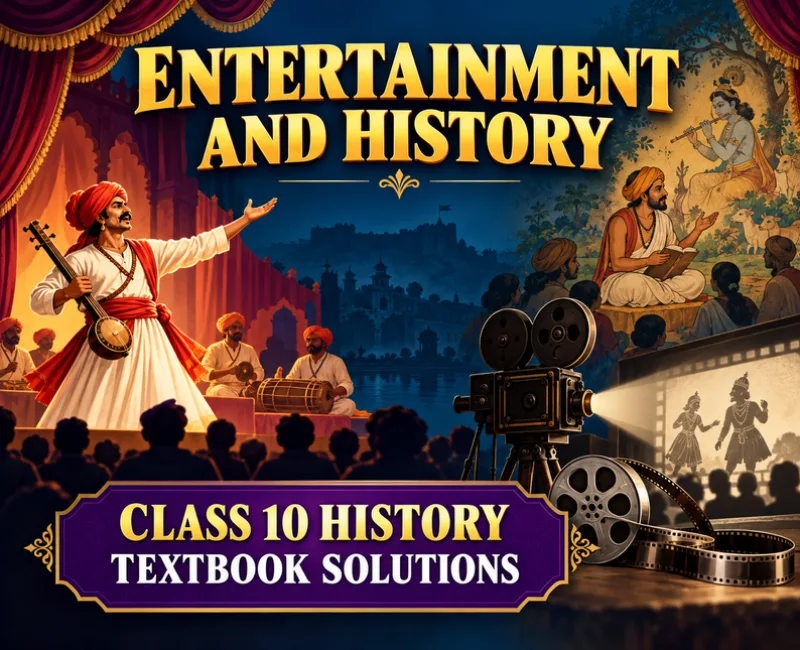
Entertainment and History
Complete Textbook Exercise Solutions
Folk arts • Marathi theatre • Indian cinema • Chart • Project • Mind map
Study Class 10 History Chapter 6: Entertainment and History with complete Maharashtra State Board textbook solutions. This chapter explores traditional performances, devotional forms, Marathi theatre and the beginnings of Indian cinema. It also shows how entertainment preserves cultural memory and why historical knowledge is valuable when presenting stories about the past.
The solutions follow the textbook exercise in order. They explain the correct options and wrong pair, complete the folk-art chart and provide detailed answers on Maharashtra’s contribution to cinema and the Powada tradition. A project model and a chapter mind map are included for further study and revision.
All textbook exercise questions; a completed comparison of Bhajan, Keertan, Lalit and Bharud; short notes on the need for entertainment, Marathi theatre and careers; answers with reasons; detailed answers on the Indian film industry and Powada; a theatre and cinema timeline; a model Bharud project; and a final-page mind map.
Why do we need entertainment?
Entertainment refreshes the mind and brings enjoyment. Reading, music, theatre, games, crafts and films can also develop skills, creativity and confidence. Some activities need active participation, while others mainly involve watching or listening. For example, performing in a play is active participation; watching the play is mainly a spectator experience.
Entertainment has a history because its forms change with society and technology. Stories once performed before a local audience may later be presented through theatre, film, radio or television. At the same time, older forms can continue to be practised by communities. Studying them helps us understand what people valued, how they shared ideas and how they responded to social change.
Bhajan, Keertan, Lalit and Bharud
The completed textbook chart compares four forms that combine entertainment with devotion or instruction. They use music, narrative, acting or humour in different ways. Learn one defining feature and one example of each form before attempting to reproduce the full chart.
Bhajan
A Bhajan is a devotional song praising God or repeating the divine name. Singing may be accompanied by rhythm instruments. The compositions of saints have kept this form alive across generations.
Keertan
Keertan combines speaking, singing, storytelling and sometimes humour or movement. It can communicate religious, ethical or social ideas to an audience. Saint Namdev is regarded as the first keertankar in Maharashtra in the chapter’s correct-option question.
Lalit
Lalit is an older theatrical form associated with devotional performance. Stories of deities and devotees are presented as part of a festival tradition. It brings together narration, performance and community participation.
Bharud
A Bharud is a metaphorical song that uses familiar characters, situations, rhythm and humour to communicate a deeper message. Saint Eknath’s Bharuds remain well known. His Vinchu Chavala uses a scorpion’s sting as a metaphor for harmful impulses such as anger.
Powada and historical memory
Powada is a Marathi ballad performed in a forceful, dramatic style. It narrates the deeds of heroic people and can inspire an audience through rhythm, voice and storytelling. Powadas about battles and resistance carried memories of important events to people who might never read a written historical account.
A Powada is therefore both entertainment and a source for studying how people remembered the past. Like any historical source, it should be examined critically. A performer may use powerful language to inspire listeners, while a historian also needs to check dates and events against other evidence.
Development of Marathi theatre
Marathi theatre developed from earlier performance traditions and grew through written plays, musical theatre and works dealing with social and historical issues. Vishnudas Bhave is known as the father of Marathi theatre. Later playwrights introduced fuller scripts and developed new ways to present stories on stage.
Musical theatre became especially important in Maharashtra. Annasaheb Kirloskar wrote Sangeet Shakuntal. In the textbook’s wrong-pair question, Ekach Pyala is incorrectly paired with Kirloskar. Its author is Ram Ganesh Gadkari. Remember the correct work and writer together.
Plays can also provide evidence of the concerns of their time. A play dealing with a social custom may show how people questioned it, while a historical play may reveal how a later generation interpreted an earlier event. The solutions PDF develops these points in its short note on Marathi theatre.
Maharashtra and the beginnings of Indian cinema
Maharashtra played an important role in the early development of Indian films. Pundalik was released in Mumbai in 1912. Dadasaheb Phalke’s Raja Harishchandra, released in 1913, was the first full-length film processed completely in India. Baburao Painter made Sairandhri, the answer to the chapter’s second correct-option question.
Film production requires many people and skills. Early filmmakers developed cameras, studios, acting methods and ways to tell stories visually. Films on mythological, historical and social subjects attracted audiences and helped the industry grow. The detailed PDF answer explains the contributions of important filmmakers and studios in a sequence useful for an examination response.
Why does a historical film need historical research?
A film set in an earlier period must make decisions about buildings, costumes, jewellery, language, transport and everyday customs. Historical experts study documents, paintings, photographs and objects to guide those decisions. For example, a prop that belongs to a much later period would look out of place in an earlier historical setting.
A film may use imagined dialogue or combine events for storytelling. Research helps its makers distinguish documented facts from creative scenes and avoid misleading viewers about major events. The chapter also explains careers for historians and other specialists in theatre and cinema, including research, scriptwriting, design and production.
Bharud project and chapter mind map
The PDF includes a model project based on Saint Eknath’s Vinchu Chavala. It explains the scorpion metaphor, the message about self-control and a possible school performance. Use the structure to show both the meaning and the performance features of a Bharud.
The final-page mind map connects folk forms, devotional performances, Marathi theatre, Indian cinema and careers. Read the full answers before using it for quick revision.
Frequently asked questions
These questions explain terms that students commonly find confusing and cover the important textbook exercise topics.
How are entertainment and history connected?
Entertainment forms preserve stories, language, customs and memories of their time. History helps us study how those forms developed. For example, an old play may reveal the social issues people discussed, while historical research helps a modern production represent its period responsibly.
Why is entertainment necessary?
Healthy entertainment provides enjoyment and refreshment and can develop creativity and social skills. Taking part in music or theatre, for example, can build confidence and cooperation in addition to offering a break from routine work.
Who is regarded as the first keertankar in Maharashtra?
Saint Namdev is regarded as the first keertankar in Maharashtra. Keertan communicates ideas through a combination of speaking, singing and storytelling.
What is the difference between Bhajan and Keertan?
A Bhajan is mainly devotional singing. A Keertan combines song with narration or explanation and may include storytelling, humour and audience engagement. Both can share devotional ideas, but their presentation differs.
What is a Bharud? Give an example.
A Bharud is a metaphorical song that uses performance, rhythm and familiar situations to teach a spiritual or ethical idea. In Saint Eknath’s Vinchu Chavala, a scorpion’s sting represents harmful emotions such as anger.
Why are Saint Eknath’s Bharuds popular?
They combine simple language, lively rhythm, humour and recognisable characters with meaningful lessons. An audience can enjoy the performance while also understanding the message behind its metaphor.
What is a Powada?
A Powada is a Marathi ballad about heroic deeds, performed with strong rhythm and dramatic narration. A Powada about a battle can preserve how a community remembered bravery and resistance, though historians must still check its factual details.
Who is called the father of Marathi theatre?
Vishnudas Bhave is known as the father of Marathi theatre. He helped develop staged Marathi performances from earlier traditions, including presentations based on stories familiar to audiences.
Who wrote Ekach Pyala?
Ram Ganesh Gadkari wrote Ekach Pyala. It is the corrected pair in the textbook exercise. Annasaheb Kirloskar is associated with Sangeet Shakuntal.
Which film did Baburao Painter make?
Baburao Painter made Sairandhri. He was among the important early figures in the development of cinema in Maharashtra.
Why is Maharashtra called a land that nurtured Indian cinema?
Several early filmmakers, technicians, studios and influential films developed there. Productions such as Pundalik, Raja Harishchandra and Sairandhri show different stages of that early growth. The detailed answer in the PDF explains the wider contribution.
Why does a film set in the past need a history expert?
An expert checks the period’s buildings, clothing, objects, customs and important events. For example, a historical film should not accidentally show a later invention in an earlier setting. Research helps the production remain convincing and responsible.
 Download