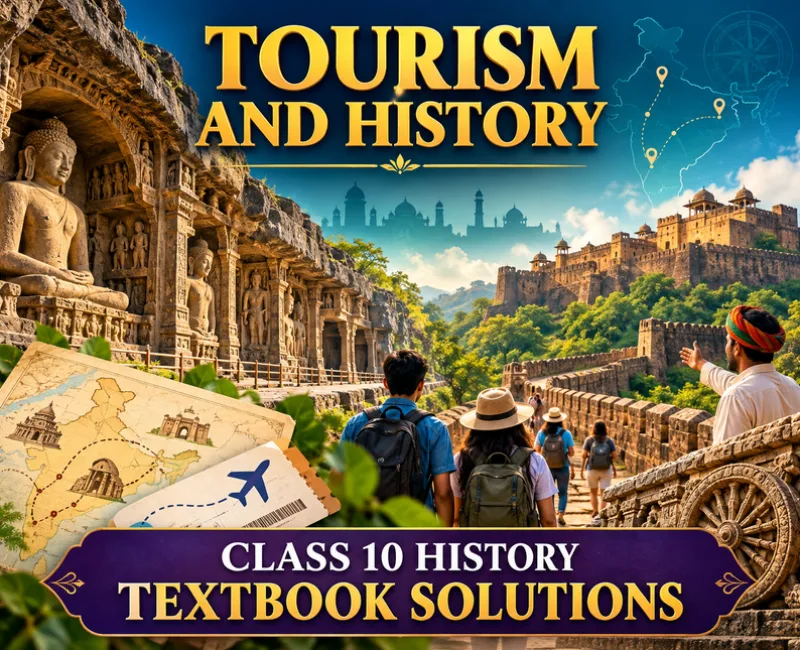
Tourism and History
Complete Textbook Exercise Solutions
Travel traditions • Heritage • Types of tourism • Concept map • Project • Mind map
Study Class 10 History Chapter 8: Tourism and History with complete Maharashtra State Board textbook solutions. This chapter explains why people have travelled through different periods and how visiting historical and natural places can support learning, conservation and local livelihoods.
The solutions follow the textbook exercise in order. They cover correct options, the wrong pair, answers with reasons, short notes, detailed answers and a completed heritage tourism concept map. The PDF also includes a model project on preserving heritage sites and a final-page mind map.
Answers about Thomas Cook and Bhilar; the corrected Tadoba pair; reasons for increased travel and heritage precautions; notes on the tradition of travelling, Marco Polo and agro-tourism; detailed answers on tourism development, livelihoods and careers; three types of tourism; a completed concept map; a preservation project; and a chapter mind map.
What is the connection between tourism and history?
Tourism takes people to places they may previously have known only through books or pictures. Visiting a fort, cave, museum or memorial can help a student understand its location, scale and setting. Historical research explains when a place was created, how it was used and why it matters. The visitor’s experience becomes more meaningful when it is supported by accurate information.
Tourism can also help protect heritage by building public interest and supporting local work. Yet visits must be managed carefully. If people carve names into stone, litter or touch fragile paintings, the evidence that attracts visitors may be damaged. History and tourism are therefore closely connected through learning, conservation and responsible use.
The long tradition of travelling
People travelled long before organised tourism agencies existed. In India, journeys were made for pilgrimage, trade, education, festivals and the sharing of religious ideas. Teachers, monks and other travellers moved between regions and carried knowledge with them. Their accounts can become sources for studying the places and societies they observed.
For example, a traveller may describe a route, a market, the food available or the customs of a community. A historian compares such writing with other sources because travellers noticed some details and missed others. The chapter’s short note explains this tradition and shows that travel has connected communities for many centuries.
Marco Polo
Marco Polo was an Italian traveller whose accounts introduced European readers to features of Asia, particularly China. His writings described places, people and trade. They are useful historical material, while still requiring critical reading like any travel account.
Thomas Cook
Thomas Cook established a travel agency that sold tourist tickets. This is the correct option in the textbook exercise. Organised tours and travel services helped tourism develop into a more planned activity.
Types of tourism explained with examples
Historical tourism
Historical tourism involves visiting places connected with the past, such as forts, rock-cut caves, museums and memorials. A visit to the Ajanta Caves, for example, can introduce students to paintings, sculpture and the historical setting of the site. Guides and reliable information help visitors understand what they see.
Health tourism
People may travel to obtain medical treatment, rehabilitation or wellness services. The main purpose differs from a visit to a monument, but visitors still need safe travel, dependable information and suitable facilities.
Agro-tourism
Agro-tourism introduces visitors to farming and rural life. They may learn about crops, farm tools, irrigation, animals, traditional food and local customs. For example, a family visiting a farm can see how a crop is grown rather than knowing it only as a product sold in a shop. Properly managed visits may provide supplementary income to farmers.
The textbook asks for any three types of tourism. The PDF provides historical tourism, health tourism and agro-tourism as complete examples. Learn the purpose of each type and add a suitable activity or destination in your answer.
Heritage attractions in Maharashtra
Maharashtra offers different kinds of destinations. The rock-cut caves at Ajanta, Verul and Gharapuri are connected with cultural history. The Western Ghats and Kas Plateau represent natural heritage. Chhatrapati Shivaji Maharaj Terminus is a historic railway building, while Tadoba-Andhari is a wildlife destination.
These examples appear in the completed concept map in the PDF. They also help with the textbook’s wrong-pair question: Tadoba is a wildlife sanctuary or tiger reserve, not a group of rock-cut caves. When revising, connect each destination with its correct type instead of memorising a list of names alone.
Bhilar is known as the Village of Books. It shows that a place can attract visitors through literature and reading as well as through monuments or natural scenery. This is the second correct-option answer in the chapter.
What does a destination need for responsible tourism?
Visitors need reliable transport, accurate directions, safety, clean drinking water, washrooms and places to stay. Historical sites also need guides and signs that explain their importance correctly. Information in more than one language can help visitors understand a place and behave responsibly.
Development should include local residents. People may work as guides, drivers, accommodation providers, performers, photographers or craftspeople. A well-planned visit can support these livelihoods. At the same time, uncontrolled traffic, litter and unsuitable construction can damage a site and the surrounding environment.
To develop a village or town for tourism, first identify its genuine attractions. Then improve cleanliness and visitor facilities, train local guides and protect the character of the place. The PDF’s detailed answer provides a practical sequence that students can adapt to their own locality.
Why must tourists protect heritage?
A historical site is an irreplaceable source. An inscription, painting or original stone surface can lose information when it is scratched or damaged. Visitors should use designated paths, avoid touching fragile objects, follow site rules and dispose of waste properly. Authorities need to provide maintenance and protection as well.
Preserving a destination is also important for the people who depend on tourism. If a site becomes unsafe or loses its historical value, visitors and local livelihoods may both be affected. Responsible tourism allows people to learn from a place while keeping it available for future generations.
Preservation project and chapter mind map
The PDF contains a model project explaining why heritage sites should be preserved and what visitors, experts, authorities and local communities can do. It covers documentation, scientific conservation, visitor management, cleanliness and public awareness.
The final-page mind map connects past travel, types of tourism, heritage, visitor facilities, livelihoods and careers. Use it to revise the chapter after studying the full answers.
Frequently asked questions
These questions explain the chapter’s common doubts with short examples you can use while preparing your answers.
Why are tourism and history closely connected?
Historical knowledge explains the importance of places tourists visit. Tourism allows people to experience those places directly. For example, a visit to Ajanta becomes more meaningful when a guide explains the caves’ paintings and historical setting.
What did Thomas Cook’s travel agency sell?
It sold tourist tickets. This is the answer to the chapter’s first correct-option question and relates to the growth of organised tourism.
Why is Bhilar called the Village of Books?
Bhilar is associated with collections of books made available to visitors, particularly Marathi literature. It is an example of a destination that connects reading, culture and tourism.
Is Tadoba a rock-cut cave site?
No. Tadoba is a wildlife sanctuary and tiger reserve. The pairing “Tadoba — rock-cut caves” is the wrong pair in the textbook exercise.
What is agro-tourism?
Agro-tourism gives visitors an opportunity to learn about farming and rural life. A farm visit might include observing crops, irrigation, animals and local food. It can also provide an additional source of income for farmers.
What are three types of tourism in this chapter?
Historical tourism involves heritage places; health tourism involves travel for treatment or wellness; and agro-tourism involves learning about farms and rural life. Give a clear purpose and example for each type in a detailed answer.
Why has travel to and from India increased?
More transport options, easier travel planning and wider connections for education, employment, business, treatment and recreation have increased travel. For example, air services make a distant destination reachable much faster than earlier forms of travel.
How does tourism create livelihoods?
Visitors spend on transport, accommodation, food, guides, tickets and local products. A heritage destination may support drivers, guides, artisans, shopkeepers and accommodation providers, as well as people who maintain the site.
Why should tourists avoid writing on monuments?
Graffiti damages original surfaces and can destroy historical evidence. An inscription or painting cannot simply be replaced once harmed. Visitors should follow site rules and help keep the place safe for future study.
How can I develop my town for tourism?
Identify genuine local attractions, document their history, improve cleanliness and facilities, train local guides and protect heritage. For example, a short walking route with accurate signs can introduce visitors to several historic buildings without changing them.
What work is available in tourism for a history student?
History knowledge is useful for guiding, researching destinations, preparing museum or site information, writing accurate travel content and supporting heritage conservation. Good communication and knowledge of local languages can help in these roles.
 Download