
Class 4 Science
States of Matter Class 4 Science Worksheet with Quiz and Activities
Why does ice melt, where does steam come from and why can air be squeezed? Explore with this States of Matter worksheet for Class 4: take the States of Matter Class 4 online quiz, heat and cool things in the labs and play the States of Matter Class 4 activities and interactive games online.
Flip the cards and try the Change It Lab, then tap the Games, Labs or Challenges island.
States of Matter Class 4 Online Quiz
20 questions · tap an answer to move on · full review at the end
Flip the cards, try the Change It Lab, then play the games, do the labs and take the challenges. Earn up to 3 stars in every activity.
Fact cards: tap a card to flip it
Change It Lab
Make three changes of state. In each one, drag the action you think will work onto the picture and watch the particles. A wrong choice shows what happens instead, so you can try again.
Challenge marks: 0 / 15 (0 of 5 challenges done)
Finish all 5 challenges to see your comment.
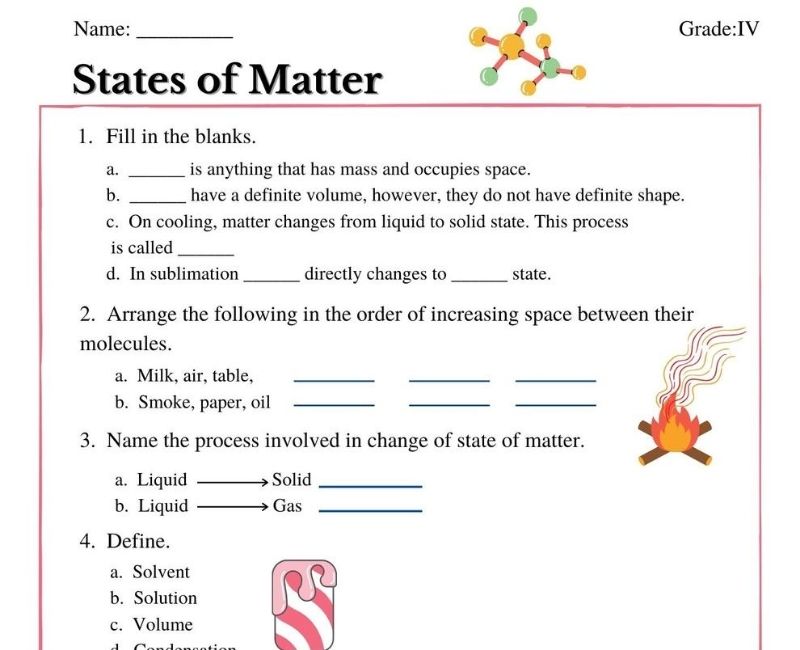
Practice sheet
States of Matter Class 4 Activities
Melt, boil, squeeze, pour and dissolve in real-looking experiments. Earn up to 3 stars in every activity.
What is matter?
Look around you. Your pencil, the water in your bottle and the air you breathe are all matter. Matter is anything that has mass and takes up space. All matter is made of tiny particles that are much too small to see, even with a magnifying glass.
Matter is found in three main states: solid, liquid and gas. The same substance can be in different states. Water can be hard ice, flowing water or invisible water vapour, depending on how hot or cold it is.
Solids, liquids and gases
| State | Shape | Volume | Examples |
|---|---|---|---|
| 🧱 Solid | fixed | fixed | pencil, table, salt |
| 💧 Liquid | takes the shape of the container | fixed | water, kerosene, curd water |
| 🎈 Gas | no fixed shape | fills any space | air, oxygen, water vapour |
Changing states
- Heating makes particles move faster and spread apart: solids melt, and liquids turn into gas.
- Cooling makes particles slow down and come closer: gases turn into liquids, and liquids freeze.
- Some solids, like camphor, turn straight into a gas.
Mixing with water
This States of Matter worksheet for Class 4 turns science into an island adventure with online activities and interactive games. Flip the cards, heat and cool things in the Change It Lab, then play the games, do the science labs and try the challenges.
Science States of Matter Class 4
States of Matter is an important Class 4 Science topic. It explains what matter is, the three states of matter (solid, liquid and gas), how the tiny particles in each state are arranged, how heating and cooling change one state into another, and what happens when things are mixed with water. This guide explains each idea in simple language for Class 4 students, parents and teachers. It goes with the States of Matter worksheet for Class 4 on WitKnowLearn, which also gives an online quiz, online activities and interactive games on the same page.
What is matter?
Matter is anything that has mass and takes up space. Everything we can touch is matter, and so is the air we cannot see. All matter is made of extremely tiny particles. How these particles are packed and how they move decides whether something is a solid, a liquid or a gas.
What is there in this topic
- Matter and its three states
- Properties of solids, liquids and gases
- Arrangement and movement of particles
- Melting, freezing, evaporation, condensation, boiling and sublimation
- Soluble and insoluble substances
Learning objectives
- Explain what matter is.
- Name the three states of matter and give examples of each.
- Describe how particles are arranged in solids, liquids and gases.
- Explain how heating and cooling change the state of matter.
Learning outcomes
After this page a child can:
- Sort everyday things into solids, liquids and gases.
- Explain why a gas can be squeezed but a liquid cannot.
- Show that a liquid keeps the same volume in any container.
- Name the change of state in everyday examples.
States of Matter Class 4 resources on this page
| Resource | What it does |
|---|---|
| States of Matter Class 4 online quiz | 20 questions in three levels with a full answer review |
| Flip cards | Six cards on solids, liquids, gases, particles, heating and cooling |
| Change It Lab | Change ice to water, water to steam and steam back to water while watching the particles |
| 5 interactive games | Solid or liquid, gas bubbles, change memory, particle patterns, heat it or cool it |
| 5 science labs | Squeeze test, pour and measure, drying race, salt from sea water and stir and see experiments |
| 5 challenges | Marked out of 3 each with a total out of 15 |
| Practice sheet | 16 questions with answer boxes and a live score |
Comparing the three states
| Property | Solid | Liquid | Gas |
|---|---|---|---|
| Shape | Fixed | Takes the shape of the container | No fixed shape |
| Volume | Fixed | Fixed | Fills the whole space |
| Can it flow? | No | Yes | Yes |
| Can it be squeezed? | No | Hardly at all | Yes, easily |
| Particles | Packed tightly, shake in place | Close together, slide past each other | Far apart, move freely |
Changes of state
| Change | From → To | Heat |
|---|---|---|
| Melting | Solid → Liquid | Added |
| Freezing | Liquid → Solid | Taken away |
| Evaporation and boiling | Liquid → Gas | Added |
| Condensation | Gas → Liquid | Taken away |
| Sublimation | Solid → Gas directly | Added |
Types of questions
- Solid, liquid or gas
- Properties of each state
- Name the change of state
- Particles and their arrangement
- Soluble or insoluble
- Hands-on experiments with heating, cooling and mixing
Solved examples
Common mistakes
| Mistake | Correct |
|---|---|
| Thinking air is not matter | Air has mass and takes up space, so it is matter. |
| Thinking a liquid changes its amount in a new container | Only its shape changes; its volume stays the same. |
| Thinking a dissolved substance is gone | It is still there, mixed in; it can be tasted. |
| Calling the white cloud above a kettle steam | Steam is invisible; the cloud is tiny water drops. |
Daily life
Changes of state happen in every kitchen: water boils for tea, ghee melts in a hot pan, and ice cubes form in the freezer. Clothes dry on the line by evaporation, and mirrors fog up after a hot bath by condensation. Knowing about states of matter helps us cook, store food and stay safe around hot things.
Tips for parents and teachers
- Put an ice cube on a plate in the sun and in the shade and compare.
- Pour the same cup of water into different containers.
- Stir salt, sugar, sand and oil into water and observe.
- Breathe on a cold mirror and watch the drops form.
- Let the child retry the challenges to earn 3 stars.
Related Class 4 Science Worksheets
- Adaptation in Plants Worksheet Class 4
- Reproduction in Animals Worksheet Class 4
- Adaptation in Animals Worksheet Class 4
- Teeth and Microbes Worksheet Class 4
- Food and Nutrition Worksheet Class 4
- Force Work and Energy Worksheet Class 4
- Air Water and Weather Worksheet Class 4
- Leaves and the Food Factory of Plants Worksheet Class 4
- Safety and First Aid Worksheet Class 4
- Our Universe Worksheet Class 4
- Clothes We Wear Worksheet Class 4
- Our Environment Worksheet Class 4
Frequently Asked Questions
 Download


