Class 4 English Grammar
Alphabetical Order Class 4 English Grammar Worksheet with Quiz and Activities
How do dictionaries keep thousands of words in order, and what do you do when two words start with the same letter? Find out with this Alphabetical Order worksheet for Class 4: take the Alphabetical Order Class 4 online quiz, make a class register in the Language Lab and play the Alphabetical Order Class 4 activities and interactive games online.
Flip the cards and try the Dictionary Lab, then tap the Games, Word Labs, Challenges or Language Lab island.
Alphabetical Order Class 4 Online Quiz
20 questions · tap an answer to move on · full review at the end
Flip the cards, try the Dictionary Lab, then play the games, do the word labs and take the challenges. Earn up to 3 stars in every activity.
Fact cards: tap a card to flip it
Dictionary Lab
Three dictionary pages each have a missing word. In each one, drag the word you think fits onto the page and watch what happens. A wrong choice shows what goes wrong, so you can try again.
Challenge marks: 0 / 15 (0 of 5 challenges done)
Finish all 5 challenges to see your comment.
Language Lab: do grammar activities step by step
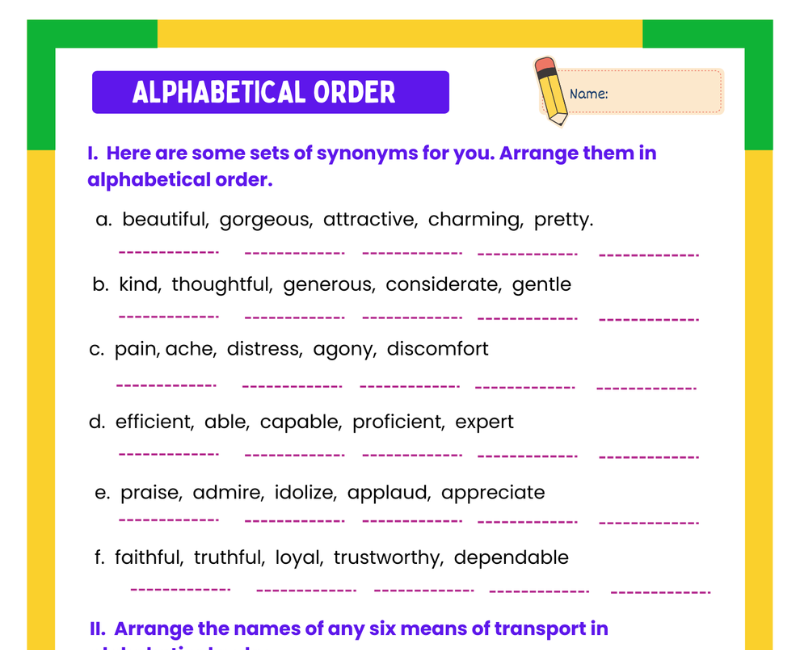
Practice sheet
Alphabetical Order Class 4 Activities
Fix dictionary pages, line up children by name, slide through the alphabet and make a class register in the Language Lab. Earn up to 3 stars in every activity.
What is alphabetical order?
The English alphabet has 26 letters, from A to Z, and they always come in the same order. When we arrange words according to this order of letters, we say the words are in alphabetical order or ABC order. It is one of the most useful skills in English because it helps us find information quickly and keep lists neat. Dictionaries, class registers, phone contact lists, library shelves and the index at the back of a book all use alphabetical order.
Rule 1: Look at the first letter
To put words in alphabetical order, start with the first letter of each word. The word whose first letter comes earliest in the alphabet goes first. For example, dog, ant, cat becomes ant, cat, dog, because A comes before C, and C comes before D. If you are not sure which letter comes first, say the alphabet aloud or look at an alphabet chart.
Rule 2: Same first letter? Look at the second letter
Many words begin with the same letter. Then the first letter cannot help us, so we look at the second letter. For example, bus, bat, bed all start with B. Their second letters are u, a and e, so the order is bat, bed, bus. This is exactly how teachers arrange names in a register: Aarav, Aditi, Akash and Amit all start with A, so the second letters (a, d, k, m) decide the order.
Rule 3: Keep going letter by letter
Sometimes the first two letters are also the same, as in tree, trip, truck. Then we move on to the third letter: e, i, u. If the third letters match too, we look at the fourth, and so on. We always compare the letters one by one from left to right and stop at the first letter that is different. That different letter decides which word comes first.
Rule 4: Shorter word first when one fits inside the other
What about car and card? The letters c-a-r are the same in both, but car runs out of letters first. When a word is the beginning of a longer word, the shorter word comes first. So the order is car, card, cart.
Capital letters and alphabetical order
Capital letters do not change alphabetical order. Apple and apple have the same place, and Mumbai comes after Delhi because M comes after D. Just look at the letters and ignore whether they are capital or small.
Using a dictionary
A dictionary lists thousands of words in alphabetical order. At the top of each page you will find two guide words: the first and the last word on that page. To find a word, first look at its first letter and open the dictionary to that section. Then check the guide words: if your word comes between them in ABC order, it is on that page. Finally, run your finger down the page using the next letters until you find your word and read its meaning.
Letters and their positions
Knowing the position of letters makes ordering faster. A is the 1st letter and Z is the 26th. M (13th) is right in the middle, so the first half of the alphabet is A to M and the second half is N to Z. The letters just before and after a letter are called its neighbours: the neighbours of K are J and L. Practising questions such as "What comes after R?" or "What comes between F and H?" builds speed.
Where we use alphabetical order every day
We use ABC order in many places: attendance registers, the contacts list on a phone, word lists in a spelling test, glossaries and indexes in textbooks, names on a results notice board and books arranged on library shelves. Once you master it, you can find any name, book or word in seconds.
This Alphabetical Order worksheet for Class 4 English Grammar turns these rules into fun practice on WitKnowLearn with an online quiz, online activities and interactive games. Flip the cards, fix the pages in the Dictionary Lab, play the games, do the word labs, take the challenges and then make a class register and use guide words in the Language Lab.
English Grammar Alphabetical Order Class 4
Alphabetical Order is an important Class 4 English Grammar topic. It explains the order of the 26 letters, how to arrange words by the first, second and third letters, what to do when one word is the beginning of another, how capital letters behave, and how alphabetical order helps us use a dictionary. This guide explains each idea in simple language for Class 4 students, parents and teachers. It goes with the Alphabetical Order worksheet for Class 4 on WitKnowLearn, which also gives an online quiz, online activities, interactive games and a Language Lab on the same page.
What is there in this topic
- The 26 letters and their order
- Letters before, after and between
- Ordering words by the first letter
- Ordering by the second and third letters
- Shorter words that fit inside longer words
- Dictionaries and guide words
- Uses of ABC order in daily life
Learning objectives
- Say and use the order of the 26 letters.
- Arrange words using the first, second and third letters.
- Use guide words to find words in a dictionary.
- Recognise where alphabetical order is used in daily life.
Learning outcomes
After this page a child can:
- Name the letter before, after or between given letters.
- Put any list of words in ABC order.
- Make a class register with names in order.
- Find a word quickly in a dictionary.
Alphabetical Order Class 4 resources on this page
| Resource | What it does |
|---|---|
| Alphabetical Order Class 4 online quiz | 20 questions in three levels with a full answer review |
| Flip cards | Six cards on the 26 letters, first and second letter rules, short and long words, dictionaries and daily uses |
| Dictionary Lab | Fill the gap on three dictionary pages using the first, second and third letters |
| 5 interactive games | Before or after M, letter bubbles, missing letter memory, library shelves, in order or not |
| 5 word labs | Line-up, alphabet slider, same first letter, find it in the dictionary and fix the list |
| 5 challenges | Marked out of 3 each with a total out of 15 |
| Language Lab | Two step-by-step activities on making a class register and using guide words, with aim, objectives, steps, check table, conclusion and outcomes |
| Practice sheet | 16 questions with answer boxes and a live score |
Rules at a glance
| Rule | Example |
|---|---|
| Look at the first letter | bird, fish, owl |
| Same first letter: look at the second | map, men, mud |
| Same first two letters: look at the third | stamp, step, stop |
| Shorter word first | for, fork |
| Capitals do not matter | apple, Bhopal, cup |
Types of questions
- Letter before, after or between
- Position of a letter
- Which word comes first or last
- Arrange words in order
- Is the list in order?
- Guide words
- Names in a register
Solved examples
Common mistakes
| Mistake | Correct |
|---|---|
| Looking only at the first letter when it is the same | Move on to the second and third letters. |
| Putting longer words first | Length does not matter, only the letters do. |
| Putting capital-letter words first | Capitals do not change the order. |
| Skipping a letter while saying the alphabet | Use an alphabet chart until you are sure. |
Daily life
Alphabetical order is everywhere: in the class register, the contacts on a phone, the index of a textbook and the shelves of a library. Children who know it well can find words, names and books in seconds.
Tips for parents and teachers
- Sing the alphabet song while pointing to each letter.
- Ask the child to arrange family members’ names in ABC order.
- Give a children’s dictionary and race to find words.
- Arrange the child’s books on a shelf in ABC order by title.
- Let the child retry the challenges to earn 3 stars.
Related Class 4 English Grammar Worksheets
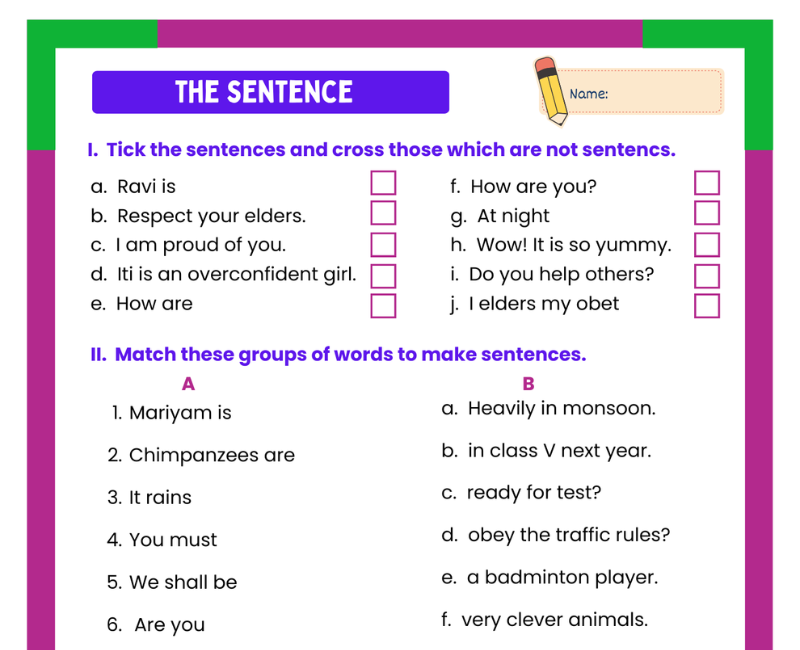
- The Sentence Worksheet Class 4
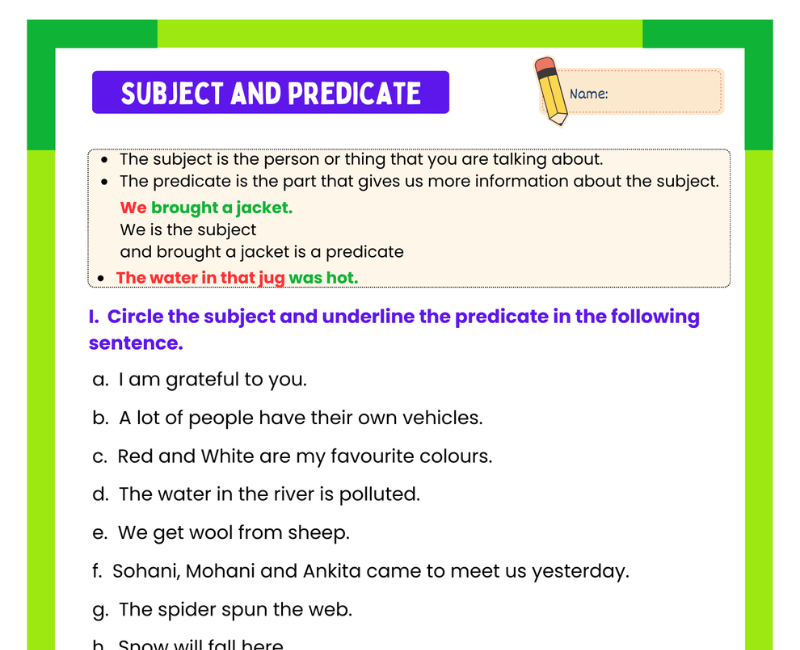
- Subject and Predicate Worksheet Class 4
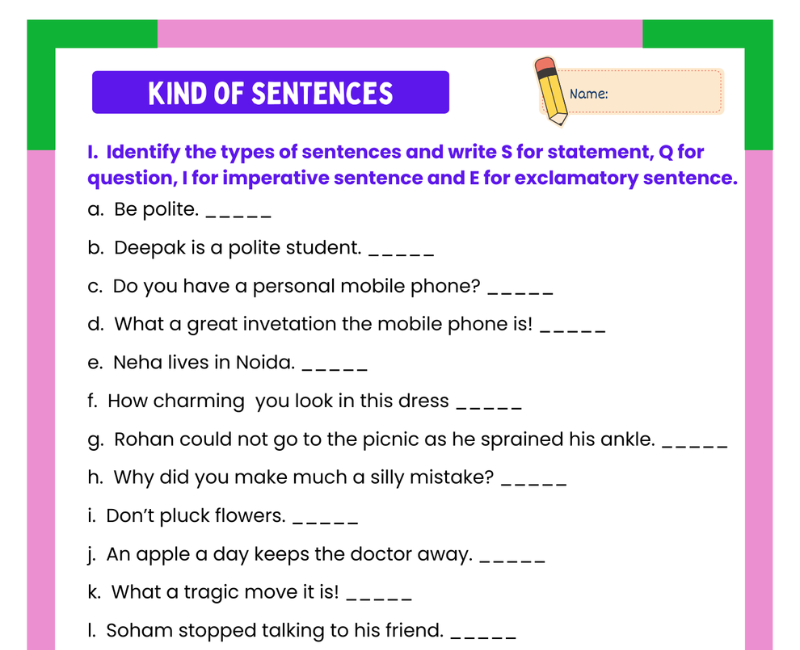
- Types of Sentences Worksheet Class 4
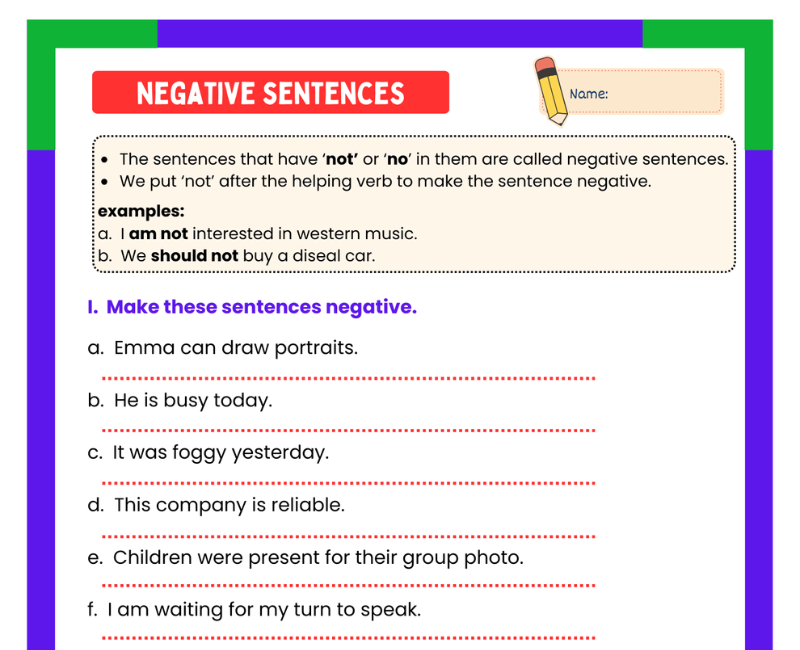
- Negative Sentences Worksheet Class 4
- Interrogative Sentences Worksheet Class 4
- Parts of Speech Worksheet Class 4
- Common Proper and Collective Nouns Worksheet Class 4
- Countable and Uncountable Nouns Worksheet Class 4
- Nouns Number Worksheet Class 4
- Nouns Gender Worksheet Class 4
- Verbs Worksheet Class 4
- Simple Present Tense Worksheet Class 4
Frequently Asked Questions
 Download