Class 4 English Grammar
Negative Sentences Class 4 English Grammar Worksheet with Quiz and Activities
How do we say no in English, and where does the word not go? Find out with this Negative Sentences worksheet for Class 4: take the Negative Sentences Class 4 online quiz, run the Negative Sentence Factory in the Language Lab and play the Negative Sentences Class 4 activities and interactive games online.
Flip the cards and try the Not-o-matic Machine Lab, then tap the Games, Word Labs, Challenges or Language Lab island.
Negative Sentences Class 4 Online Quiz
20 questions · tap an answer to move on · full review at the end
Flip the cards, try the Not-o-matic Machine Lab, then play the games, do the word labs and take the challenges. Earn up to 3 stars in every activity.
Fact cards: tap a card to flip it
Not-o-matic Machine Lab
The Not-o-matic machine turns yes sentences into no sentences. In each round, drag the negative you think is correct into the machine and watch what happens. A wrong choice shows what goes wrong, so you can try again.
Challenge marks: 0 / 15 (0 of 5 challenges done)
Finish all 5 challenges to see your comment.
Language Lab: do grammar activities step by step
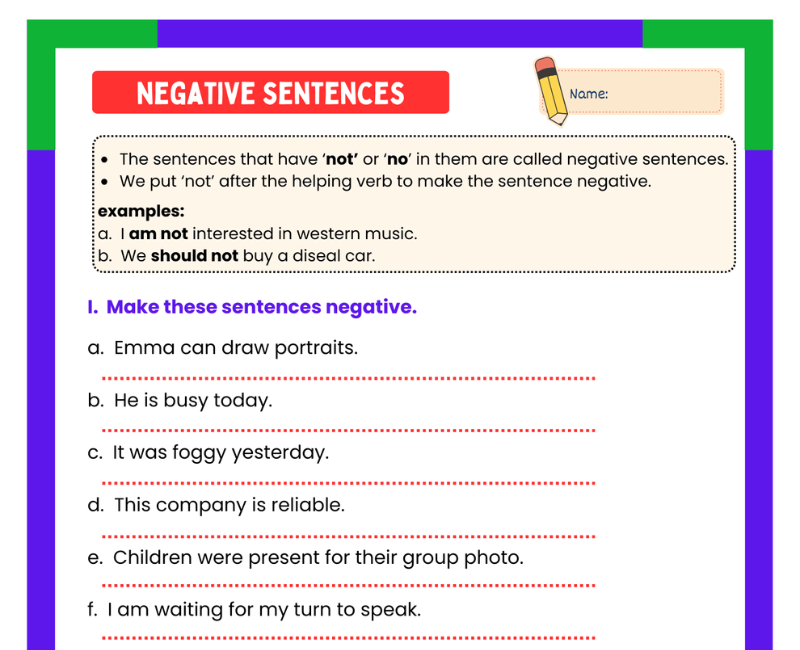
Practice sheet
Negative Sentences Class 4 Activities
Run the Not-o-matic machine, fix a double negative, detect no-words and build negative sentences in the Language Lab. Earn up to 3 stars in every activity.
Saying yes and saying no
Every day we tell people what is true and what is not true. "I am hungry." says yes. "I am not hungry." says no. A sentence that says something is true or happens is called an affirmative (or positive) sentence. A sentence that says something is not true or does not happen is called a negative sentence. Learning to change affirmative sentences into negative ones correctly is an important grammar skill for Class 4.
Rule 1: Put "not" after the helping verb
Many sentences have a helping verb such as am, is, are, was, were, can, will, shall, has, have or had. To make such a sentence negative, simply put not right after the helping verb. "The baby is sleeping." becomes "The baby is not sleeping." "We were tired." becomes "We were not tired." "Dad will cook dinner." becomes "Dad will not cook dinner." Remember that can and not are written together as one word: cannot.
Rule 2: No helping verb? Use do, does or did
Some sentences have only an action word, like "Birds sing." or "Mira reads comics." There is no helping verb to put not after. So we bring in a helper:
- Use do not with I, you, we, they and plural nouns: "They play football." → "They do not play football."
- Use does not with he, she, it and singular nouns: "Mira reads comics." → "Mira does not read comics."
- Use did not for the past with every subject: "We visited the zoo." → "We did not visit the zoo."
Notice something important: after do, does or did, the action word goes back to its base form. We say "does not read", never "does not reads", and "did not visit", never "did not visited".
Short forms (contractions)
In speech and friendly writing, we often join the helper and not into a short form, or contraction. An apostrophe (’) takes the place of the missing letter. For example: is not → isn’t, are not → aren’t, was not → wasn’t, do not → don’t, does not → doesn’t, did not → didn’t, cannot → can’t, have not → haven’t and will not → won’t. "Won’t" is a special one because the letters change.
Other negative words
"Not" is not the only word that makes a sentence negative. Words such as no, never, nobody, no one, nothing, nowhere and none also say no. "There is no milk." "I never eat chillies." "Nobody knocked." "Nothing happened." These are all negative sentences, even without the word not.
Avoid double negatives
In standard English we use only one negative word in a simple sentence. "I don’t have nothing." uses two negatives (don’t and nothing), which is incorrect. We should say either "I don’t have anything." or "I have nothing." In the same way, "He didn’t see nobody." should be "He didn’t see anybody."
Negative answers and questions
When someone asks a yes-or-no question, we can give a short negative answer using the same helper: "Are you cold?" "No, I am not." "Does he swim?" "No, he does not." Questions can also contain a negative, such as "Isn’t it a lovely day?" or "Don’t you like ice cream?"
Negatives in everyday life
Look around and you will find negative sentences everywhere. Road signs say "No Parking" and "Do not overtake". Notices in libraries say "Please do not talk loudly". Parents remind us, "Don’t forget your water bottle." When you write a story, negative sentences help you show what a character could not do or did not want, which makes the story more interesting and real.
This Negative Sentences worksheet for Class 4 English Grammar turns these rules into fun practice on WitKnowLearn with an online quiz, online activities and interactive games. Flip the cards, run the Not-o-matic Machine Lab, play the games, do the word labs, take the challenges and then use the Negative Sentence Factory and give short no answers in the Language Lab.
English Grammar Negative Sentences Class 4
Negative Sentences is an important Class 4 English Grammar topic. It explains affirmative and negative sentences, how to add "not" after a helping verb, when to use do not, does not and did not, short forms such as isn’t and don’t, other negative words, and why we avoid double negatives. This guide explains each idea in simple language for Class 4 students, parents and teachers. It goes with the Negative Sentences worksheet for Class 4 on WitKnowLearn, which also gives an online quiz, online activities, interactive games and a Language Lab on the same page.
What is there in this topic
- Affirmative and negative sentences
- Adding not after helping verbs
- Do not, does not and did not
- Base form of the verb after do, does, did
- Short forms (contractions)
- Negative words: no, never, nobody, nothing
- Avoiding double negatives
Learning objectives
- Tell affirmative sentences from negative sentences.
- Change affirmative sentences into negative sentences.
- Use do, does and did correctly with not.
- Write and read common short forms.
Learning outcomes
After this page a child can:
- Make any simple sentence negative.
- Choose do not, does not or did not.
- Fix double negatives.
- Give short negative answers to questions.
Negative Sentences Class 4 resources on this page
| Resource | What it does |
|---|---|
| Negative Sentences Class 4 online quiz | 20 questions in three levels with a full answer review |
| Flip cards | Six cards on saying no, saying yes, helper + not, do-helpers, short forms and no-words |
| Not-o-matic Machine Lab | Turn three yes sentences into correct negatives |
| 5 interactive games | Yes or no sentence, no-word bubbles, short form memory, do does or did, right or wrong negative |
| 5 word labs | Where does not go, yes to no slider, fix the double negative, negative maker steps and no-word detector |
| 5 challenges | Marked out of 3 each with a total out of 15 |
| Language Lab | Two step-by-step activities on a negative sentence factory and short no answers, with aim, objectives, steps, check table, conclusion and outcomes |
| Practice sheet | 16 questions with answer boxes and a live score |
Negative forms at a glance
| Affirmative | Negative |
|---|---|
| I am ready. | I am not ready. |
| The lights were on. | The lights were not on. |
| You eat rice. | You do not eat rice. |
| Raju drives a van. | Raju does not drive a van. |
| They painted the wall. | They did not paint the wall. |
Types of questions
- Affirmative or negative
- Change into negative
- Fill in do not, does not or did not
- Write the short form
- Write the full form
- Find the mistake
- Give a short negative answer
Solved examples
Common mistakes
| Mistake | Correct |
|---|---|
| She don’t like it. | She doesn’t like it. |
| He does not plays. | He does not play. |
| We did not went. | We did not go. |
| I can not swim. (two words) | I cannot swim. |
Daily life
We use negative sentences all the time: "I don’t want any more rice.", "Don’t forget your bag.", "There is no school tomorrow." Signs such as "No Entry" and "Do not touch" are also negatives. Using them correctly helps children speak and write clearly.
Tips for parents and teachers
- Play "opposite day": the child changes your sentences into negatives.
- Spot negative signs on a walk.
- Write a list of things the child does not like, using doesn’t and don’t correctly.
- Make short form flash cards.
- Let the child retry the challenges to earn 3 stars.
Related Class 4 English Grammar Worksheets
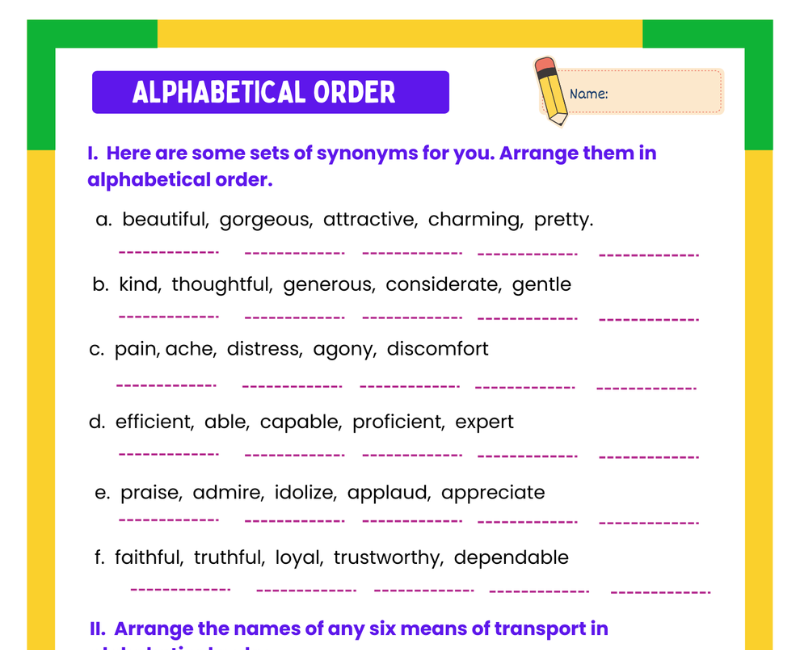
- Alphabetical Order Worksheet Class 4
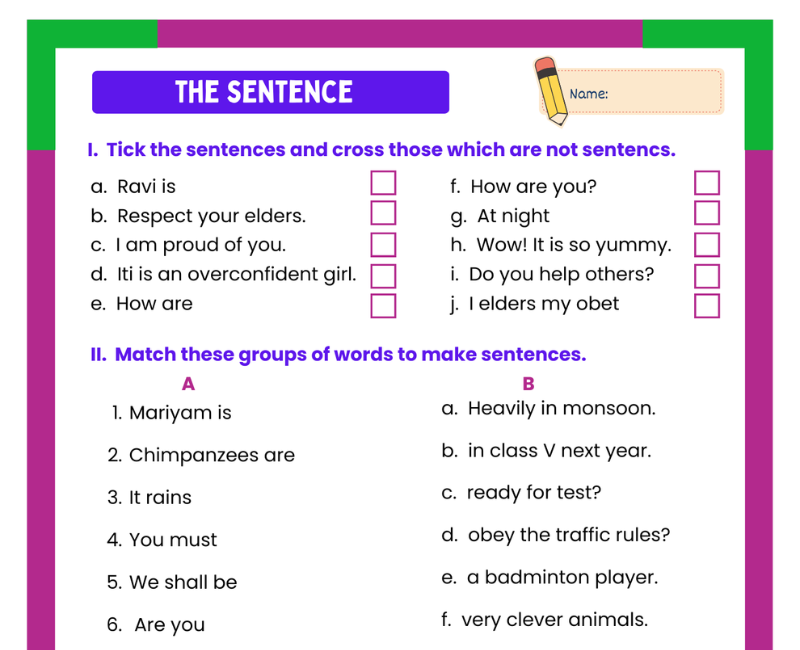
- The Sentence Worksheet Class 4
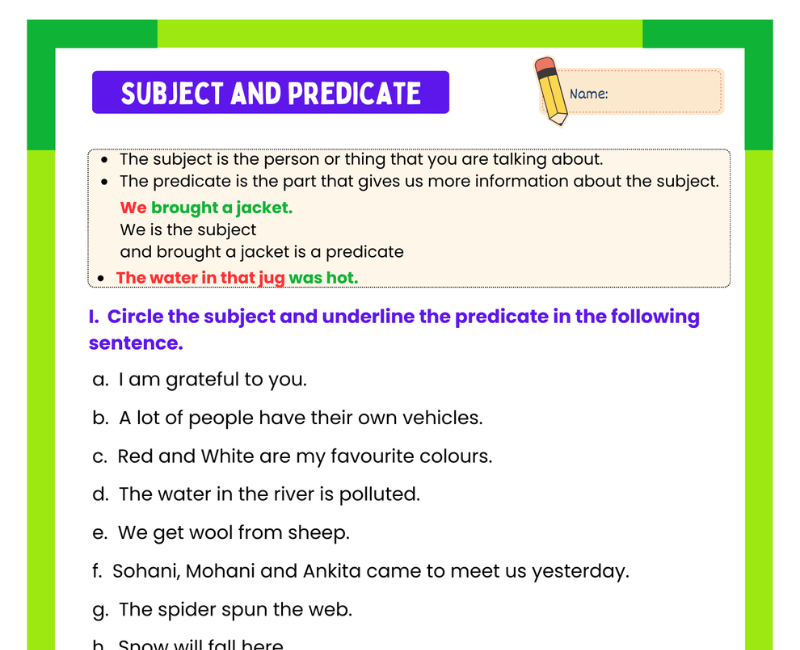
- Subject and Predicate Worksheet Class 4
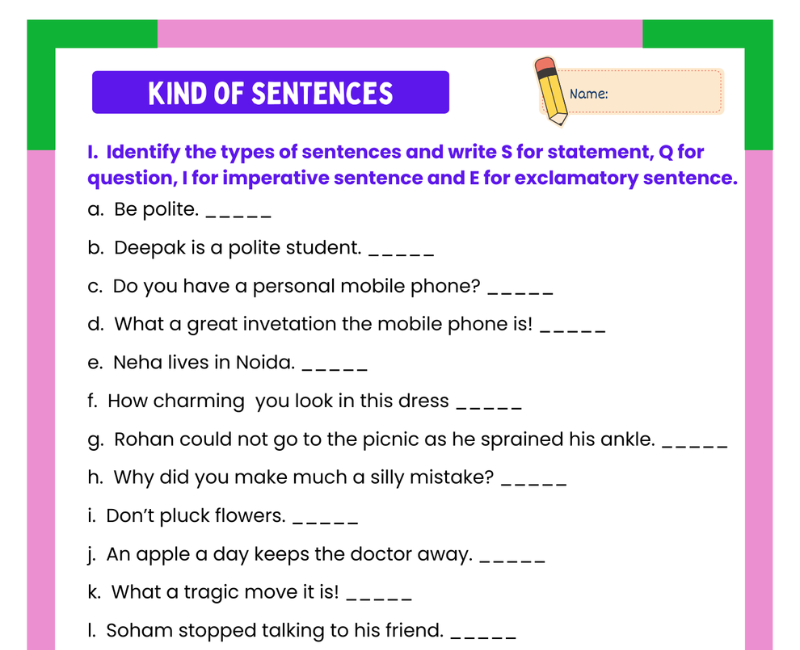
- Types of Sentences Worksheet Class 4
- Interrogative Sentences Worksheet Class 4
- Parts of Speech Worksheet Class 4
- Common Proper and Collective Nouns Worksheet Class 4
- Countable and Uncountable Nouns Worksheet Class 4
- Nouns Number Worksheet Class 4
- Nouns Gender Worksheet Class 4
- Verbs Worksheet Class 4
- Simple Present Tense Worksheet Class 4
Frequently Asked Questions
 Download