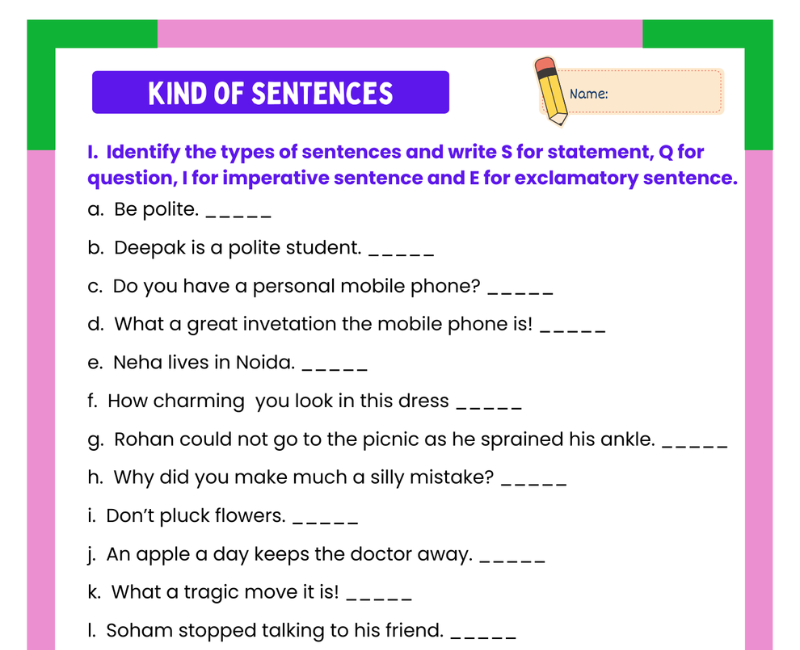
Class 4 English Grammar
Types of Sentences Class 4 English Grammar Worksheet with Quiz and Activities
Do you want to tell, ask, order or show a feeling? Find out how with this Types of Sentences worksheet for Class 4: take the Types of Sentences Class 4 online quiz, turn one idea into four sentences in the Language Lab and play the Types of Sentences Class 4 activities and interactive games online.
Flip the cards and try the Sentence Situations Lab, then tap the Games, Word Labs, Challenges or Language Lab island.
Types of Sentences Class 4 Online Quiz
20 questions · tap an answer to move on · full review at the end
Flip the cards, try the Sentence Situations Lab, then play the games, do the word labs and take the challenges. Earn up to 3 stars in every activity.
Fact cards: tap a card to flip it
Sentence Situations Lab
Asha is in three different situations. In each one, drag the sentence you think she should say into her speech bubble and watch what happens. A wrong choice shows what goes wrong, so you can try again.
Challenge marks: 0 / 15 (0 of 5 challenges done)
Finish all 5 challenges to see your comment.
Language Lab: do grammar activities step by step
Practice sheet
Types of Sentences Class 4 Activities
Help Asha pick the right sentence, command a robot, test sentences with the type detector and turn one idea into four sentences in the Language Lab. Earn up to 3 stars in every activity.
Why are there different types of sentences?
Think about all the things you do with words in a single day. You tell your friend about a film, you ask your teacher a question, your mother tells you to finish your milk, and you shout with joy when your team wins. Each of these needs a different kind of sentence. In English we group sentences into four types according to what they do: declarative, interrogative, imperative and exclamatory.
1. Declarative (assertive) sentences: telling
A declarative sentence tells or states something. It may give a fact, an opinion or a piece of news. It always ends with a full stop (.). Examples: "Kolkata is a big city." "I enjoy reading comics." "The train will arrive at six." Declarative sentences are also called assertive sentences. Most of the sentences in your textbooks and storybooks are of this type. A declarative sentence can also say what is not true: "It did not rain yesterday."
2. Interrogative sentences: asking
An interrogative sentence asks a question and ends with a question mark (?). Many questions begin with a question word such as who, what, where, when, why, which or how: "Where do penguins live?" Others begin with a helping word such as is, are, do, does, can, will or have: "Do you like dancing?" We often make a question by moving the helping word to the front of a telling sentence: "The bus has left." becomes "Has the bus left?"
3. Imperative sentences: ordering and requesting
An imperative sentence gives an order, a command, an instruction, a piece of advice or a request. It usually begins with an action word, and its subject, you, is hidden: "Stand in a line." "Mix the flour and water." We use words like please and kindly to make polite requests: "Please lend me your eraser." Imperative sentences can also tell someone not to do something: "Don’t feed the animals." They usually end with a full stop, but a strong or urgent command can end with an exclamation mark: "Watch out!"
4. Exclamatory sentences: showing feeling
An exclamatory sentence shows a strong feeling such as joy, surprise, anger, sadness, fear or wonder. It ends with an exclamation mark (!). Exclamatory sentences often begin with What or How: "What a delicious pizza!" "How cold the water is!" They may also begin with an exclamation word (an interjection) such as Hurray, Wow, Oh, Ouch or Alas: "Hurray, we are going to the zoo!" Remember, even though an exclamation may begin with What, it is not a question, because it does not ask anything.
Clues to spot the type
To find the type of a sentence, ask yourself what the speaker wants to do. Is the speaker telling something, asking something, telling someone to do something or showing a feeling? Then check the clues: the end mark (. ? !), the first word (a question word, a helping word, an action word, or What and How) and the tone when you read it aloud.
Using all four types in writing
Good writers mix the four types to make their writing lively. A story might begin with a question to catch the reader’s attention, use telling sentences to describe what happened, include commands in the characters’ conversations and add an exclamation at an exciting moment. Try it yourself: write a short paragraph about your last birthday using at least one sentence of each type.
This Types of Sentences worksheet for Class 4 English Grammar turns these ideas into fun practice on WitKnowLearn with an online quiz, online activities and interactive games. Flip the cards, help Asha in the Sentence Situations Lab, play the games, do the word labs, take the challenges and then sort a conversation and change one idea into four sentences in the Language Lab.
English Grammar Types of Sentences Class 4
Types of Sentences is an important Class 4 English Grammar topic. It explains the four kinds of sentences (declarative, interrogative, imperative and exclamatory), their end marks, the words they usually begin with, and how to change a sentence from one type to another. This guide explains each idea in simple language for Class 4 students, parents and teachers. It goes with the Types of Sentences worksheet for Class 4 on WitKnowLearn, which also gives an online quiz, online activities, interactive games and a Language Lab on the same page.
What is there in this topic
- Declarative (assertive) sentences
- Interrogative sentences and question words
- Imperative sentences: commands, instructions and requests
- Exclamatory sentences and exclamation words
- End marks for each type
- Changing sentences from one type to another
- Using all four types in writing
Learning objectives
- Name and explain the four types of sentences.
- Identify the type of any given sentence.
- Use the correct end mark for each type.
- Change a sentence from one type to another.
Learning outcomes
After this page a child can:
- Sort sentences into the four types.
- Write questions using question words and helping words.
- Give clear instructions and polite requests.
- Express feelings with exclamatory sentences.
Types of Sentences Class 4 resources on this page
| Resource | What it does |
|---|---|
| Types of Sentences Class 4 online quiz | 20 questions in three levels with a full answer review |
| Flip cards | Six cards on telling, asking, commanding, exclaiming, end marks and starting words |
| Sentence Situations Lab | Help Asha choose the right type of sentence in three real situations |
| 5 interactive games | Telling or asking, command bubbles, sentence types memory, three sentence boxes, telling or exclaiming |
| 5 word labs | Make a question, feeling meter, robot commands, question words and type detector |
| 5 challenges | Marked out of 3 each with a total out of 15 |
| Language Lab | Two step-by-step activities on sorting a classroom conversation and turning one idea into four sentences, with aim, objectives, steps, check table, conclusion and outcomes |
| Practice sheet | 16 questions with answer boxes and a live score |
The four types at a glance
| Type | Job | End mark | Example |
|---|---|---|---|
| Declarative | Tells | . | The monsoon brings rain. |
| Interrogative | Asks | ? | Which book is yours? |
| Imperative | Orders or requests | . or ! | Please switch off the fan. |
| Exclamatory | Shows feeling | ! | What a funny clown! |
Types of questions
- Name the type of sentence
- Add the correct end mark
- Fill in the question word
- Change a telling sentence into a question
- Make a command or request
- Write an exclamation with What or How
- Count sentence types in a passage
Solved examples
Common mistakes
| Mistake | Correct |
|---|---|
| Calling every What sentence a question | "What a view!" is exclamatory. |
| Ending questions with a full stop | Questions end with ? |
| Thinking commands have no subject | The hidden subject is "you". |
| Using ! in every sentence | Use it only for strong feeling or urgent commands. |
Daily life
We use all four types every day: telling news at dinner, asking for directions, following instructions in recipes and games, and cheering at matches. Knowing the types helps children read with the right expression and write lively stories.
Tips for parents and teachers
- Play "change it" by turning one sentence into all four types.
- Read comic strips aloud and name the sentence types.
- Write a recipe together using only imperative sentences.
- Ask the child to interview a family member with five questions.
- Let the child retry the challenges to earn 3 stars.
Related Class 4 English Grammar Worksheets
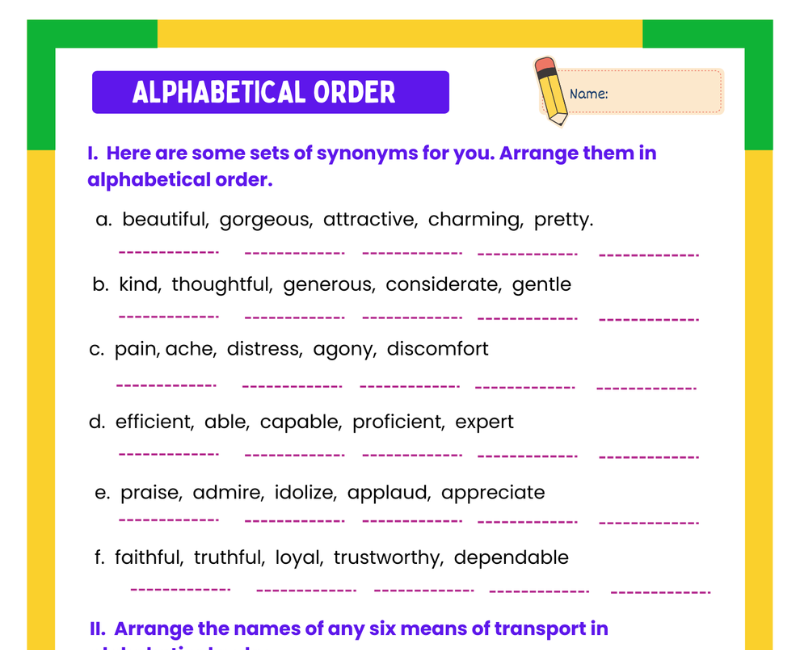
- Alphabetical Order Worksheet Class 4
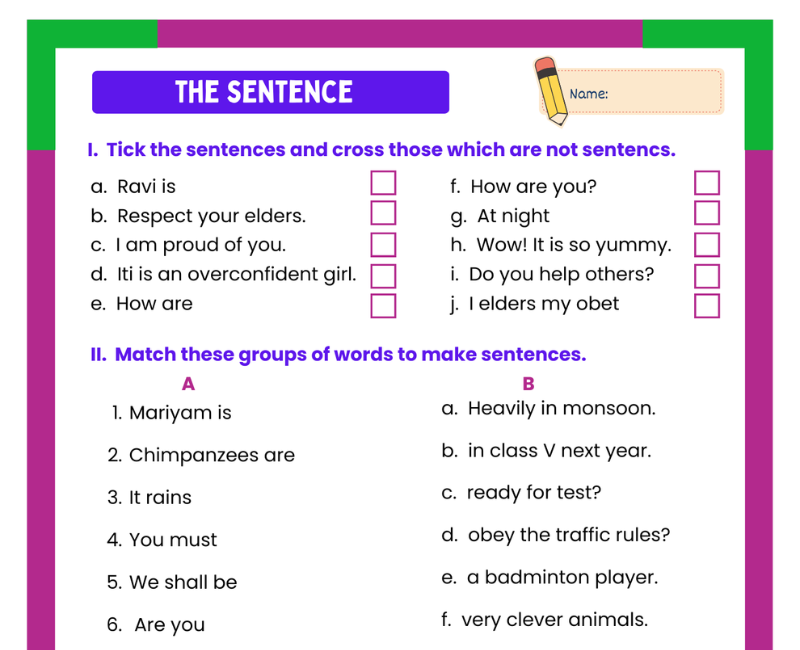
- The Sentence Worksheet Class 4
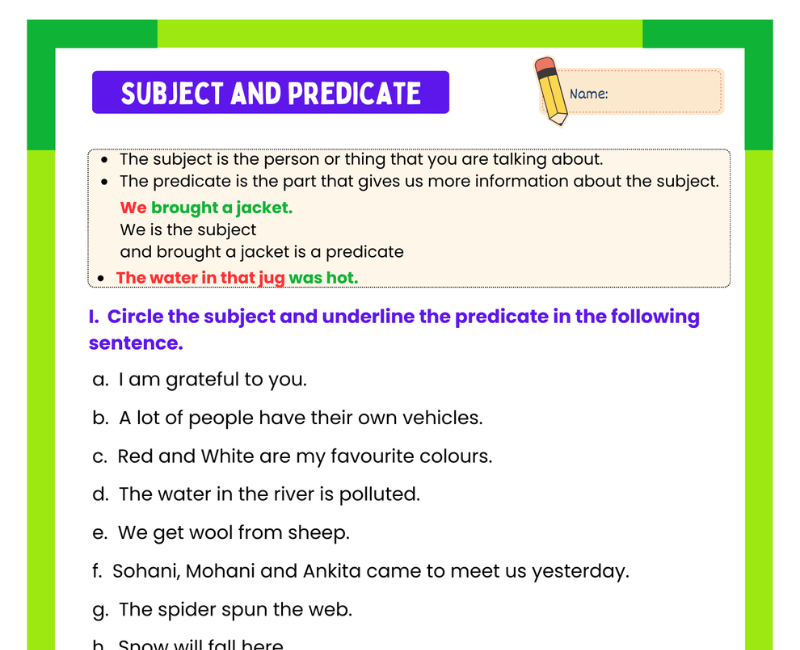
- Subject and Predicate Worksheet Class 4
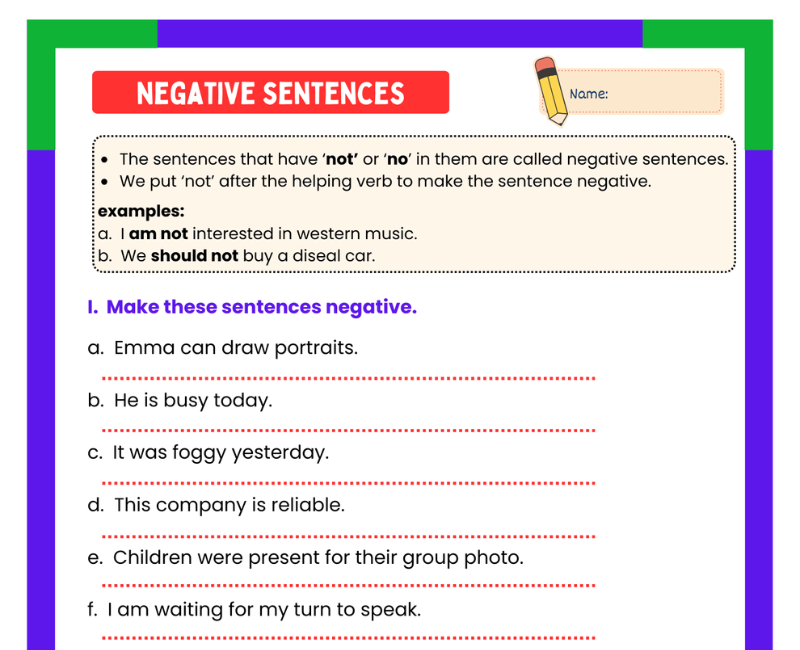
- Negative Sentences Worksheet Class 4
- Interrogative Sentences Worksheet Class 4
- Parts of Speech Worksheet Class 4
- Common Proper and Collective Nouns Worksheet Class 4
- Countable and Uncountable Nouns Worksheet Class 4
- Nouns Number Worksheet Class 4
- Nouns Gender Worksheet Class 4
- Verbs Worksheet Class 4
- Simple Present Tense Worksheet Class 4
Frequently Asked Questions
 Download