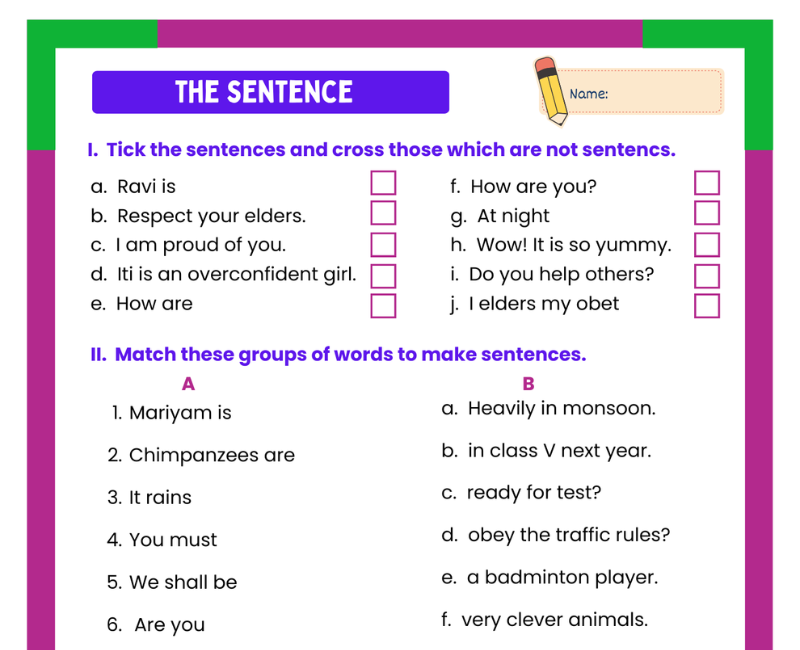
Class 4 English Grammar
The Sentence Class 4 English Grammar Worksheet with Quiz and Activities
What turns a group of words into a sentence, and why do capital letters and full stops matter? Find out with this Sentence worksheet for Class 4: take The Sentence Class 4 online quiz, build sentences in the Language Lab and play The Sentence Class 4 activities and interactive games online.
Flip the cards and try the Sentence Builder Lab, then tap the Games, Word Labs, Challenges or Language Lab island.
The Sentence Class 4 Online Quiz
20 questions · tap an answer to move on · full review at the end
Flip the cards, try the Sentence Builder Lab, then play the games, do the word labs and take the challenges. Earn up to 3 stars in every activity.
Fact cards: tap a card to flip it
Sentence Builder Lab
Three sentence strips each have a gap. In each one, drag the card you think is right onto the strip and watch what happens. A wrong choice shows what goes wrong, so you can try again.
Challenge marks: 0 / 15 (0 of 5 challenges done)
Finish all 5 challenges to see your comment.
Language Lab: do grammar activities step by step
Practice sheet
The Sentence Class 4 Activities
Fix sentence strips, grow a sentence, add missing capitals and turn phrases into sentences in the Language Lab. Earn up to 3 stars in every activity.
What is a sentence?
When we talk or write, we share our ideas in sentences. A sentence is a group of words that makes complete sense. "The boy is flying a kite." is a sentence because it tells us who (the boy) and what he is doing (flying a kite). But "flying a kite" alone is not a sentence, because we do not know who is flying it. Learning to write clear, complete sentences is the first big step in good writing.
The two parts of a sentence
Every complete sentence answers two questions: Who or what is it about? and What happens, or what is said about it? In "Parrots can talk.", the sentence is about parrots, and it tells us they can talk. If either part is missing, the words do not make complete sense. You will learn more about these two parts, called the subject and the predicate, in the next worksheet.
Sentence or phrase?
A group of words that does not make complete sense is called a phrase. Phrases such as "a glass of water", "near the gate" or "after the rain" give us some information, but they leave us waiting for more. We can turn a phrase into a sentence by adding the missing part: "Please give me a glass of water." or "The dog sat near the gate." Remember, a sentence can be short or long. "Fish swim." has only two words, but it is still complete.
Rule 1: Begin with a capital letter
The first word of every sentence begins with a capital letter. This tells the reader that a new idea is starting. Names of people, places, days, months and festivals also begin with capital letters wherever they appear, for example "Our school trip to Mysore is on Friday." The word I is always written as a capital letter.
Rule 2: End with the right mark
Every sentence must end with a punctuation mark. A sentence that tells something ends with a full stop (.): "The shop opens at nine." A sentence that asks something ends with a question mark (?): "Have you finished your homework?" A sentence that shows a strong feeling such as joy, surprise or pain ends with an exclamation mark (!): "Wow, what a beautiful painting!" You will explore these kinds of sentences in detail later.
Rule 3: Put the words in the right order
The same words can make sense or nonsense depending on their order. "The teacher reads a poem." makes sense, but "Poem a reads teacher the." does not. In most English sentences, we first say who or what the sentence is about, then what happens. When you are given jumbled words, look for the naming word first, then the action word, and then the rest.
Making sentences interesting
Short sentences are correct, but adding describing words can make them more interesting. "Cats sleep." can grow into "Fluffy cats sleep on soft cushions." Each version is still a complete sentence. Good writers also check that each sentence says just one clear idea and that sentences follow one another in a sensible order to make a paragraph or a story.
Checking your sentences
Before you finish writing, read each sentence aloud and ask: Does it make complete sense? Does it start with a capital letter? Does it end with the right mark? Are names written with capitals? Are the words in the right order? This simple checklist helps you catch most mistakes.
This Sentence worksheet for Class 4 English Grammar brings these rules to life on WitKnowLearn with an online quiz, online activities and interactive games. Flip the cards, fix the strips in the Sentence Builder Lab, play the games, do the word labs, take the challenges and then build sentences from jumbled words and phrases in the Language Lab.
English Grammar The Sentence Class 4
The Sentence is an important Class 4 English Grammar topic. It explains what a sentence is, the two parts of a sentence, the difference between a sentence and a phrase, capital letters, end marks and word order. This guide explains each idea in simple language for Class 4 students, parents and teachers. It goes with The Sentence worksheet for Class 4 on WitKnowLearn, which also gives an online quiz, online activities, interactive games and a Language Lab on the same page.
What is there in this topic
- Meaning of a sentence
- Who or what, and what happens
- Sentence or phrase
- Capital letters at the start and for names
- Full stop, question mark and exclamation mark
- Word order and jumbled sentences
- Making sentences longer and more interesting
Learning objectives
- Explain what makes a group of words a sentence.
- Tell a sentence from a phrase.
- Use capital letters and end marks correctly.
- Arrange jumbled words into a sentence.
Learning outcomes
After this page a child can:
- Write complete sentences with a capital letter and an end mark.
- Turn a phrase into a sentence.
- Correct mistakes in given sentences.
- Put sentences in order to tell a short story.
The Sentence Class 4 resources on this page
| Resource | What it does |
|---|---|
| The Sentence Class 4 online quiz | 20 questions in three levels with a full answer review |
| Flip cards | Six cards on sentences, capitals, end marks, word order, phrases and the two parts |
| Sentence Builder Lab | Complete three sentence strips using sense, a capital and an end mark |
| 5 interactive games | Sentence or not, capital letter bubbles, sentence halves memory, which end mark, correct or not |
| 5 word labs | Word order, grow a sentence, capital letters, write a good sentence and sense detector |
| 5 challenges | Marked out of 3 each with a total out of 15 |
| Language Lab | Two step-by-step activities on building a sentence from jumbled words and turning phrases into sentences, with aim, objectives, steps, check table, conclusion and outcomes |
| Practice sheet | 16 questions with answer boxes and a live score |
Sentence checklist
| Check | Example |
|---|---|
| Makes complete sense | The baby laughed. |
| Starts with a capital letter | Our class went on a trip. |
| Names have capitals | We met Anil in Shimla. |
| Ends with the right mark | Where are my shoes? |
| Words in the right order | The cook made soup. |
Types of questions
- Sentence or phrase
- Rearrange jumbled words
- Add a capital letter
- Choose the end mark
- Complete the sentence
- Find the mistake
- Order sentences into a story
Solved examples
Common mistakes
| Mistake | Correct |
|---|---|
| Starting with a small letter | Always start with a capital. |
| Forgetting the end mark | Finish with . ? or ! |
| Writing a phrase as a sentence | Add who or what happens. |
| Writing names in small letters | Names of people and places take capitals. |
Daily life
We use sentences all day: in messages to friends, answers in class, notices on the board and stories we read. Clear sentences help people understand exactly what we mean.
Tips for parents and teachers
- Cut a sentence into word cards and let the child rebuild it.
- Play "finish my sentence" with phrases at the dinner table.
- Ask the child to proofread a short note for capitals and end marks.
- Write a three-sentence story together about the day.
- Let the child retry the challenges to earn 3 stars.
Related Class 4 English Grammar Worksheets
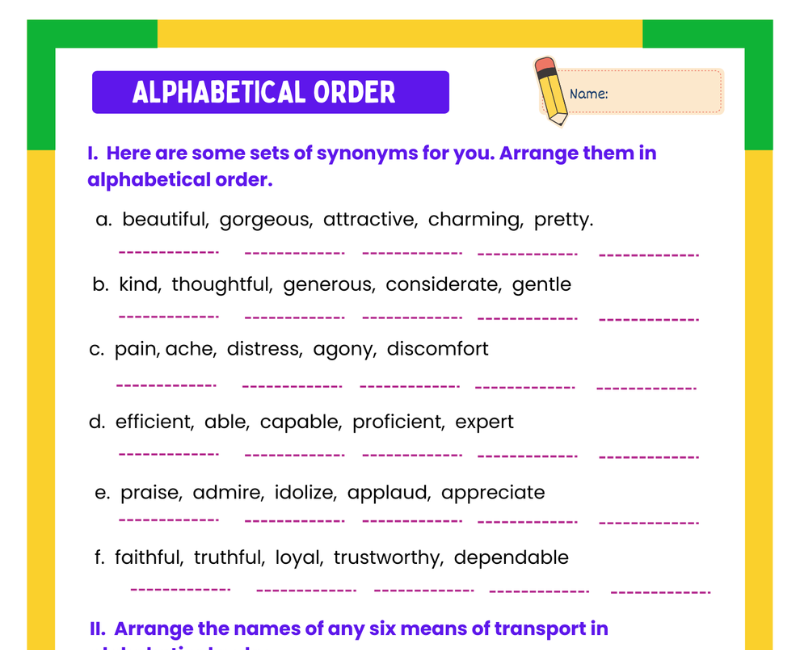
- Alphabetical Order Worksheet Class 4
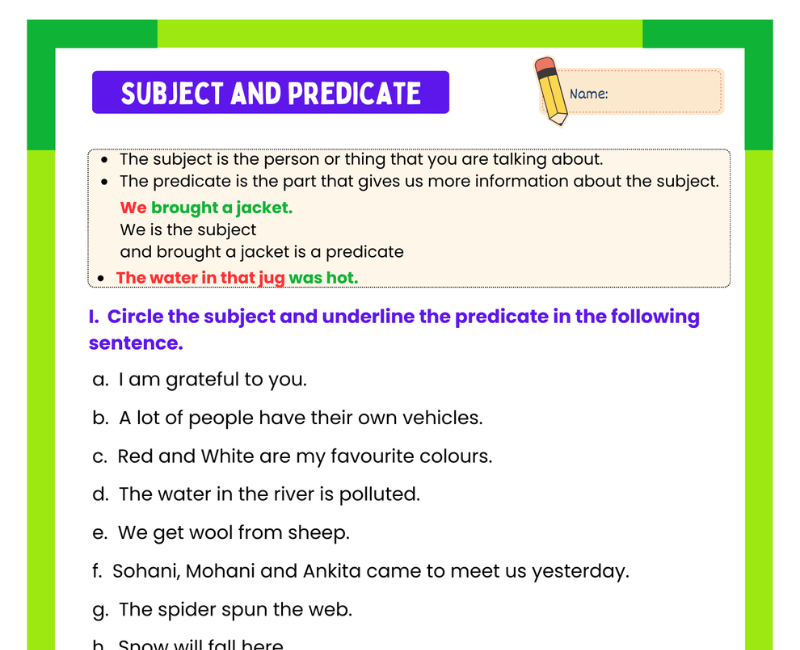
- Subject and Predicate Worksheet Class 4
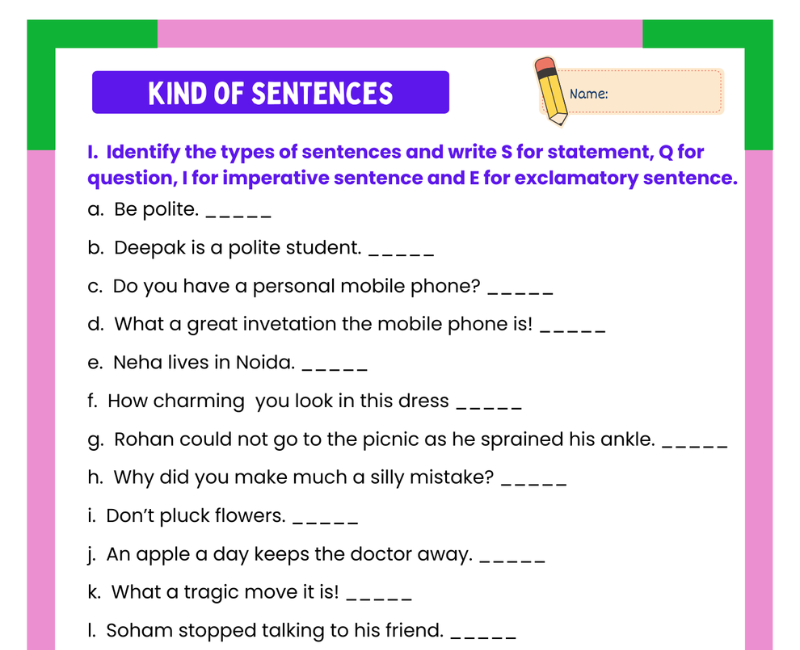
- Types of Sentences Worksheet Class 4
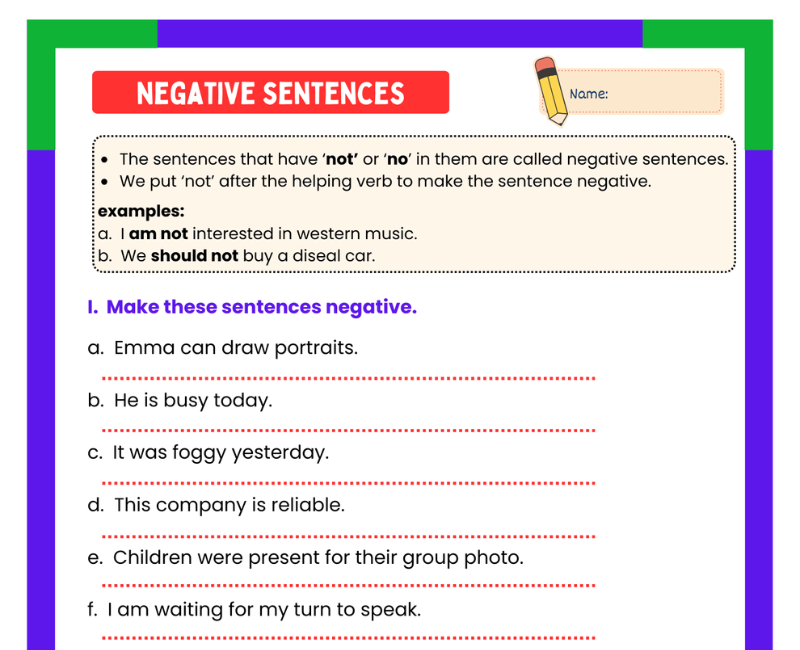
- Negative Sentences Worksheet Class 4
- Interrogative Sentences Worksheet Class 4
- Parts of Speech Worksheet Class 4
- Common Proper and Collective Nouns Worksheet Class 4
- Countable and Uncountable Nouns Worksheet Class 4
- Nouns Number Worksheet Class 4
- Nouns Gender Worksheet Class 4
- Verbs Worksheet Class 4
- Simple Present Tense Worksheet Class 4
Frequently Asked Questions
 Download