Class 4 English Grammar
Subject and Predicate Class 4 English Grammar Worksheet with Quiz and Activities
Who is the sentence about, and what does it say about them? Find out with this Subject and Predicate worksheet for Class 4: take the Subject and Predicate Class 4 online quiz, colour-code sentences in the Language Lab and play the Subject and Predicate Class 4 activities and interactive games online.
Flip the cards and try the Sentence Splitter Lab, then tap the Games, Word Labs, Challenges or Language Lab island.
Subject and Predicate Class 4 Online Quiz
20 questions · tap an answer to move on · full review at the end
Flip the cards, try the Sentence Splitter Lab, then play the games, do the word labs and take the challenges. Earn up to 3 stars in every activity.
Fact cards: tap a card to flip it
Sentence Splitter Lab
Three sentences need to be cut into subject and predicate. In each one, drag the cut you think is right onto the splitter and watch what happens. A wrong choice shows what goes wrong, so you can try again.
Challenge marks: 0 / 15 (0 of 5 challenges done)
Finish all 5 challenges to see your comment.
Language Lab: do grammar activities step by step
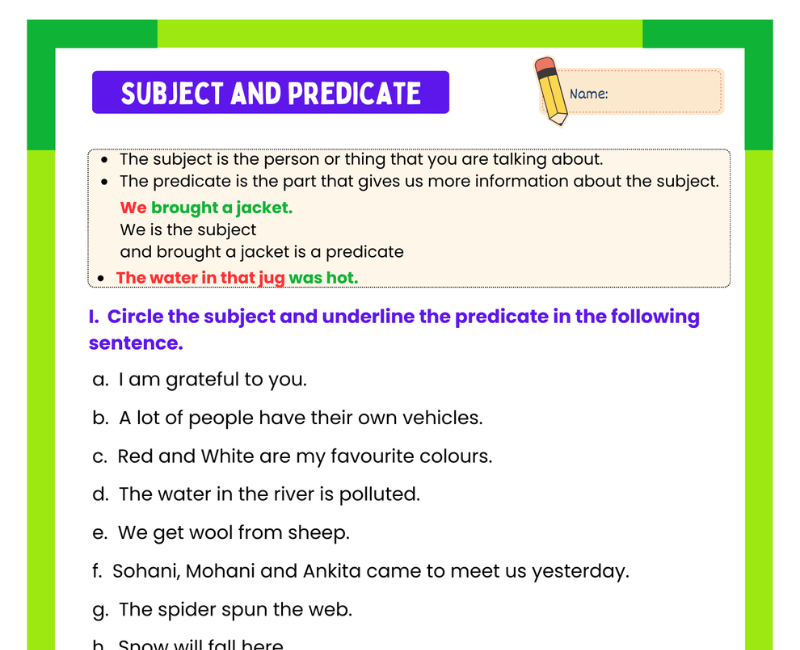
Practice sheet
Subject and Predicate Class 4 Activities
Split sentences with the Sentence Splitter, grow a subject, colour-code sentences and find hidden subjects in the Language Lab. Earn up to 3 stars in every activity.
Two parts of every sentence
You already know that a sentence is a group of words that makes complete sense. But have you noticed that every sentence can be split into two parts? One part tells us who or what the sentence is about. The other part tells us something about that person, animal or thing. These two parts are called the subject and the predicate. Knowing them helps you understand sentences better and write your own sentences correctly.
What is the subject?
The subject is the naming part of a sentence. It answers the question "Who?" or "What?". In the sentence "The farmer ploughs the field.", ask: who ploughs the field? The answer, the farmer, is the subject. A subject can be a person (my uncle), an animal (the horse), a place (Delhi), a thing (the old car) or even an idea. It can be a single word, such as Elephants, or a group of words, such as The elephants in the circus. Pronouns like I, you, he, she, it, we and they can also be subjects: "They are playing outside."
What is the predicate?
The predicate is the telling part of a sentence. It tells us what the subject does or what the subject is. In "The farmer ploughs the field.", the predicate is ploughs the field. Every predicate contains a verb. The verb may be a doing word such as runs, wrote or will play, or a being word such as is, am, are, was and were. For example, in "The soup is hot.", the predicate is is hot. A predicate can be just one word, as in "The baby slept.", or many words, as in "The baby slept peacefully in her cot."
How to find the subject and predicate
Here is an easy method. First, read the sentence and find the verb. Next, ask "Who?" or "What?" before the verb. The answer is the subject. Everything else that tells about the subject is the predicate. Try it with "My brother's friend plays the guitar." The verb is plays. Who plays? My brother's friend, which is the subject. The predicate is plays the guitar. Some teachers like to draw a single line under the subject and a double line under the predicate, or to colour them in two different colours.
Compound subjects and predicates
Sometimes two or more naming words share the same predicate. "Rani and her brother went to the fair." Here Rani and her brother is a compound subject. In the same way, a subject can do more than one action: "The children laughed and clapped." Here laughed and clapped is a compound predicate. The word and joins the parts together.
When the subject is not at the start
In most sentences the subject comes first, but not always. In questions, the subject often comes after a helping verb: "Is your mother at home?" In sentences beginning with Here or There, the subject comes after the verb: "Here comes the postman." Sometimes a writer puts a describing phrase first: "Across the road ran a little squirrel." In commands such as "Close the gate.", the subject you is hidden. It is understood, even though it is not written.
Why subject and predicate matter
When you know the two parts, you can check that your own sentences are complete. If a group of words has only a subject ("The tall girl in the blue dress") or only a predicate ("jumped over the puddle"), it is not a sentence yet. You can also make your writing more interesting by adding describing words to the subject or extra details to the predicate.
This Subject and Predicate worksheet for Class 4 English Grammar makes these ideas easy and fun on WitKnowLearn with an online quiz, online activities and interactive games. Flip the cards, split sentences in the Sentence Splitter Lab, play the games, do the word labs, take the challenges and then colour-code sentences and find hidden subjects in the Language Lab.
English Grammar Subject and Predicate Class 4
Subject and Predicate is an important Class 4 English Grammar topic. It explains the two parts of a sentence, how to find the subject and the predicate, compound subjects and predicates, pronouns as subjects, and sentences where the subject is not at the start. This guide explains each idea in simple language for Class 4 students, parents and teachers. It goes with the Subject and Predicate worksheet for Class 4 on WitKnowLearn, which also gives an online quiz, online activities, interactive games and a Language Lab on the same page.
What is there in this topic
- Meaning of subject and predicate
- Finding the verb in the predicate
- One-word and many-word subjects
- Pronouns as subjects
- Compound subjects and predicates
- Subjects in questions and commands
- Completing sentences with a subject or predicate
Learning objectives
- Identify the subject and predicate of a sentence.
- Use the who-or-what question to find the subject.
- Recognise compound subjects and predicates.
- Complete sentences by adding a suitable subject or predicate.
Learning outcomes
After this page a child can:
- Split any simple sentence into subject and predicate.
- Replace a subject with a pronoun.
- Find the hidden subject in a command.
- Build sentences from subject and predicate parts.
Subject and Predicate Class 4 resources on this page
| Resource | What it does |
|---|---|
| Subject and Predicate Class 4 online quiz | 20 questions in three levels with a full answer review |
| Flip cards | Six cards on the subject, the predicate, the who-or-what question, the verb clue, long subjects and compound subjects |
| Sentence Splitter Lab | Cut three sentences into subject and predicate, including a long and a compound subject |
| 5 interactive games | Subject or predicate, subject bubbles, pronoun subject memory, who is the subject, underlined part |
| 5 word labs | Add the subject, growing subject, highlighter, split any sentence and part detector |
| 5 challenges | Marked out of 3 each with a total out of 15 |
| Language Lab | Two step-by-step activities on colour-coding sentences and finding the hidden subject, with aim, objectives, steps, check table, conclusion and outcomes |
| Practice sheet | 16 questions with answer boxes and a live score |
Examples at a glance
| Sentence | Subject | Predicate |
|---|---|---|
| Owls hoot. | Owls | hoot |
| The new teacher is friendly. | The new teacher | is friendly |
| Ali and Zara built a sandcastle. | Ali and Zara | built a sandcastle |
| The goat jumped and ran away. | The goat | jumped and ran away |
| Sit quietly. | (You) | sit quietly |
Types of questions
- Underline the subject
- Underline the predicate
- Match subjects with predicates
- Add a subject or predicate
- Replace the subject with a pronoun
- Find compound subjects
- Find subjects in questions and commands
Solved examples
Common mistakes
| Mistake | Correct |
|---|---|
| Taking only one word of a long subject | Take the whole naming group. |
| Thinking the subject is always first | In questions and here or there sentences it can come later. |
| Putting the verb in the subject | The verb belongs to the predicate. |
| Thinking commands have no subject | The hidden subject is "you". |
Daily life
Every message we send and every story we read is made of subjects and predicates. Knowing the two parts helps children write complete sentences in tests, letters and stories.
Tips for parents and teachers
- Use two colours to underline subjects and predicates in a storybook.
- Play "you give the subject, I give the predicate" aloud.
- Ask the child to grow a short sentence by adding describing words.
- Turn commands into full sentences by adding "You".
- Let the child retry the challenges to earn 3 stars.
Related Class 4 English Grammar Worksheets
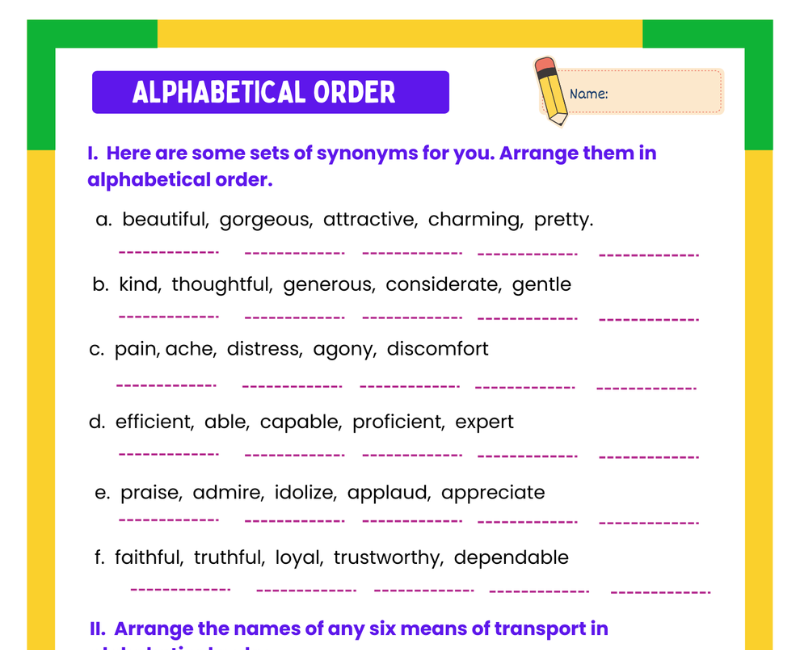
- Alphabetical Order Worksheet Class 4
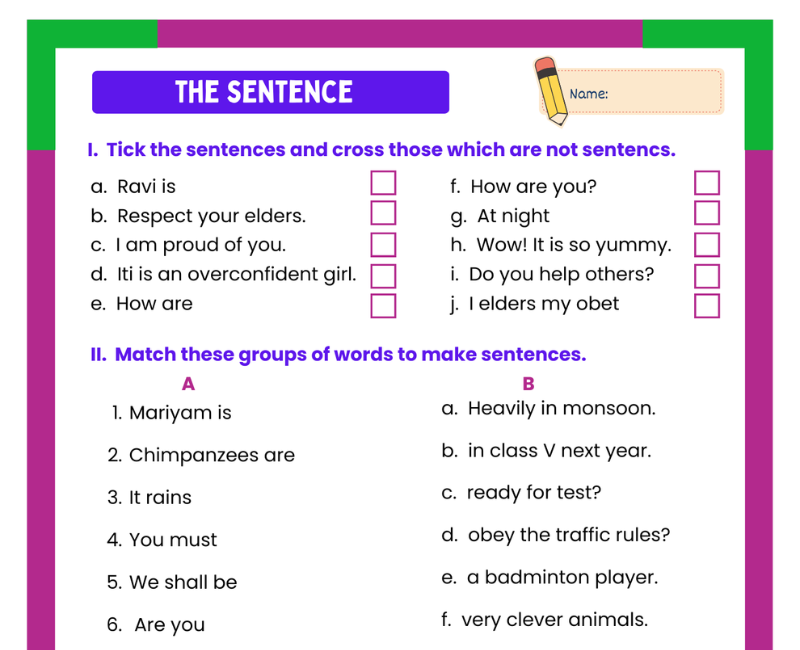
- The Sentence Worksheet Class 4
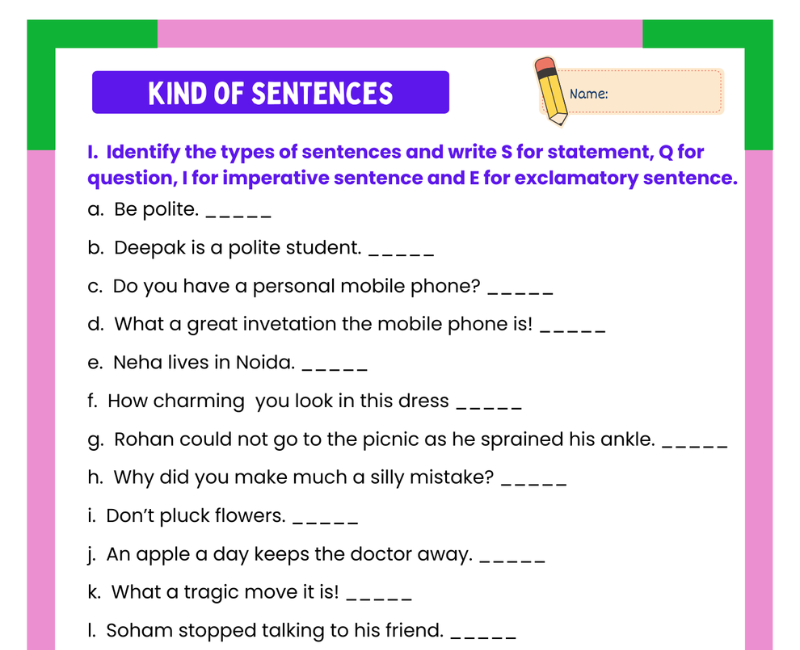
- Types of Sentences Worksheet Class 4
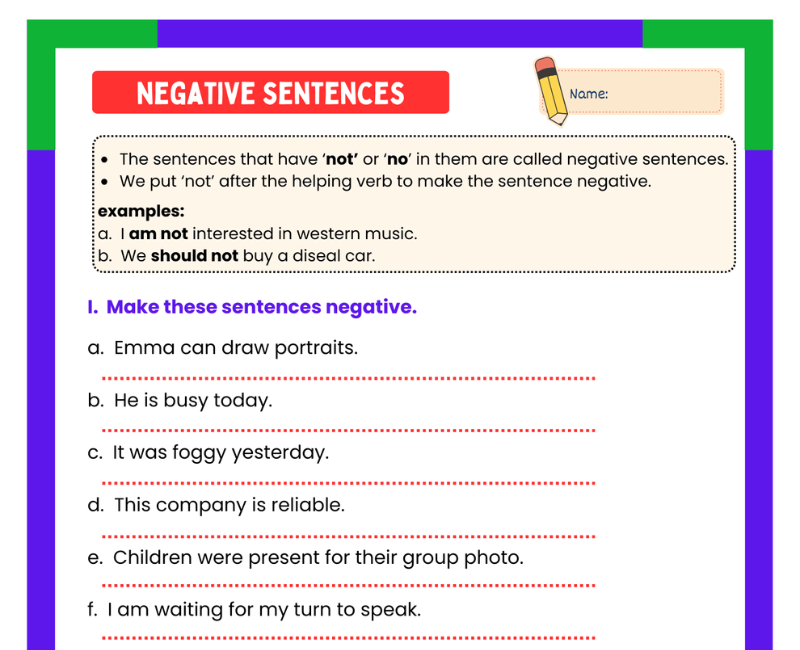
- Negative Sentences Worksheet Class 4
- Interrogative Sentences Worksheet Class 4
- Parts of Speech Worksheet Class 4
- Common Proper and Collective Nouns Worksheet Class 4
- Countable and Uncountable Nouns Worksheet Class 4
- Nouns Number Worksheet Class 4
- Nouns Gender Worksheet Class 4
- Verbs Worksheet Class 4
- Simple Present Tense Worksheet Class 4
Frequently Asked Questions
 Download