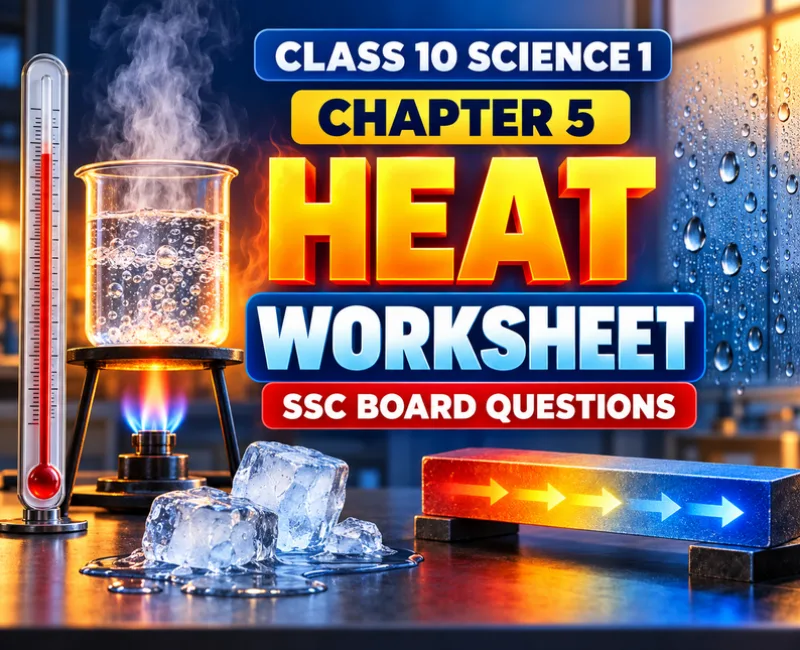
Class 10 Science 1 Chapter 5 Heat Worksheet
Practise Maharashtra State Board Class 10 Science 1 Chapter 5 Heat with MCQs, numericals, scientific reasons, diagrams and important questions based on the Maharashtra SSC Board examination pattern.
Class 10 Science 1 Heat Worksheet
This Class 10 Science 1 Heat worksheet is designed for Maharashtra State Board students preparing for school tests, preliminary examinations and the SSC Board examination. It works as a chapter-wise Maharashtra SSC Science question bank containing important concepts, numericals, scientific reasons and different question formats from Chapter 5.
The worksheet covers heat and temperature, specific heat capacity, the principle of heat exchange, latent heat, melting and boiling, anomalous behaviour of water, regelation, humidity, absolute humidity, relative humidity and dew point. Questions connect these concepts with daily-life examples such as ice melting, water pipes bursting in cold regions and water droplets forming on a cold surface.
Selected questions previously asked in Maharashtra SSC Board examinations are marked with their examination years wherever applicable. Additional similar questions help students apply the concepts in unfamiliar situations. This makes the worksheet suitable for Maharashtra State Board Class 10 Science 1 question-paper practice and final board-exam revision.
SSC Board Questions
Selected previous Maharashtra Board questions are included with examination-year references.
Concepts and Numericals
Practise heat-exchange calculations, latent heat, humidity and scientific reasoning.
Answer Key Included
Check your responses after independently completing the full worksheet.
What Is Included in the Heat Worksheet?
- Multiple-choice questions with options written on separate lines.
- Fill-in-the-blanks and one-word answer questions.
- True-or-false, match-the-pairs and odd-one-out questions.
- Give-scientific-reason questions frequently used in SSC examinations.
- Very short, short and long answer questions.
- Numericals based on heat, mass and specific heat capacity.
- Questions based on the principle of heat exchange.
- Questions on latent heat, melting and boiling.
- Graph and diagram-based questions.
- Humidity, relative humidity and dew-point questions.
- Selected previous SSC Board questions with examination years.
- Additional board-exam-style questions and an answer key.
Important Heat Concepts Covered
Heat and Temperature
Heat is a form of energy transferred from a body at a higher temperature to a body at a lower temperature. Temperature indicates the degree of hotness or coldness of a body. Two objects can have the same temperature but contain different amounts of heat energy because their masses and materials may be different.
Specific Heat Capacity
Specific heat capacity is the amount of heat required to raise the temperature of one unit mass of a substance by one degree Celsius. Different materials require different amounts of heat for the same rise in temperature. Water has a comparatively high specific heat capacity.
Principle of Heat Exchange
When a hot body and a cold body are placed in contact in an isolated system, heat flows from the hot body to the cold body. Ideally, heat lost by the hot body is equal to heat gained by the cold body until both reach the same temperature.
Latent Heat
Latent heat is absorbed or released during a change of state without a change in temperature. Ice absorbs latent heat while melting, and water absorbs latent heat while changing into steam. This explains why temperature remains constant during a phase change.
Anomalous Behaviour of Water
Water has maximum density at 4°C. When water cools below 4°C, it expands instead of contracting. In cold regions, this causes lakes to freeze from the surface while water below remains liquid, allowing aquatic organisms to survive.
Regelation
Regelation is the melting of ice under pressure and its refreezing when the pressure is removed. It helps explain how a thin wire with weights can pass through a block of ice while the ice joins again above the wire.
Humidity and Dew Point
Humidity refers to water vapour present in air. Relative humidity compares the water vapour actually present with the maximum amount the air can hold at that temperature. Dew point is the temperature at which air becomes saturated and condensation begins.
How to Solve Heat Numericals
- Identify the mass, temperature change and specific heat capacity.
- Convert all quantities into compatible units.
- Write the appropriate heat formula.
- For mixtures, identify the body losing heat and the body gaining heat.
- Apply the principle: heat lost equals heat gained.
- Substitute the values carefully.
- Show every calculation step clearly.
- Write the final answer with the correct unit.
Benefits of Practising This Worksheet
- Provides Maharashtra SSC Science question-bank practice.
- Builds confidence in solving heat-exchange numericals.
- Improves understanding of phase changes and latent heat.
- Provides practice with previous board-exam questions.
- Helps students explain anomalous expansion using examples.
- Improves answers related to humidity and dew point.
- Supports school tests, prelims and SSC Board preparation.
Common Mistakes Students Should Avoid
- Do not use heat and temperature as identical terms.
- Do not forget the mass while calculating heat energy.
- Do not assume that temperature changes during a phase change.
- Do not confuse specific heat with latent heat.
- Do not forget that water has maximum density at 4°C.
- Do not confuse absolute humidity with relative humidity.
- Do not omit units from numerical answers.
- Always identify whether heat is gained or lost.
Check Your Answers with Chapter 5 Solutions
Attempt all MCQs, scientific reasons, descriptive questions and numericals independently. After completing the worksheet, compare your answers with the detailed Chapter 5 Heat solutions.
View Chapter 5 Heat Solutions →Frequently Asked Questions
Select any question to read its explanation.
What questions are included in this Heat worksheet?
Does the worksheet include previous board questions?
What is specific heat capacity?
What is latent heat?
Why do lakes freeze only at the surface?
What is dew point?
When should students check the solutions?
 Download