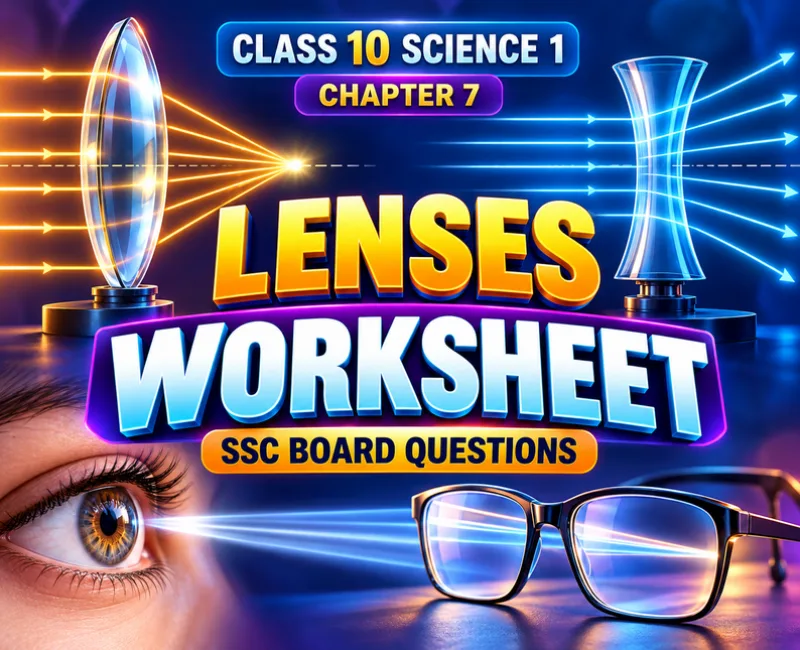
Class 10 Science 1 Chapter 7 Lenses Worksheet
Maharashtra State Board SSC important questions, ray diagrams, numericals, MCQs and previous board exam questions
Class 10 Science 1 Lenses Worksheet
The Class 10 Science 1 Chapter 7 Lenses Worksheet is designed according to the Maharashtra State Board syllabus. It provides focused practice for one of the most important optics chapters in the SSC Science 1 textbook. Students can use this worksheet to revise definitions, understand ray diagrams and practise numerical problems before their school tests and Maharashtra SSC Board examination.
The worksheet contains Maharashtra State Board exam important questions, MCQs, short-answer questions, diagram-based activities, application-based questions and selected previous board exam questions with their examination-year labels. It also works as an SSC question bank for students who want additional practice beyond the textbook exercises.
Questions cover the construction and working of convex and concave lenses, principal focus, optical centre, focal length, image formation, lens formula, magnification and power of a lens. Students also revise the human eye, myopia, hypermetropia, presbyopia and the lenses used to correct these vision defects.
SSC Board Questions
Practise important textbook-based and board-style questions that are useful for Maharashtra SSC examination preparation.
Ray Diagrams
Draw and study ray diagrams for convex and concave lenses at different positions of the object.
Lens Numericals
Solve numerical problems based on focal length, image distance, object distance, magnification and power.
What Is Included in This Worksheet?
- Multiple-choice questions based on lenses and refraction
- Fill in the blanks and match-the-column activities
- Definitions and scientific reasons
- Convex and concave lens ray diagrams
- Lens formula and magnification numericals
- Power of a lens and its SI unit
- Human eye and defects of vision
- Uses of lenses in daily life and optical instruments
- Maharashtra SSC Board important questions
- Selected previous board exam questions with year labels
- Answer key for checking practice
Important Concepts Covered
1. Convex and Concave Lenses
A convex lens is thicker at the centre and thinner near its edges. It generally converges parallel rays of light to a point and is therefore called a converging lens. A concave lens is thinner at the centre and thicker near its edges. It spreads parallel rays of light and is called a diverging lens.
2. Important Terms Related to a Lens
Students should understand the principal axis, optical centre, centre of curvature, principal focus, focal length and aperture of a lens. The optical centre is the point through which a ray of light passes without significant deviation. The distance between the optical centre and principal focus is called the focal length.
3. Standard Rays Used in Ray Diagrams
- A ray parallel to the principal axis passes through the principal focus after refraction through a convex lens.
- A ray passing through the principal focus emerges parallel to the principal axis.
- A ray passing through the optical centre travels almost undeviated.
- In a concave lens, a ray parallel to the principal axis appears to diverge from its principal focus.
4. Lens Formula
The lens formula gives the relationship between the focal length, image distance and object distance. Students must apply the Cartesian sign convention correctly before substituting values.
Here, f is the focal length, v is the image distance and u is the object distance. Distances measured in the direction of incident light are considered positive, while distances measured in the opposite direction are considered negative.
5. Magnification Produced by a Lens
Magnification compares the height of the image with the height of the object. A positive magnification indicates an erect image, while a negative magnification indicates an inverted image.
6. Power of a Lens
The focal length must be expressed in metres while calculating power. The SI unit of power is the dioptre, represented by D. A convex lens has positive power, whereas a concave lens has negative power.
Image Formation by Lenses
Convex Lens
The nature and position of the image formed by a convex lens depend on the position of the object. The image may be real or virtual, magnified or diminished, and erect or inverted. For example, when the object is beyond 2F, the image is formed between F and 2F. It is real, inverted and smaller than the object.
When the object is placed between F and the optical centre, the image formed is virtual, erect and magnified. This property is used in a magnifying glass.
Concave Lens
A concave lens always forms a virtual, erect and diminished image for a real object. The image appears between the principal focus and the optical centre on the same side as the object.
Human Eye and Vision Defects
Myopia
A person with myopia can see nearby objects clearly but cannot see distant objects clearly. The image of a distant object forms in front of the retina. Myopia is corrected using a concave lens.
Hypermetropia
A person with hypermetropia can see distant objects clearly but faces difficulty seeing nearby objects. The image of a nearby object would form behind the retina. A convex lens is used to correct this defect.
Presbyopia
Presbyopia commonly develops with increasing age because the eye lens loses flexibility and the eye muscles become weaker. A person may have difficulty focusing on nearby objects. Depending on the condition, convex lenses or bifocal lenses may be prescribed.
How to Draw a Correct Ray Diagram
- Draw the principal axis using a ruler.
- Draw the lens and mark its optical centre.
- Mark F₁, F₂, 2F₁ and 2F₂ at equal and correct distances.
- Place the object in the position given in the question.
- Draw at least two standard rays from the top of the object.
- Use arrowheads to show the direction of light.
- Mark the point where the refracted rays meet or appear to meet.
- State the position, size, orientation and nature of the image.
Common Mistakes Students Should Avoid
- Using centimetres instead of metres while calculating power
- Applying an incorrect sign to object distance or focal length
- Drawing rays without arrowheads
- Confusing convex lenses with concave lenses
- Writing that a concave lens produces a real image of a real object
- Forgetting to state the nature and size of an image after drawing a ray diagram
Need Help with the Worksheet?
Read the complete Class 10 Science 1 Chapter 7 Lenses solutions for clear explanations, formulas, diagrams and Maharashtra Board textbook answers.
View Chapter 7 Lenses SolutionsFrequently Asked Questions
What is the main difference between a convex lens and a concave lens?
A convex lens is thicker at the centre and converges parallel rays of light. A concave lens is thinner at the centre and diverges parallel rays. For example, a magnifying glass uses a convex lens, while spectacles used to correct myopia contain concave lenses.
Why is a convex lens called a converging lens?
A convex lens bends parallel rays of light towards the principal axis. These rays meet at the principal focus after passing through the lens. Since the rays come together or converge, it is called a converging lens.
What type of image is formed by a concave lens?
A concave lens forms a virtual, erect and diminished image of a real object. The image is formed between the optical centre and principal focus on the same side of the lens as the object.
How is the power of a lens calculated?
Power is calculated using P = 1/f, where focal length is measured in metres. For example, a concave lens having a focal length of −0.25 m has a power of 1/−0.25 = −4 D.
Which lens is used to correct myopia?
A concave lens is used to correct myopia. It diverges incoming light rays before they enter the eye, allowing the eye lens to focus the image correctly on the retina instead of in front of it.
Which lens is used to correct hypermetropia?
A convex lens is used to correct hypermetropia. It converges light rays before they enter the eye and helps the eye lens form a clear image of a nearby object on the retina.
Is this worksheet useful for the Maharashtra SSC Board examination?
Yes. It includes Maharashtra State Board exam important questions, an SSC question bank, ray diagrams, numericals, MCQs and selected previous board exam questions. These activities help students prepare for both school examinations and the SSC Board examination.
 Download