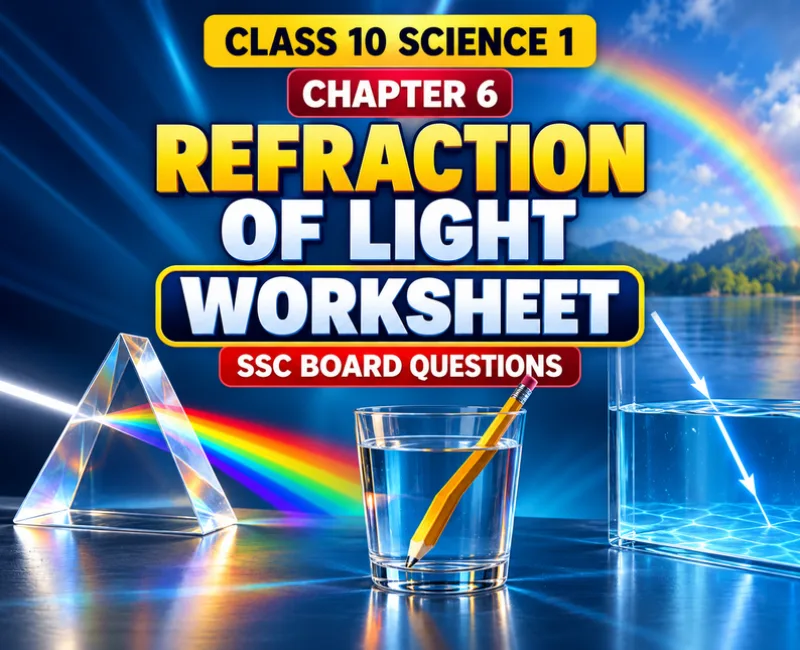
Class 10 Science 1 Chapter 6 Refraction of Light Worksheet
Practise Maharashtra State Board Class 10 Science 1 Chapter 6 Refraction of Light with MCQs, ray diagrams, refractive-index numericals, scientific reasons and important questions based on the Maharashtra SSC Board examination pattern.
Class 10 Refraction of Light Worksheet
This Class 10 Science 1 Refraction of Light worksheet is designed for Maharashtra State Board students preparing for school tests, preliminary examinations and the SSC Board examination. It works as a chapter-wise Maharashtra SSC Science question bank covering definitions, laws, diagrams, scientific reasons and numerical problems from Chapter 6.
The worksheet includes questions on refraction through different transparent media, the incident ray, refracted ray, normal, angle of incidence, angle of refraction, laws of refraction, refractive index, apparent depth, dispersion of white light, atmospheric refraction and rainbow formation.
Selected questions previously asked in Maharashtra SSC Board examinations are marked with their examination years wherever applicable. Additional similar questions help students apply the same principles to new situations. This makes the worksheet useful for Maharashtra State Board Class 10 Science 1 question-paper practice and board-exam revision.
SSC Board Questions
Selected previous Maharashtra Board questions are included with examination-year references.
Diagrams and Numericals
Practise ray diagrams, refractive-index calculations, prism questions and scientific reasoning.
Answer Key Included
Check your answers after independently completing every section of the worksheet.
What Is Included in This Worksheet?
- Multiple-choice questions with options written on separate lines.
- Fill-in-the-blanks and one-word answer questions.
- True-or-false, match-the-pairs and odd-one-out questions.
- Give-scientific-reason questions important for SSC examinations.
- Very short, short and long answer questions.
- Labelled ray-diagram questions.
- Numericals based on speed of light and refractive index.
- Questions based on apparent depth and bending of light.
- Prism and dispersion questions.
- Questions on atmospheric refraction and rainbow formation.
- Previous SSC Board questions marked with examination years.
- Additional board-exam-style questions and an answer key.
Important Refraction Concepts Covered
Refraction of Light
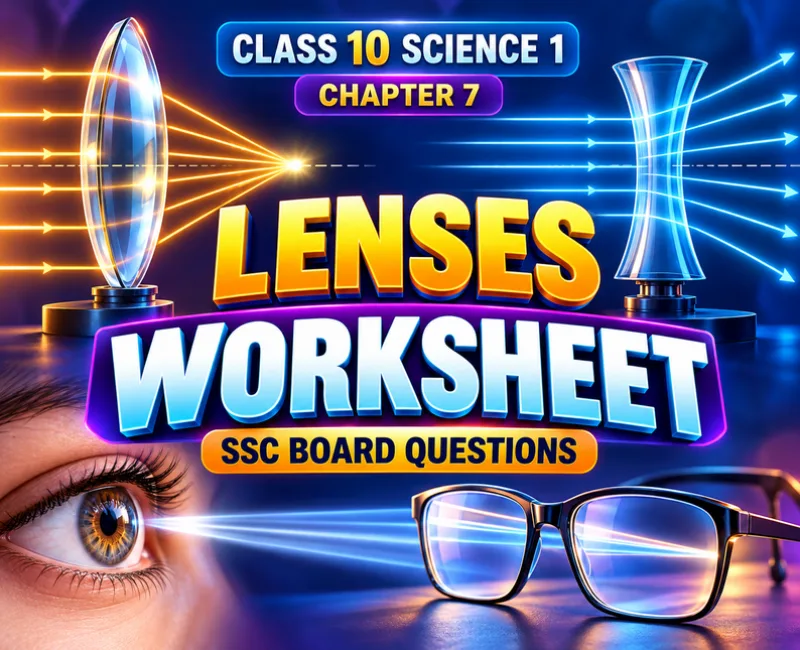
Refraction is the change in direction of light when it passes obliquely from one transparent medium into another. The change occurs because the speed of light is different in different media. A pencil partly immersed in water appears bent because light from the submerged portion changes direction while entering air.
Laws of Refraction
The incident ray, refracted ray and normal at the point of incidence lie in the same plane. For a given pair of media, the ratio of the sine of the angle of incidence to the sine of the angle of refraction remains constant. This relation is known as Snell’s law.
Bending Towards or Away from the Normal
When light travels from an optically rarer medium to an optically denser medium, it bends towards the normal. When it travels from a denser medium to a rarer medium, it bends away from the normal. Light travelling along the normal passes without changing direction.
Refractive Index
The absolute refractive index of a medium is the ratio of the speed of light in vacuum to its speed in that medium. A larger refractive index indicates that light travels more slowly through the medium. Students practise calculations using the correct speed units.
Apparent Depth
An object below the surface of water appears closer to the surface because light bends away from the normal when it travels from water to air. For this reason, the bottom of a clear pond appears shallower than its actual depth.
Dispersion of White Light
Dispersion is the splitting of white light into its component colours when it passes through a prism. Different colours bend by different amounts. Violet deviates more, while red deviates less.
Atmospheric Refraction and Rainbow
Atmospheric refraction occurs because the density and refractive index of air vary with height. Twinkling stars and the apparent early sunrise are examples. A rainbow forms when sunlight undergoes refraction, dispersion and internal reflection inside water droplets.
How to Draw a Refraction Ray Diagram
- Draw the boundary between the two transparent media.
- Mark the point where the incident ray meets the boundary.
- Draw the normal perpendicular to the boundary.
- Draw the incident ray with an arrow towards the boundary.
- Decide whether the second medium is optically denser or rarer.
- Draw the refracted ray towards or away from the normal.
- Mark the angles from the normal, not from the surface.
- Label the rays, normal and media clearly.
Benefits of Practising This Worksheet
- Provides Maharashtra SSC Science question-bank practice.
- Improves accuracy in drawing and labelling ray diagrams.
- Builds confidence in refractive-index numericals.
- Provides practice with previous board-exam questions.
- Helps students explain common optical observations scientifically.
- Strengthens understanding of dispersion and rainbow formation.
- Supports school tests, prelims and SSC Board preparation.
Common Mistakes Students Should Avoid
- Do not measure angles from the surface; measure them from the normal.
- Do not confuse optically denser with physically denser.
- Do not bend a ray towards the normal when it enters a rarer medium.
- Do not omit arrowheads from light rays.
- Do not leave ray diagrams unlabelled.
- Do not confuse refraction with reflection.
- Do not write the colours of the spectrum in the wrong order.
- Always include units in refractive-index calculations where required.
Check Your Answers with Chapter 6 Solutions
Attempt all MCQs, scientific reasons, numericals and ray diagrams independently. After completing the worksheet, compare your work with the detailed Chapter 6 Refraction of Light solutions.
View Chapter 6 Solutions →Frequently Asked Questions
Select any question to read its explanation.
What questions are included in this worksheet?
Does it include previous board questions?
Why does light bend during refraction?
When does light bend towards the normal?
Why does a pencil appear bent in water?
How is a rainbow formed?
When should students check the solutions?
 Download