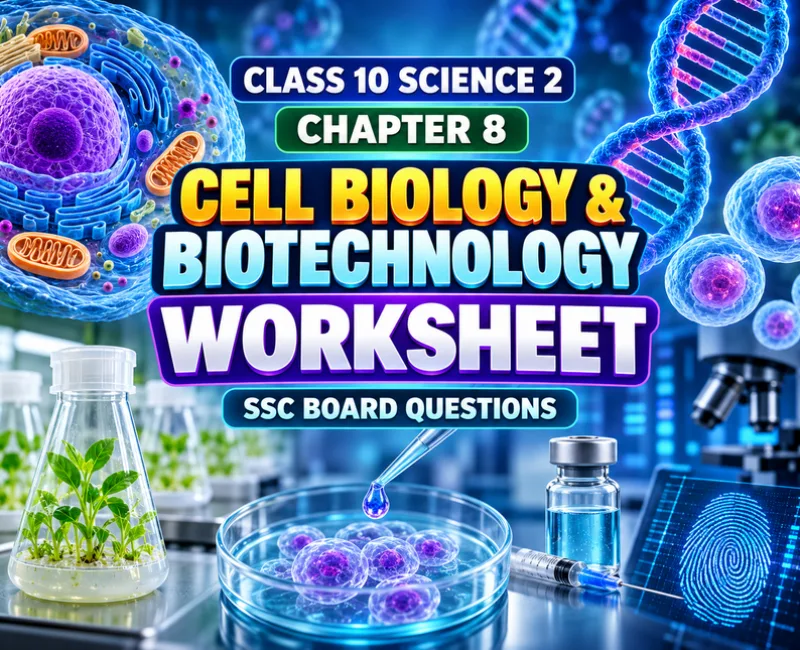
Class 10 Science 2 Chapter 8 Cell Biology and Biotechnology Worksheet
Maharashtra SSC Board important questions, stem cells, tissue culture, genetic engineering, vaccines and DNA fingerprinting
Cell Biology and Biotechnology Worksheet
This worksheet follows the Maharashtra State Board syllabus and contains MCQs, matching pairs, corrected statements, short notes, detailed answers, diagrams and application-based questions. Selected previous SSC Board questions are included with their examination-year labels.
Students revise stem cells, organ transplantation, tissue culture, genetic engineering, genetically modified organisms, vaccines, DNA fingerprinting and biotechnology applications in agriculture, health and industry.
Board Questions
Textbook-based and application-based examination practice.
Modern Applications
Stem cells, tissue culture, vaccines and DNA fingerprinting.
Answer Key
Check terms, processes, examples and explanations.
What Is Included?
- MCQs, fill in the blanks and matching pairs
- Stem-cell and organ-transplant questions
- Plant-tissue-culture process questions
- Genetic-engineering applications
- Vaccines and biotechnology in healthcare
- DNA-fingerprinting applications
- Ethics, safety and responsible biotechnology
- SSC important and previous board questions
Stem Cells and Organ Transplantation
Stem cells are undifferentiated cells capable of self-renewal and development into specialised cell types under suitable conditions. Their properties make them important in research and selected medical treatments.
Organ transplantation replaces a damaged or failing organ with a healthy donor organ. Compatibility testing, informed consent, legal procedures, infection control and long-term medical supervision are essential.
Plant Tissue Culture
Tissue culture produces plants from a small piece of plant tissue under sterile laboratory conditions. The tissue is placed on a nutrient medium containing suitable growth regulators.
The method can rapidly multiply selected plants, help produce disease-free material and conserve valuable plant varieties. Strict sterile conditions are necessary because contaminating microorganisms can grow faster than the plant tissue.
Genetic Engineering
Genetic engineering involves deliberate modification or transfer of genetic material using biotechnology. It may be used to produce useful substances or introduce selected characteristics.
- Production of medically useful proteins
- Development of selected agricultural traits
- Study of gene function
- Improvement of industrial microorganisms
Vaccines and DNA Fingerprinting
Vaccines prepare the immune system to recognise specific disease-causing agents. Biotechnology supports the development and production of several vaccine types.
DNA fingerprinting examines selected variable regions of DNA to help distinguish individuals. It may support forensic investigation, biological-relationship testing and identification, but samples and results must be handled responsibly.
Common Mistakes
- Writing that every body cell is a stem cell
- Confusing tissue culture with ordinary seed germination
- Writing that all genetically modified organisms are identical
- Confusing vaccination with antibiotic treatment
- Presenting DNA fingerprinting as automatically proving every conclusion
- Ignoring consent, safety and legal requirements
Check the Complete Chapter 8 Solutions
Revise stem cells, transplantation, tissue culture, genetic engineering, vaccines and DNA fingerprinting.
View Chapter 8 SolutionsFrequently Asked Questions
What is a stem cell?
A stem cell is an undifferentiated cell that can self-renew and may develop into specialised cells under suitable conditions.
Why are sterile conditions required in tissue culture?
Sterility prevents bacteria and fungi from contaminating the nutrient medium and damaging the plant tissue.
What is genetic engineering?
It is the deliberate modification or transfer of genetic material to produce a selected biological result.
What is DNA fingerprinting used for?
It may support forensic investigation, identification and biological-relationship testing.
Does this worksheet contain Board questions?
Yes. It includes Maharashtra SSC important questions and selected previous exam questions with year labels.
 Download