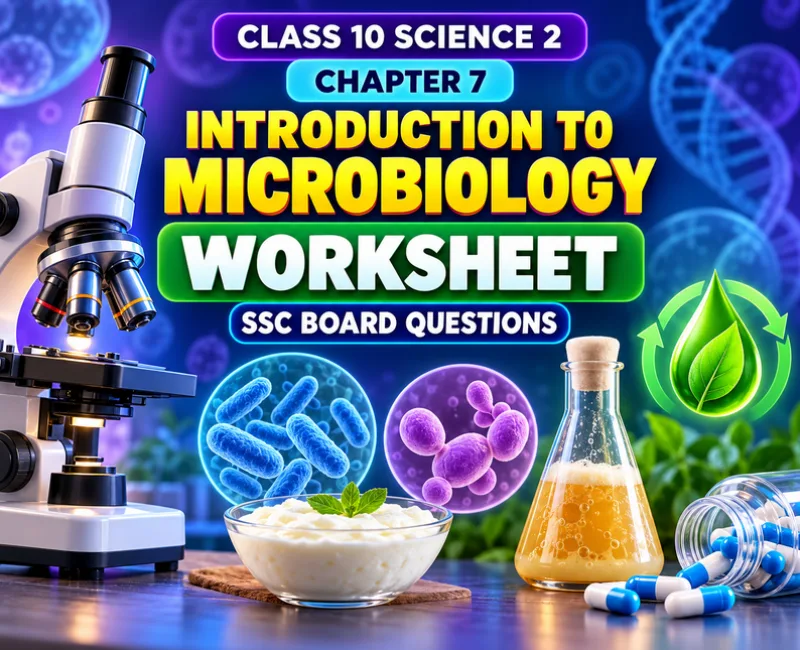
Class 10 Science 2 Chapter 7 Introduction to Microbiology Worksheet
Maharashtra SSC Board important questions, useful microorganisms, fermentation, medicines, agriculture and biofuels
Introduction to Microbiology Worksheet
This worksheet follows the Maharashtra State Board Science 2 syllabus and supports school-test, prelim and SSC Board preparation. It contains MCQs, matching pairs, scientific reasons, short notes, application-based questions and selected previous board exam questions with year labels.
Students revise useful microorganisms in food production, medicine, agriculture, industry, waste management, environmental cleanup and fuel production. Questions connect every product with the correct microorganism or microbial process.
Board Questions
Important textbook and examination-style questions.
Everyday Examples
Curd, bread, antibiotics, compost and biofuels.
Answer Key
Check organisms, products and processes.
What Is Included?
- MCQs, fill in the blanks and matching pairs
- Useful and harmful effects of microorganisms
- Fermentation and food-production questions
- Antibiotics, vaccines and enzyme questions
- Microbes in agriculture and waste treatment
- Biofuel and environmental-cleanup questions
- Maharashtra SSC important questions
- Previous exam questions with year labels
Microorganisms in Food Production
Microorganisms are used to prepare many food products. Lactic acid bacteria convert lactose into lactic acid during curd formation. Yeast ferments sugar and releases carbon dioxide, which makes bread dough rise.
Fermentation is a controlled microbial process in which microorganisms convert organic substances into useful products. Temperature, cleanliness, suitable nutrients and the correct microbial culture influence the final product.
Microorganisms in Medicine
Microorganisms are used to produce antibiotics, vaccines, vitamins, enzymes and other medically useful substances. Antibiotics act against susceptible bacteria, but they do not cure viral infections such as the common cold.
Vaccines train the immune system to recognise particular disease-causing agents. Their purpose differs from antibiotics: vaccination helps prevent specific infections, whereas antibiotics treat susceptible bacterial infections.
Agriculture, Industry and Environment
Biofertilisers
Some microorganisms improve soil fertility by fixing atmospheric nitrogen or making nutrients more available to plants. Rhizobium lives in the root nodules of leguminous plants and supports nitrogen fixation.
Waste Management
Decomposer microorganisms break down biodegradable waste. They are useful in composting, sewage treatment and the conversion of organic waste into biogas.
Bioremediation
Bioremediation uses microorganisms to reduce or remove pollutants from contaminated environments. The selected organism must be capable of acting on the particular pollutant under suitable conditions.
Biofuels
Microorganisms help produce fuels such as ethanol, methane-rich biogas and other biologically derived fuels.
Common Mistakes
- Writing that all microorganisms are harmful
- Confusing fermentation with ordinary food spoilage
- Writing that antibiotics cure viral infections
- Confusing biofertilisers with chemical fertilisers
- Giving a microbial product without naming its process or organism
Check the Complete Microbiology Solutions
Revise useful microbes, fermentation, medical products, agriculture, waste management and biofuels.
View Chapter 7 SolutionsFrequently Asked Questions
Are all microorganisms harmful?
No. Many microorganisms produce food, medicines, enzymes, biofertilisers and fuels or help decompose waste.
Why does bread dough rise?
Yeast ferments sugar and releases carbon dioxide. The trapped gas bubbles make the dough rise.
Why should antibiotics not be used for a common cold?
A common cold is usually viral, while antibiotics act against susceptible bacteria.
How does Rhizobium help plants?
Rhizobium lives in legume root nodules and helps convert atmospheric nitrogen into usable compounds.
Does this worksheet contain Board questions?
Yes. It includes SSC important questions and selected previous exam questions with year labels.
 Download