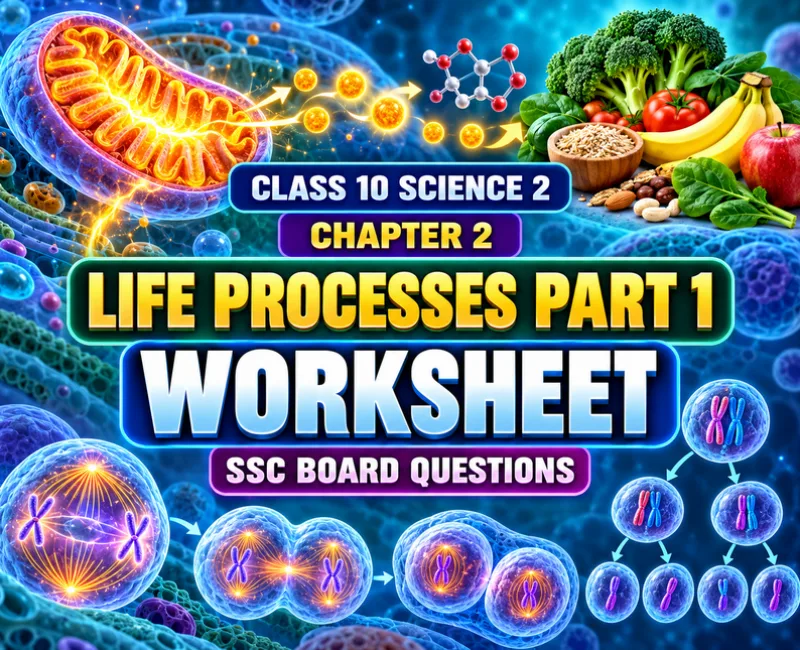
Class 10 Science 2 Chapter 2 Life Processes Part 1 Worksheet
Maharashtra SSC Board important questions, nutrition, respiration, energy production, cell division and previous exam questions
Class 10 Science 2 Life Processes Part 1 Worksheet
This Class 10 Science 2 Chapter 2 Life Processes in Living Organisms Part 1 Worksheet is prepared according to the Maharashtra State Board Science and Technology Part 2 syllabus. It provides organised practice for unit tests, school examinations, preliminary examinations and the Maharashtra SSC Board examination.
The worksheet contains Maharashtra State Board exam important questions, MCQs, one-word answers, matching pairs, diagram-based questions, scientific reasons, comparisons, short-answer questions and detailed explanatory questions. Selected previous board exam questions are also included with their examination-year labels, making it useful as an SSC question bank.
Students revise nutrition, important nutrients, vitamins, energy production, ATP, glycolysis, aerobic respiration, anaerobic respiration, the Krebs cycle, mitosis and meiosis. Questions connect these processes with examples such as vigorous exercise, growth, wound healing and the production of reproductive cells.
SSC Board Questions
Practise definitions, scientific reasons, comparisons, diagrams and process-based answers asked in Maharashtra Board examinations.
Process-Based Learning
Follow energy production and cell division as connected sequences instead of memorising isolated terms.
Answer Key Included
Check biological terms, process steps, differences and diagram labels after completing the worksheet.
What Is Included in the Worksheet?
- Multiple-choice questions with clearly arranged options
- Fill in the blanks and one-word answers
- Match-the-pairs and odd-one-out questions
- Questions based on nutrients and vitamins
- Aerobic and anaerobic respiration comparisons
- Glycolysis and Krebs-cycle questions
- ATP and cellular-energy questions
- Mitosis and meiosis diagrams
- Scientific reasons with proper explanations
- Maharashtra SSC Board important questions
- Selected previous board questions with year labels
- Answer key for self-assessment
Nutrition and Important Nutrients
Nutrition is the process by which living organisms obtain and use food. The body requires carbohydrates, proteins, fats, vitamins, minerals, water and fibre in suitable proportions. Each nutrient performs particular functions, and no single food generally supplies every requirement in the correct amount.
| Nutrient | Main Function | Common Example |
|---|---|---|
| Carbohydrates | Provide readily available energy | Rice, wheat and potatoes |
| Proteins | Support growth and tissue repair | Pulses, milk and eggs |
| Fats | Provide stored energy and insulation | Oil, nuts and seeds |
| Vitamins and minerals | Regulate body processes | Fruits and vegetables |
| Fibre | Supports movement of food through the digestive tract | Whole grains and vegetables |
Energy Production in Cells
ATP: The Usable Energy Currency
Energy released from nutrients cannot always be used directly by cells. A significant part of it is transferred to ATP molecules. When required, ATP releases energy for cellular activities such as movement, active transport, growth and synthesis of substances.
Glycolysis
Glycolysis is the initial stage of glucose breakdown. It takes place in the cytoplasm and converts one glucose molecule into pyruvic acid. A comparatively small amount of energy is released during this process.
Aerobic Respiration
Aerobic respiration occurs in the presence of oxygen. After glycolysis, pyruvic acid enters the mitochondria and undergoes further reactions. Glucose is oxidised more completely, producing carbon dioxide, water and a comparatively large amount of energy.
Anaerobic Respiration
Anaerobic respiration releases energy without using oxygen. Since glucose is not completely oxidised, less energy is released than in aerobic respiration.
Aerobic and Anaerobic Respiration
| Point | Aerobic Respiration | Anaerobic Respiration |
|---|---|---|
| Oxygen | Required | Not required |
| Breakdown of glucose | More complete | Incomplete |
| Energy released | Comparatively more | Comparatively less |
| Common products | Carbon dioxide and water | Lactic acid or alcohol and carbon dioxide |
| Main location | Later stages occur in mitochondria | Occurs in cytoplasm |
Cell Division
Cell division is necessary for growth, replacement of damaged cells, healing of injuries and reproduction. The two important types studied in this chapter are mitosis and meiosis.
Mitosis
Mitosis produces two daughter cells that are genetically similar to the parent cell and normally contain the same chromosome number. It supports growth, tissue repair and replacement of worn-out cells.
Meiosis
Meiosis occurs during the formation of reproductive cells. It involves two successive divisions and usually produces four haploid daughter cells. The chromosome number is reduced to half, helping maintain a constant chromosome number after fertilisation.
| Point | Mitosis | Meiosis |
|---|---|---|
| Number of divisions | One | Two |
| Daughter cells | Two | Usually four |
| Chromosome number | Normally remains unchanged | Reduced to half |
| Main importance | Growth and tissue repair | Formation of reproductive cells |
Common Mistakes Students Should Avoid
- Writing that respiration and breathing are exactly the same
- Writing that glycolysis occurs inside mitochondria
- Stating that anaerobic respiration releases more energy
- Forgetting that glycolysis is common to both respiration pathways
- Confusing ATP with a nutrient
- Writing that mitosis produces four daughter cells
- Writing that meiosis maintains the complete diploid chromosome number in gametes
- Drawing cell-division stages without proper labels
Check the Complete Chapter 2 Solutions
Use the detailed Life Processes Part 1 solutions to check worksheet answers and revise nutrition, respiration, ATP, mitosis and meiosis.
View Life Processes Part 1 SolutionsFrequently Asked Questions
Why is ATP called the energy currency of the cell?
ATP stores energy released during cellular respiration and supplies it for different cellular activities. Like money used for different purchases, ATP provides usable energy for movement, transport, growth and synthesis.
Where does glycolysis occur?
Glycolysis occurs in the cytoplasm. During this process, glucose is converted into pyruvic acid and a small amount of energy is released.
Why does aerobic respiration release more energy?
In aerobic respiration, oxygen permits the more complete oxidation of glucose. The later reactions occur in mitochondria and release much more energy than incomplete anaerobic breakdown.
Why do muscles feel tired after vigorous exercise?
During vigorous exercise, the oxygen supply may become temporarily insufficient. Muscle cells perform anaerobic respiration, and lactic acid may accumulate, contributing to fatigue and discomfort.
What is the main difference between mitosis and meiosis?
Mitosis involves one division and forms two similar daughter cells for growth and repair. Meiosis involves two divisions and forms haploid reproductive cells with half the chromosome number.
Why is meiosis important in sexual reproduction?
Meiosis reduces the chromosome number to half in reproductive cells. During fertilisation, two haploid cells combine and restore the normal diploid chromosome number.
What is the role of mitosis in wound healing?
Cells near an injured area divide by mitosis and produce new cells that replace damaged or lost tissue. This gradually helps close and repair the wound.
Does this worksheet contain Maharashtra Board questions?
Yes. It contains Maharashtra State Board exam important questions, MCQs, diagrams, scientific reasons, comparisons and selected previous board exam questions with year labels.
 Download