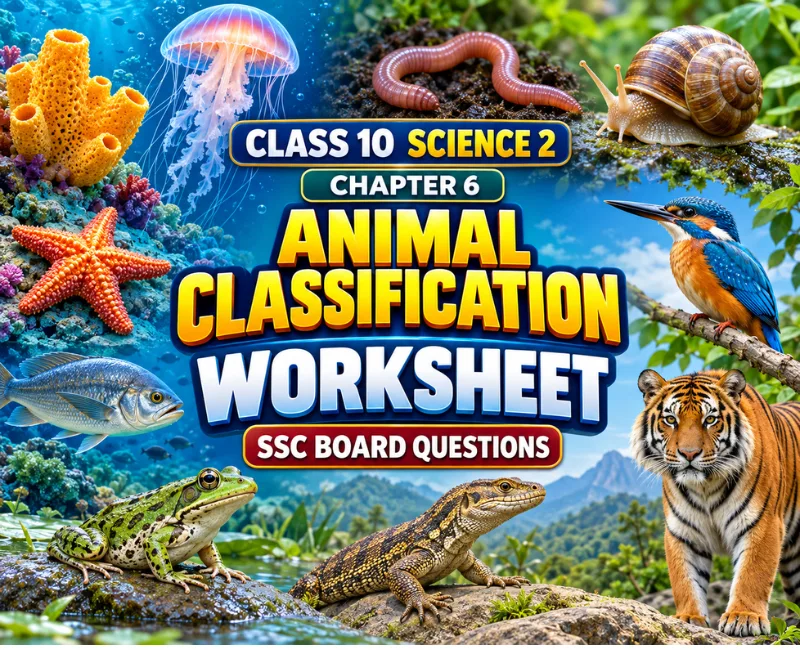
Class 10 Science 2 Chapter 6 Animal Classification Worksheet
Maharashtra SSC Board important questions, animal phyla, vertebrate classes, diagrams and previous exam questions
Class 10 Animal Classification Worksheet
This Class 10 Science 2 Chapter 6 Animal Classification Worksheet follows the Maharashtra State Board syllabus. It supports preparation for school tests, preliminary examinations and the Maharashtra SSC Board examination.
The worksheet contains Maharashtra State Board exam important questions, MCQs, one-word answers, matching pairs, odd-one-out questions, classification charts, diagrams, scientific reasons and detailed answers. Selected previous board exam questions are included with their examination-year labels, making it useful as an SSC question bank.
Students revise the basis of animal classification, body symmetry, germ layers, body cavity, segmentation, notochord, invertebrate phyla and major vertebrate classes. Representative examples are included so students can connect each group with its distinguishing characteristics.
Board Questions
Definitions, characteristics, comparisons, examples and diagram-based questions.
Classification Charts
Compare animal groups using symmetry, body cavity, segmentation and notochord.
Answer Key
Check scientific terms, examples and distinguishing features.
What Is Included?
- MCQs with properly arranged options
- Fill in the blanks, matching pairs and odd-one-out questions
- Identify the phylum or class from given features
- Distinguish between chordates and non-chordates
- Invertebrate phyla and vertebrate-class questions
- Labelled diagrams and classification flowcharts
- Maharashtra SSC Board important questions
- Selected previous board questions with year labels
Basis of Animal Classification
Body Symmetry
Animals may be asymmetrical, radially symmetrical or bilaterally symmetrical. In radial symmetry, several planes passing through the central axis can divide the body into similar halves. In bilateral symmetry, only one plane divides the body into approximately equal right and left halves.
Germ Layers and Body Cavity
Diploblastic animals develop from two primary germ layers, while triploblastic animals develop from three. Based on the body cavity, animals may be acoelomate, pseudocoelomate or coelomate.
Segmentation and Notochord
Segmentation means repetition of similar body units. The notochord is a flexible supporting structure found at least during some stage of development in chordates. Its presence is a major basis for separating chordates from non-chordates.
Important Invertebrate Groups
- Porifera: Aquatic animals with pores and a canal system; example: Sycon.
- Cnidaria: Radially symmetrical animals with stinging cells; example: Hydra.
- Platyhelminthes: Dorsoventrally flattened worms; example: Planaria.
- Aschelminthes: Round, unsegmented worms; example: Ascaris.
- Annelida: True segmentation and a body cavity; example: earthworm.
- Arthropoda: Jointed appendages and an exoskeleton; example: cockroach.
- Mollusca: Soft body, muscular foot and often a shell; example: snail.
- Echinodermata: Spiny-skinned marine animals; example: starfish.
Major Vertebrate Classes
- Pisces: Aquatic vertebrates that generally breathe through gills.
- Amphibia: Animals adapted to both aquatic and terrestrial environments.
- Reptilia: Dry, scaly skin and lungs for respiration.
- Aves: Feathers, wings and a lightweight skeleton.
- Mammalia: Hair and mammary glands; most give birth to young ones.
Common Mistakes
- Classifying animals only according to habitat
- Writing starfish as a fish
- Confusing body segmentation with body symmetry
- Writing that all chordates have a vertebral column throughout life
- Giving an example without mentioning the distinguishing feature
Check the Complete Animal Classification Solutions
Revise the basis of classification, animal phyla, chordates and vertebrate classes with complete textbook solutions.
View Chapter 6 SolutionsFrequently Asked Questions
Why is animal classification necessary?
Classification arranges a large variety of animals into manageable groups. It helps students compare common features and understand evolutionary relationships.
What is the main difference between chordates and non-chordates?
Chordates possess a notochord at least during some developmental stage. Non-chordates do not possess a notochord.
Why is a whale classified as a mammal?
A whale breathes through lungs, gives birth to young ones and feeds them milk. Its aquatic habitat does not make it a fish.
Why is starfish not classified under Pisces?
Starfish is an invertebrate belonging to Echinodermata. It lacks the vertebrate characteristics of true fishes.
Does this worksheet contain SSC Board questions?
Yes. It includes Maharashtra Board important questions, MCQs, classification charts and selected previous exam questions with year labels.
 Download