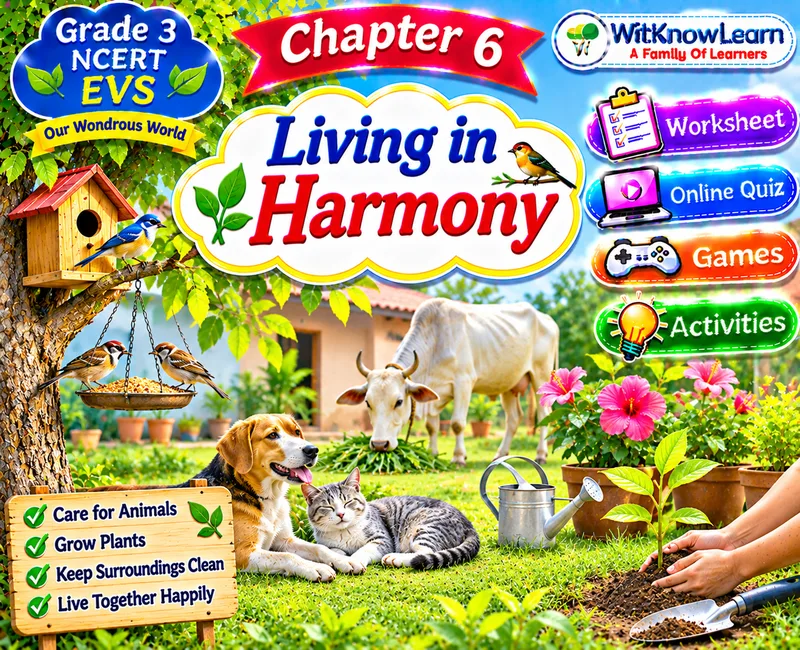
Living in Harmony Class 3 EVS Worksheet with Quiz and Activities
NCERT Our Wondrous World Chapter 6: the mango tree story, what plants and animals give us, how they help each other, kindness to living beings and the Grey Wagtails of Valparai. On WitKnowLearn you get the Living in Harmony Class 3 online quiz, online activities and interactive games, science labs, a virtual lab and a worksheet-style practice sheet, all on one page.
Living in Harmony Class 3 Online Quiz
20 questions: 10 easy, 5 average and 5 thinking. Tap an answer and the next question comes up.
Living in Harmony Class 3 Activities
👆 Tap a tab to switch: Learn, Games, Labs, Challenges, Virtual Lab and Practice sheet
Living in Harmony: the Chapter Story
A short read for Class 3 before you play. These notes are written for this page and are not copied from the textbook.
🏠 Animals and plants at home
We bring some animals and plants into our homes, and some visit on their own. We take care of them with water, food and shelter, and we never hurt animals even if we are scared.
🥭 The mango tree
Shambhu and his father rest under a huge mango tree that shelters birds, squirrels and monkeys. A monkey eats a mango and throws out the seed, and Shambhu’s father explains that a new plant will grow from it.
🌳 What plants give us
Plants give us shade, shelter for animals, wood, medicine, fibre for clothes, fruit and fresh air.
🐿 We need each other
Squirrels forget the nuts they bury, and new trees grow. Animals spread seeds and make the soil fertile, and cows, buffaloes and goats give us milk and company.
🐜 Things to try
Children observe an animal, watch busy ants find food, share feelings with a plant friend and act out animals in a guessing game.
🐦 A true story from Valparai
In Valparai, children and teachers record birds all year. When Grey Wagtails arrive from the mountains in winter, they welcome them with posters and sweets.
Living in Harmony Class 3 Activities
Read, play and learn about how plants, animals and people depend on each other. Earn up to 3 stars in every activity.
Nature works like a team. This chapter helps children see how plants feed and shelter animals, how animals spread seeds and enrich the soil, and why kindness to all living beings matters.
The activities on this page turn each idea into a game. Children sort gifts of plants and animals, pop the things plants give us, match words, fill gaps from the story and plan the ant activity. Explore more Class 3 EVS worksheets on WitKnowLearn after this chapter.
Words and facts to know
| Word | Meaning | Example |
|---|---|---|
| Harmony | Living together peacefully | Plants and animals |
| Dispersing | Spreading far and wide | Animals spread seeds |
| Fertile | Rich in nutrients for plants | Soil with animal waste |
| Fibre | Thread-like material from plants | Used for clothes |
How to use this page
- Flip the six cards and try the Harmony Lab in the Learn tab.
- Play the five games and the five labs to practise each idea.
- Finish the five challenges to collect up to 15 points.
- Take the 20-question online quiz and fill in the practice sheet.
Worked examples
They bury nuts and forget where they put them.
Wood and fruit.
Animals only hurt when they feel threatened, and they deserve kindness.
This Living in Harmony worksheet for Class 3 EVS (NCERT Our Wondrous World Chapter 6) gives you online activities and interactive games that turn the chapter into play. Every activity has a goal, a hint and a short fact, so children learn while they enjoy.
Complete Guide: EVS Living in Harmony Class 3
This guide is for Class 3 students, parents and teachers who are studying NCERT Our Wondrous World, Chapter 6, Living in Harmony. It explains the main ideas in simple words and shows how to use the quiz, labs and games on this page.
Introduction to NCERT Class 3 EVS Chapter 6
Chapter 6 of Our Wondrous World is called Living in Harmony and completes Unit 2, Plants and Animals. It shows that all living beings are connected and encourages children to care for them. This introduction is written for this page and is not copied from the textbook.
What is there in this chapter
- Animals and plants at home and in the neighbourhood.
- The story of the mango tree and the monkey.
- Uses of plants and what animals give us.
- How animals spread seeds and make soil fertile.
- Activities on observing an animal, ants and a plant friend.
- A true story of Grey Wagtails in Valparai.
Learning objectives (written for this page, not copied from the book)
- Understand that plants, animals and people depend on each other.
- Name the things we get from plants and animals.
- Explain how animals help plants.
- Show kindness and respect towards living beings.
- Observe animals carefully without harming them.
Learning outcomes
- The child can list uses of plants.
- The child can explain how a monkey or squirrel helps a plant grow.
- The child can describe how to care for animals at home.
- The child can tell the Valparai story in a few lines.
Living in Harmony Class 3 resources on this page
| Resource | What it gives |
|---|---|
| Online quiz | 20 questions: 10 easy, 5 average and 5 thinking, with a full review |
| Flip cards | 6 picture cards with one-line rules |
| Harmony Lab | A hands-on lab with 3 rounds |
| Games | 5 interactive games |
| Labs | 5 activity labs |
| Virtual Lab | 2 experiments with aim, procedure, observation table and conclusion |
| Challenges | 5 challenges, 15 points in all |
| Practice sheet | A worksheet-style sheet with 16 questions, name and date lines and a live score |
Key facts
| Topic | Key idea |
|---|---|
| Plants give | Shade, shelter, wood, medicine, fibre, fruit, fresh air. |
| Animals give | Milk, company, seed spreading, fertile soil. |
| Squirrels | Plant trees by accident. |
| Kindness | Never hurt animals. |
| Valparai | Welcomes Grey Wagtails every winter. |
Types of questions you may see
- What we get from plants and animals.
- How animals help plants.
- Kind behaviour with animals.
- Questions on the Valparai story.
Solved examples
A monkey.
Milk and loving company.
Animal waste.
The Grey Wagtail.
Making clothes.
Keep a bowl of water.
Common mistakes
| Mistake | Correct idea |
|---|---|
| Hurting an animal we fear. | Stay calm and ask an elder for help. |
| Thinking plants give only fruit. | They also give wood, fibre, medicine and air. |
| Thinking animals do not help plants. | Animals spread seeds and enrich the soil. |
| Teasing cows and goats. | Treat them with kindness. |
Living in Harmony in daily life
Children can keep water for birds, watch ants and birds quietly, plant a seed, and talk about how they help the plants and animals around them.
Tips for parents and teachers
- Plant a seed together and watch it grow.
- Keep a bowl of water for birds in summer.
- Do the ant activity and record what the ants do.
- Talk about stories of pets and plants from elders’ childhood.
Related NCERT Our Wondrous World Class 3 Worksheets
- 👪Chapter 1: Family and Friends Class 3
- 🎡Chapter 2: Going to the Mela Class 3
- 🪔Chapter 3: Celebrating Festivals Class 3
- 🌿Chapter 4: Getting to Know Plants Class 3
- 🦋Chapter 5: Plants and Animals Live Together Class 3
- 💧Chapter 7: Water, A Precious Gift Class 3
- 🥗Chapter 8: Food We Eat Class 3
- 😊Chapter 9: Staying Healthy and Happy Class 3
- 🧸Chapter 10: This World of Things Class 3
- 🏺Chapter 11: Making Things Class 3
- ♻Chapter 12: Taking Charge of Waste Class 3
Living in Harmony Class 3 FAQs
What is Living in Harmony in Class 3 EVS?
Living in Harmony is Chapter 6 of the NCERT Class 3 book Our Wondrous World, in Unit 2 Plants and Animals. Children learn how plants, animals and people depend on each other, why we must care for all living beings, and how a town in Tamil Nadu welcomes visiting birds.
What is the story of The Mango Tree?
Shambhu and his father rest under a huge mango tree that is home to birds, squirrels and monkeys. Shambhu sees a monkey throw away a mango seed, and his father explains that a new plant will grow from it, showing how animals and plants help each other.
What do we get from plants?
Plants give us shade, shelter for animals, wood for houses, medicine, fibre for clothes, fruit, vegetables and fresh air.
How do animals help plants?
Animals help plants by dispersing seeds, which spreads plants near and far, and by making the soil fertile through their waste. Squirrels even plant thousands of trees by accident when they bury nuts and forget them.
What do we get from animals?
We get milk and loving company from cows, buffaloes and goats, and we depend on animals for food, shelter, clothing and companionship. We treat them with kindness, care and compassion.
How should we behave with animals we do not like?
We should never hurt animals even if we do not like them or are scared of them. Animals generally do not hurt us unless they feel threatened, so we should stay calm and ask an elder for help.
What is the true story of Valparai?
Valparai is a small town in Tamil Nadu where children and teachers record the birds that come to their town. In the cold months, Grey Wagtails arrive from the mountains, and the town welcomes them with posters and sweets.
What are the activities in this chapter?
Children get to know an animal by observing it, watch ants with three types of food, make friends with a plant to share feelings, and play Guess Who I Am by acting as animals, birds, insects or trees.
Does this page have Living in Harmony Class 3 questions and answers?
Yes. The 20-question online quiz ends with a full review that shows the correct answer and a short reason for every question. The practice sheet has 16 questions and a Show answers button.
Which class and book is this worksheet for?
This worksheet is for Class 3 and follows NCERT Our Wondrous World (EVS) Chapter 6, Living in Harmony. The learning objectives and all questions are written for this page and are not copied from the textbook.
What can children do on this page?
Children can take the online quiz, play interactive games, try online activities and science labs, finish challenges, do the hands-on Harmony Lab, run two virtual experiments and solve a worksheet-style practice sheet. They can earn up to 3 stars in every activity.
What is included on this page?
This page has a 20-question online quiz, 6 flip cards, the Harmony Lab, 5 games, 5 labs, 5 challenges, a virtual lab with 2 experiments, a 16-question practice sheet, a chapter story, a topic description, a complete guide, related NCERT Class 3 worksheets and 12 FAQs.
 Download