Making Things Class 3 EVS Worksheet with Quiz and Activities
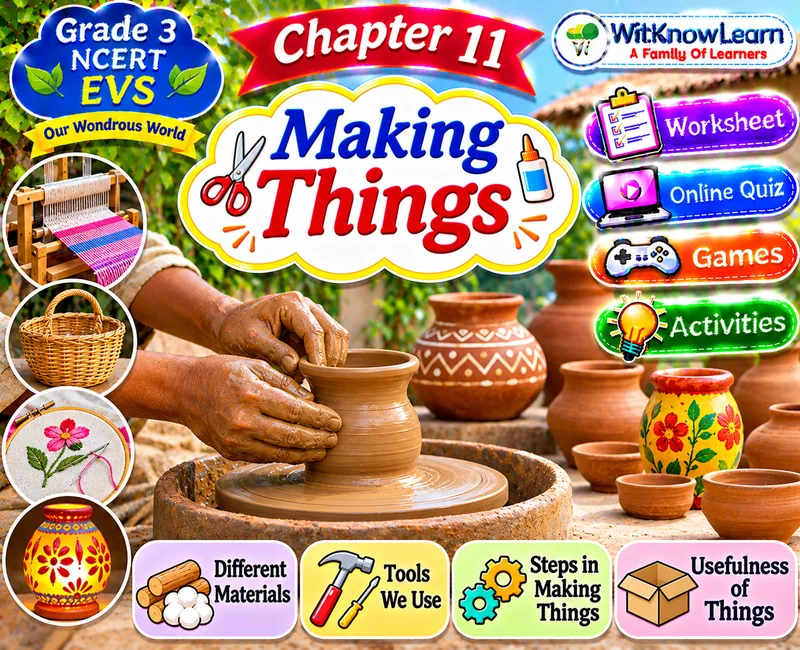
NCERT Our Wondrous World Chapter 11: a potter’s family and how a pot is made, making clay, patterns in nature, how bricks are made, kinds of houses and safety rules. On WitKnowLearn you get the Making Things Class 3 online quiz, online activities and interactive games, science labs, a virtual lab and a worksheet-style practice sheet, all on one page.
Making Things Class 3 Online Quiz
20 questions: 10 easy, 5 average and 5 thinking. Tap an answer and the next question comes up.
Making Things Class 3 Activities
👆 Tap a tab to switch: Learn, Games, Labs, Challenges, Virtual Lab and Practice sheet
Making Things: the Chapter Story
A short read for Class 3 before you play. These notes are written for this page and are not copied from the textbook.
🏺 A potter’s family
In a seaside town, Mini watches her Appooppan make a pot. He wets the clay, pounds and kneads it, and shapes it on a spinning wheel. Her mother bakes the pots in a kiln, and the family adds patterns.
🧪 Make your own clay
With elders, children collect wet soil, sieve out pebbles, soak it in water for a few days and shape the dough into things to dry in the sun.
🦓 Patterns in nature
Spots on a leopard and stripes on a zebra are patterns. Artists copy shapes and colours from nature to decorate pots.
🧱 Brick by brick
Bricks are made of mud in moulds and baked in a kiln. Rohan watches a wall grow brick by brick into a building.
🏠 Many kinds of houses
In warm places, people build mud houses with grass, wood and cow dung to stay cool and keep insects away.
⛑ Safety first
Rohan’s father wears a helmet, a safety vest and strong shoes at work. We should follow safety rules too.
Making Things Class 3 Activities
Read, play and learn about pots, bricks, patterns, houses and safety rules. Earn up to 3 stars in every activity.
Everything we use was made by someone. This chapter helps children see how a potter turns clay into pots, how bricks are made and how people build houses, and why makers follow safety rules.
The activities on this page turn each idea into a game. Children sort safe and unsafe habits, pop clay things, match maker words, fill gaps from the potter’s story and choose the right way to work. Explore more Class 3 EVS worksheets on WitKnowLearn after this chapter.
Words and facts to know
| Word | Meaning | Example |
|---|---|---|
| Kiln | A very hot oven for baking clay | Bakes pots and bricks |
| Mould | A hollow shape that gives form | Brick or idli mould |
| Pattern | Shapes or lines that repeat | Stripes on a zebra |
| Gullak | A clay piggy bank | Saves coins |
How to use this page
- Flip the six cards and try the Maker’s Workshop Lab in the Learn tab.
- Play the five games and the five labs to practise each idea.
- Finish the five challenges to collect up to 15 points.
- Take the 20-question online quiz and fill in the practice sheet.
Worked examples
A potter’s oven that bakes clay.
Mud, shaped in a mould.
To protect their heads.
This Making Things worksheet for Class 3 EVS (NCERT Our Wondrous World Chapter 11) gives you online activities and interactive games that turn the chapter into play. Every activity has a goal, a hint and a short fact, so children learn while they enjoy.
Complete Guide: EVS Making Things Class 3
This guide is for Class 3 students, parents and teachers who are studying NCERT Our Wondrous World, Chapter 11, Making Things. It explains the main ideas in simple words and shows how to use the quiz, labs and games on this page.
Introduction to NCERT Class 3 EVS Chapter 11
Chapter 11 of Our Wondrous World is called Making Things and continues Unit 4, Things Around Us. It follows how a pot is made, how patterns inspire artists and how bricks and houses are built. This introduction is written for this page and is not copied from the textbook.
What is there in this chapter
- A potter’s family and the steps of making a pot.
- Making clay from soil with elders.
- Patterns in nature and on pottery.
- How bricks are made and used.
- Mud houses and other kinds of houses.
- Safety rules for workers.
Learning objectives (written for this page, not copied from the book)
- Describe the steps of making a pot.
- Explain what a kiln and a mould do.
- Find patterns in nature.
- Name materials used to build houses.
- Follow safety rules.
Learning outcomes
- The child can order the steps of pot making.
- The child can name two patterns on animals.
- The child can say why mud houses keep cool.
- The child can name three safety items.
Making Things Class 3 resources on this page
| Resource | What it gives |
|---|---|
| Online quiz | 20 questions: 10 easy, 5 average and 5 thinking, with a full review |
| Flip cards | 6 picture cards with one-line rules |
| Maker’s Workshop Lab | A hands-on lab with 3 rounds |
| Games | 5 interactive games |
| Labs | 5 activity labs |
| Virtual Lab | 2 experiments with aim, procedure, observation table and conclusion |
| Challenges | 5 challenges, 15 points in all |
| Practice sheet | A worksheet-style sheet with 16 questions, name and date lines and a live score |
Key facts
| Topic | Key idea |
|---|---|
| Pots | Clay, wheel, drying, kiln. |
| Bricks | Mud, moulds and baking. |
| Patterns | Repeating shapes and lines in nature. |
| Mud houses | Mud, grass, wood and cow dung. |
| Safety | Helmet, vest and sturdy footwear. |
Types of questions you may see
- Steps of making a pot.
- Kiln and mould.
- Patterns in nature.
- Houses and safety.
Solved examples
It spins the clay into shape.
Gullak.
Stripes.
Mud walls and cow dung.
To protect the feet.
Jaipur.
Common mistakes
| Mistake | Correct idea |
|---|---|
| Thinking bricks are made of glass. | Bricks are made of mud. |
| Skipping the kiln step. | Baking makes clay hard. |
| Ignoring safety gear. | Wear helmets and sturdy shoes. |
| Thinking patterns exist only on pots. | Patterns are everywhere in nature. |
Making Things in daily life
Children can visit a potter, make clay with elders, spot patterns around them and follow safety rules at home and school.
Tips for parents and teachers
- Visit a local potter or craftsperson.
- Make clay together and dry the shapes in the sun.
- Build two brick walls with boxes and test which is sturdier.
- Talk about safety rules at home and school.
Related NCERT Our Wondrous World Class 3 Worksheets
- 👪Chapter 1: Family and Friends Class 3
- 🎡Chapter 2: Going to the Mela Class 3
- 🪔Chapter 3: Celebrating Festivals Class 3
- 🌿Chapter 4: Getting to Know Plants Class 3
- 🦋Chapter 5: Plants and Animals Live Together Class 3
- 🌍Chapter 6: Living in Harmony Class 3
- 💧Chapter 7: Water A Precious Gift Class 3
- 🥗Chapter 8: Food We Eat Class 3
- 😊Chapter 9: Staying Healthy and Happy Class 3
- 🧸Chapter 10: This World of Things Class 3
- ♻Chapter 12: Taking Charge of Waste Class 3
Making Things Class 3 FAQs
What is Making Things in Class 3 EVS?
Making Things is Chapter 11 of the NCERT Class 3 book Our Wondrous World, in Unit 4 Things Around Us. Children learn how a potter makes pots from clay, how bricks are made, how houses are built from different materials and why safety rules matter.
How is a pot made?
The potter makes clay wet with water, pounds and kneads it like dough, shapes it on a spinning wheel, dries it and then bakes it in a hot oven called a kiln. Patterns are often added to make the pot beautiful.
What is a kiln?
A kiln is the potter's oven. The fire inside a kiln bakes the clay so that the pot becomes hard and ready to use. Bricks are also baked in a kiln.
How can children make clay at home?
With the help of elders, collect soil from a wet place, remove pebbles and leaves with a sieve, soak the soil in water for a few days, pour off the top water and make dough that can be shaped and dried in the sun.
Where do patterns come from?
Patterns are found everywhere in nature, such as spots on a leopard, stripes on a squirrel or zebra and the arrangement of neem leaves. Artists get ideas from these shapes and colours.
How are bricks made?
Bricks are made of mud in moulds, like an idli or a cake mould, and become hard after they are baked in a kiln. They are used to build houses, schools and hospitals.
What are traditional mud houses made of?
In warm areas, people make mud houses with natural materials like mud, grass and wood. Cow dung is used on walls and floors instead of cement, which keeps heat out and stops insects from coming in.
What safety rules does the chapter teach?
Construction workers wear a helmet with a strap, a safety vest and sturdy footwear. We should follow safety rules at home and at school too.
Does this page have Making Things Class 3 questions and answers?
Yes. The 20-question online quiz ends with a full review that shows the correct answer and a short reason for every question. The practice sheet has 16 questions and a Show answers button.
Which class and book is this worksheet for?
This worksheet is for Class 3 and follows NCERT Our Wondrous World (EVS) Chapter 11, Making Things. The learning objectives and all questions are written for this page and are not copied from the textbook.
What can children do on this page?
Children can take the online quiz, play interactive games, try online activities and science labs, finish challenges, do the hands-on Maker's Workshop Lab, run two virtual experiments and solve a worksheet-style practice sheet. They can earn up to 3 stars in every activity.
What is included on this page?
This page has a 20-question online quiz, 6 flip cards, the Maker's Workshop Lab, 5 games, 5 labs, 5 challenges, a virtual lab with 2 experiments, a 16-question practice sheet, a chapter story, a topic description, a complete guide, related NCERT Class 3 worksheets and 12 FAQs.
 Download