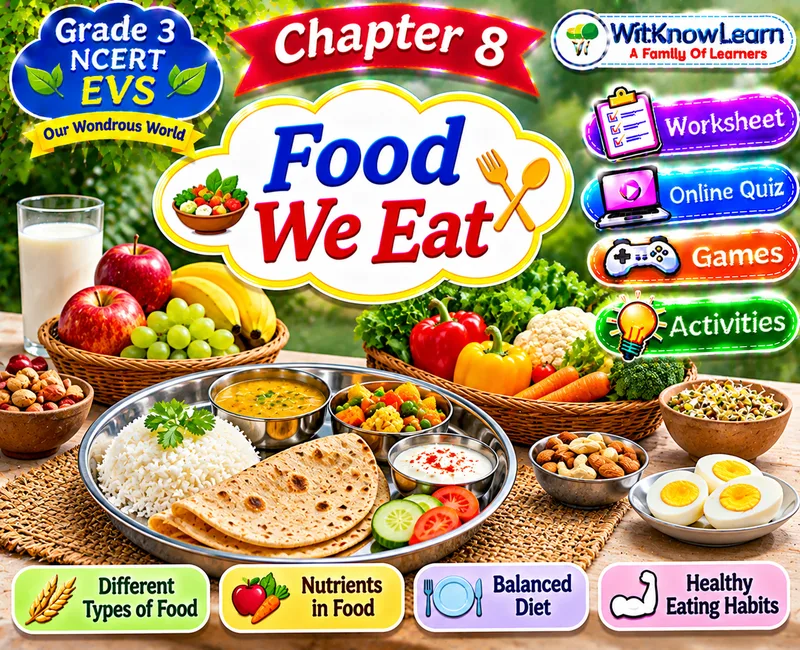
Food We Eat Class 3 EVS Worksheet with Quiz and Activities
NCERT Our Wondrous World Chapter 8: why we eat and drink, Shirin the runner and a balanced diet, foods of summer and winter, parts of plants we eat, foods from animals and sharing food. On WitKnowLearn you get the Food We Eat Class 3 online quiz, online activities and interactive games, science labs, a virtual lab and a worksheet-style practice sheet, all on one page.
Food We Eat Class 3 Online Quiz
20 questions: 10 easy, 5 average and 5 thinking. Tap an answer and the next question comes up.
Food We Eat Class 3 Activities
👆 Tap a tab to switch: Learn, Games, Labs, Challenges, Virtual Lab and Practice sheet
Food We Eat: the Chapter Story
A short read for Class 3 before you play. These notes are written for this page and are not copied from the textbook.
🍽 Why we eat and drink
We all like different foods: sweet, sour, spicy or bitter. We eat and drink to get energy and to keep our body strong.
🏃 Shirin the runner
Shirin runs fast but often falls sick because she eats only rice and potatoes. A champion tells her to eat vegetables, fruits, grains, pulses and nuts cooked at home. Shirin follows this advice and wins a medal.
☀ Foods in every season
In summer we love kulfi, lime water and coconut water, and mangoes and melons are plentiful. In winter we enjoy warm soups and stew, and apples. We drink more water when we sweat.
🌾 Where food comes from
We eat leaves, fruits, roots, stems and seeds of plants. Animals give us milk, curd, ghee, paneer, honey and eggs.
🍬 Chhappan bhog
Chhappan bhog is a festival feast with many varieties of food that blend six tastes.
🤝 Share and do not waste
We should share food with a friend who has none and avoid wasting food.
Food We Eat Class 3 Activities
Read, play and learn about a balanced diet, seasonal foods and where our food comes from. Earn up to 3 stars in every activity.
Good food helps us grow, play and learn. This chapter helps children see why they need many kinds of food, why water is life and how plants and animals give us what we eat.
The activities on this page turn each idea into a game. Children sort plant and animal foods, pop cool summer drinks, match foods with plant parts, fill gaps from Shirin’s story and choose healthy habits. Explore more Class 3 EVS worksheets on WitKnowLearn after this chapter.
Words and facts to know
| Word | Meaning | Example |
|---|---|---|
| Balanced diet | A healthy mix of many foods | Dal, rice, vegetables, fruit |
| Grain | Seed of a cereal plant | Rice, wheat, bajra |
| Pulses | Seeds used to make dal | Moong, masoor |
| Seasonal | Available in one season | Mangoes in summer |
How to use this page
- Flip the six cards and try the Food Plate Lab in the Learn tab.
- Play the five games and the five labs to practise each idea.
- Finish the five challenges to collect up to 15 points.
- Take the 20-question online quiz and fill in the practice sheet.
Worked examples
She ate only rice and potatoes.
Milk and eggs.
We sweat and lose water.
This Food We Eat worksheet for Class 3 EVS (NCERT Our Wondrous World Chapter 8) gives you online activities and interactive games that turn the chapter into play. Every activity has a goal, a hint and a short fact, so children learn while they enjoy.
Complete Guide: EVS Food We Eat Class 3
This guide is for Class 3 students, parents and teachers who are studying NCERT Our Wondrous World, Chapter 8, Food We Eat. It explains the main ideas in simple words and shows how to use the quiz, labs and games on this page.
Introduction to NCERT Class 3 EVS Chapter 8
Chapter 8 of Our Wondrous World is called Food We Eat and continues the unit on food. It explains why we need food and water, what a balanced diet is and where our food comes from. This introduction is written for this page and is not copied from the textbook.
What is there in this chapter
- Favourite foods and the reasons we eat and drink.
- The story of Shirin the runner and a balanced diet.
- Foods and drinks of summer and winter.
- Why we drink more water when we sweat.
- Parts of plants we eat and foods from animals.
- Sharing food and avoiding food waste.
Learning objectives (written for this page, not copied from the book)
- Explain why we need different kinds of food.
- Name the parts of plants we eat.
- Name foods that come from animals.
- Describe foods and drinks of different seasons.
- Show care by sharing food and not wasting it.
Learning outcomes
- The child can describe a balanced diet.
- The child can sort foods into plant and animal sources.
- The child can explain why we drink more water in summer.
- The child can give two ways to avoid wasting food.
Food We Eat Class 3 resources on this page
| Resource | What it gives |
|---|---|
| Online quiz | 20 questions: 10 easy, 5 average and 5 thinking, with a full review |
| Flip cards | 6 picture cards with one-line rules |
| Food Plate Lab | A hands-on lab with 3 rounds |
| Games | 5 interactive games |
| Labs | 5 activity labs |
| Virtual Lab | 2 experiments with aim, procedure, observation table and conclusion |
| Challenges | 5 challenges, 15 points in all |
| Practice sheet | A worksheet-style sheet with 16 questions, name and date lines and a live score |
Key facts
| Topic | Key idea |
|---|---|
| Balanced diet | Eat many kinds of food. |
| Plant foods | Leaves, fruits, roots, stems, seeds. |
| Animal foods | Milk, eggs, honey, paneer. |
| Water | Drink often, especially in summer. |
| Food waste | Take only what you need. |
Types of questions you may see
- Why Shirin fell sick and what she changed.
- Parts of plants we eat.
- Foods from animals.
- Summer and winter foods.
Solved examples
A root.
Spinach.
Pulses, which are seeds.
Lime water.
Lassi.
Share our food.
Common mistakes
| Mistake | Correct idea |
|---|---|
| Eating only one kind of food. | Eat many kinds for a balanced diet. |
| Thinking milk comes from plants. | Milk comes from animals. |
| Not drinking water when we play. | Drink water often. |
| Wasting food. | Take only what you need. |
Food We Eat in daily life
Children can try one new vegetable or fruit each week, help prepare a salad, drink water often, share their lunch and finish what they take.
Tips for parents and teachers
- Make a fruit chaat together and share it.
- Ask children to name the plant part in each dish.
- Talk about foods eaten in different seasons and places.
- Plan ways to reduce food waste at home.
Related NCERT Our Wondrous World Class 3 Worksheets
- 👪Chapter 1: Family and Friends Class 3
- 🎡Chapter 2: Going to the Mela Class 3
- 🪔Chapter 3: Celebrating Festivals Class 3
- 🌿Chapter 4: Getting to Know Plants Class 3
- 🦋Chapter 5: Plants and Animals Live Together Class 3
- 🌍Chapter 6: Living in Harmony Class 3
- 💧Chapter 7: Water A Precious Gift Class 3
- 😊Chapter 9: Staying Healthy and Happy Class 3
- 🧸Chapter 10: This World of Things Class 3
- 🏺Chapter 11: Making Things Class 3
- ♻Chapter 12: Taking Charge of Waste Class 3
Food We Eat Class 3 FAQs
What is Food We Eat in Class 3 EVS?
Food We Eat is Chapter 8 of the NCERT Class 3 book Our Wondrous World, in Unit 3 Food. Children learn why we need food and water, what a balanced diet is, how foods change with seasons, and which parts of plants and animals give us food.
What is the story of Shirin the runner?
Shirin is a fast runner who often falls sick because she eats only rice and potatoes. A champion tells her to eat many kinds of food cooked at home, and after a few months she feels energetic and wins a medal.
What is a balanced diet?
A balanced diet means eating a variety of foods such as vegetables, fruits, grains like rice, ragi and wheat, pulses and nuts, so the body stays strong and healthy.
Why do we drink more water in summer?
In hot weather and when we play, we sweat and lose water from the body. So we drink water, buttermilk, lime water, aam panna, sugarcane juice or tender coconut water. We cannot live without water.
Which parts of plants do we eat?
We eat leaves like spinach, fruits like mango, roots like carrot, stems like ginger and onion, and seeds such as grains, pulses and dry fruits.
Which foods come from animals?
Milk, curd, ghee, cheese, paneer, honey, eggs and meat come from animals. Some foods such as lassi have both plant and animal ingredients.
What is chhappan bhog?
Chhappan bhog is a special festival food with 56 varieties of items that blend six tastes: sweet, spicy, astringent, sour, salty and bitter.
Why should we avoid wasting food?
Food takes effort and resources to grow and cook, and many people have too little. We can take only what we need, share with others and finish what is on our plate.
Does this page have Food We Eat Class 3 questions and answers?
Yes. The 20-question online quiz ends with a full review that shows the correct answer and a short reason for every question. The practice sheet has 16 questions and a Show answers button.
Which class and book is this worksheet for?
This worksheet is for Class 3 and follows NCERT Our Wondrous World (EVS) Chapter 8, Food We Eat. The learning objectives and all questions are written for this page and are not copied from the textbook.
What can children do on this page?
Children can take the online quiz, play interactive games, try online activities and science labs, finish challenges, do the hands-on Food Plate Lab, run two virtual experiments and solve a worksheet-style practice sheet. They can earn up to 3 stars in every activity.
What is included on this page?
This page has a 20-question online quiz, 6 flip cards, the Food Plate Lab, 5 games, 5 labs, 5 challenges, a virtual lab with 2 experiments, a 16-question practice sheet, a chapter story, a topic description, a complete guide, related NCERT Class 3 worksheets and 12 FAQs.
 Download