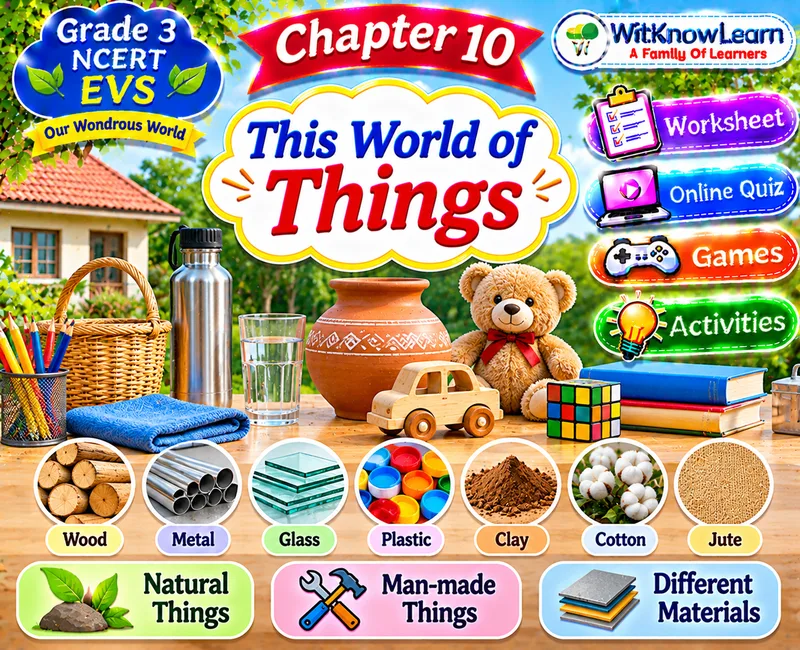
This World of Things Class 3 EVS Worksheet with Quiz and Activities
NCERT Our Wondrous World Chapter 10: what things in a classroom are made of, wood, metal, glass and plastic, transparent, translucent and opaque materials, solids, liquids and gases, and natural and artificial things. On WitKnowLearn you get the This World of Things Class 3 online quiz, online activities and interactive games, science labs, a virtual lab and a worksheet-style practice sheet, all on one page.
This World of Things Class 3 Online Quiz
20 questions: 10 easy, 5 average and 5 thinking. Tap an answer and the next question comes up.
This World of Things Class 3 Activities
👆 Tap a tab to switch: Learn, Games, Labs, Challenges, Virtual Lab and Practice sheet
This World of Things: the Chapter Story
A short read for Class 3 before you play. These notes are written for this page and are not copied from the textbook.
🏫 Khushi’s classroom
Khushi reaches school early and draws her bright classroom. She wonders where the things come from, who made them and what they are made of.
🧱 What is it made of?
Tables and chairs are made of wood from trees. Hinges, nails and latches are made of metals taken from ore. Windowpanes and bulbs are glass, and switches are plastic.
🔍 See-through materials
We see clearly through transparent glass, partly through translucent things and not at all through opaque wood. We never look at the sun through any object.
🎵 Touch and sound
Materials feel and sound different when we tap them. Wood is hard and rigid, and fabric is soft and flexible.
💧 Solid, liquid or gas
Solids keep their shape, liquids flow and gases float and spread. We cannot build walls from water.
🌳 Natural and artificial
Natural things exist in nature, whether alive or not. Artificial things are made by people.
This World of Things Class 3 Activities
Read, play and learn about materials, see-through things, solids, liquids, gases and natural and artificial things. Earn up to 3 stars in every activity.
Every object around us is made of some material. This chapter helps children observe closely, name materials, test how they look, feel and sound, and sort things in different ways.
The activities on this page turn each idea into a game. Children sort natural and artificial things, pop metal objects, match material words, fill gaps from Khushi’s classroom and choose the right material for the job. Explore more Class 3 EVS worksheets on WitKnowLearn after this chapter.
Words and facts to know
| Word | Meaning | Example |
|---|---|---|
| Transparent | We see clearly through it | Glass |
| Opaque | We cannot see through it | Wood |
| Natural | Exists in nature | Rock, tree |
| Artificial | Made by people | Shoes, table |
How to use this page
- Flip the six cards and try the Material Detective Lab in the Learn tab.
- Play the five games and the five labs to practise each idea.
- Finish the five challenges to collect up to 15 points.
- Take the 20-question online quiz and fill in the practice sheet.
Worked examples
Metal.
No, it is opaque.
Natural.
This This World of Things worksheet for Class 3 EVS (NCERT Our Wondrous World Chapter 10) gives you online activities and interactive games that turn the chapter into play. Every activity has a goal, a hint and a short fact, so children learn while they enjoy.
Complete Guide: EVS This World of Things Class 3
This guide is for Class 3 students, parents and teachers who are studying NCERT Our Wondrous World, Chapter 10, This World of Things. It explains the main ideas in simple words and shows how to use the quiz, labs and games on this page.
Introduction to NCERT Class 3 EVS Chapter 10
Chapter 10 of Our Wondrous World is called This World of Things and begins Unit 4, Things Around Us. It teaches children to observe things closely and to group them by material, by how we see through them and by their state. This introduction is written for this page and is not copied from the textbook.
What is there in this chapter
- Naming the things in a classroom.
- Wood, metal, glass and plastic and where they come from.
- Transparent, translucent and opaque materials.
- How materials feel, sound and bend.
- Solids, liquids and gases.
- Natural and artificial things.
Learning objectives (written for this page, not copied from the book)
- Name the materials things are made of.
- Tell where common materials come from.
- Group materials by how we see through them.
- Classify objects as solids, liquids or gases.
- Tell natural things from artificial things.
Learning outcomes
- The child can name three materials and an object made of each.
- The child can use the words transparent, translucent and opaque.
- The child can sort five objects into solid, liquid and gas.
- The child can list natural and artificial things.
This World of Things Class 3 resources on this page
| Resource | What it gives |
|---|---|
| Online quiz | 20 questions: 10 easy, 5 average and 5 thinking, with a full review |
| Flip cards | 6 picture cards with one-line rules |
| Material Detective Lab | A hands-on lab with 3 rounds |
| Games | 5 interactive games |
| Labs | 5 activity labs |
| Virtual Lab | 2 experiments with aim, procedure, observation table and conclusion |
| Challenges | 5 challenges, 15 points in all |
| Practice sheet | A worksheet-style sheet with 16 questions, name and date lines and a live score |
Key facts
| Topic | Key idea |
|---|---|
| Wood | From trees; hard and rigid. |
| Metal | From ore dug from the Earth. |
| Glass | Mostly made of sand; transparent. |
| Solid, liquid, gas | Keeps shape, flows, floats. |
| Natural and artificial | Nature or made by people. |
Types of questions you may see
- What a thing is made of.
- Transparent, translucent or opaque.
- Solid, liquid or gas.
- Natural or artificial.
Solved examples
Sand.
It is soft and flexible.
Air.
Natural.
Thin paper.
Water flows and cannot keep its shape.
Common mistakes
| Mistake | Correct idea |
|---|---|
| Calling wood transparent. | Wood is opaque. |
| Thinking air is not a thing. | Air is a gas. |
| Calling a plant artificial. | Plants are natural. |
| Looking at the sun through glass. | Never look at the sun. |
This World of Things in daily life
Children can name the material of each object at home, tap objects to hear sounds and collect a few different things to sort by material.
Tips for parents and teachers
- Make a materials table with objects from home.
- Play the odd pairs game with unsuitable materials.
- Test see-through objects with a torch, not the sun.
- Ask grandparents which materials were used long ago.
Related NCERT Our Wondrous World Class 3 Worksheets
- 👪Chapter 1: Family and Friends Class 3
- 🎡Chapter 2: Going to the Mela Class 3
- 🪔Chapter 3: Celebrating Festivals Class 3
- 🌿Chapter 4: Getting to Know Plants Class 3
- 🦋Chapter 5: Plants and Animals Live Together Class 3
- 🌍Chapter 6: Living in Harmony Class 3
- 💧Chapter 7: Water A Precious Gift Class 3
- 🥗Chapter 8: Food We Eat Class 3
- 😊Chapter 9: Staying Healthy and Happy Class 3
- 🏺Chapter 11: Making Things Class 3
- ♻Chapter 12: Taking Charge of Waste Class 3
This World of Things Class 3 FAQs
What is This World of Things in Class 3 EVS?
This World of Things is Chapter 10 of the NCERT Class 3 book Our Wondrous World, and it opens Unit 4, Things Around Us. Children look closely at things in a classroom, find what they are made of and where the materials come from, and learn about natural and artificial things.
What materials are things made of?
Things around us are made of wood, metal, glass, plastic, cloth, clay, rubber and many other materials. Tables are made of wood, hinges of metal, windowpanes of glass and switches of plastic.
What are transparent, translucent and opaque materials?
Transparent materials let us see clearly through them, like glass. Translucent materials let us see through only partly, like thin paper. Opaque materials, like wood, do not let us see through at all.
Where do materials come from?
Wood comes from trees, metals are taken from ore dug from the Earth, and glass is mostly made of sand. Cloth comes from fibres.
What are solids, liquids and gases?
Solids keep their shape, like a stone or a spoon. Liquids flow, like water, ink and honey. Gases like air float in and out of a cup.
What is the difference between natural and artificial things?
Natural things exist in nature, such as plants, animals, rocks, water and air. Artificial things are made by people, such as clothes, shoes and tables.
Why is wood used for tables and fabric for clothes?
Wood is hard and rigid, so it holds up a table. Fabric is soft and flexible, so it suits clothes and curtains.
What safety rule does the chapter teach?
Never look at the sun continuously, either directly or through any object, because it harms the eyes.
Does this page have This World of Things Class 3 questions and answers?
Yes. The 20-question online quiz ends with a full review that shows the correct answer and a short reason for every question. The practice sheet has 16 questions and a Show answers button.
Which class and book is this worksheet for?
This worksheet is for Class 3 and follows NCERT Our Wondrous World (EVS) Chapter 10, This World of Things. The learning objectives and all questions are written for this page and are not copied from the textbook.
What can children do on this page?
Children can take the online quiz, play interactive games, try online activities and science labs, finish challenges, do the hands-on Material Detective Lab, run two virtual experiments and solve a worksheet-style practice sheet. They can earn up to 3 stars in every activity.
What is included on this page?
This page has a 20-question online quiz, 6 flip cards, the Material Detective Lab, 5 games, 5 labs, 5 challenges, a virtual lab with 2 experiments, a 16-question practice sheet, a chapter story, a topic description, a complete guide, related NCERT Class 3 worksheets and 12 FAQs.
 Download