Water A Precious Gift Class 3 EVS Worksheet with Quiz and Activities
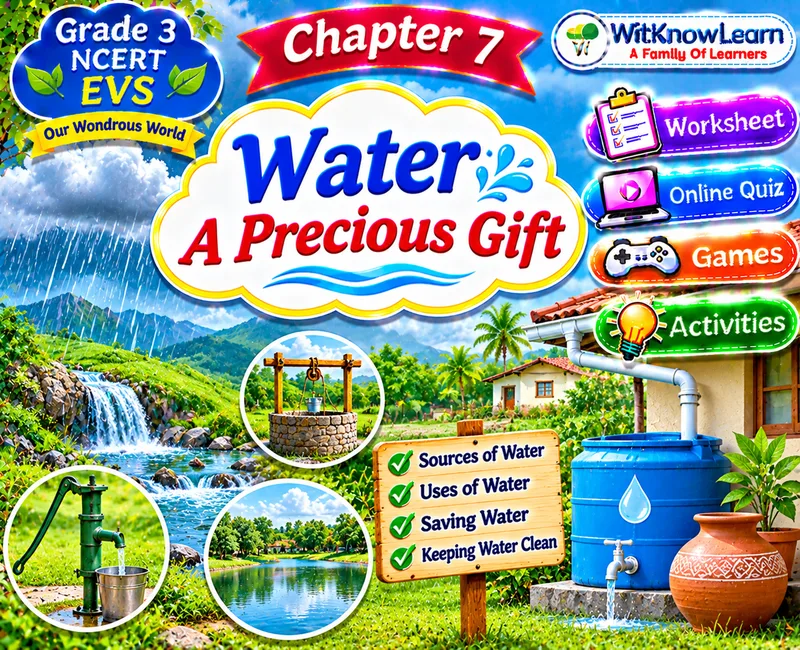
NCERT Our Wondrous World Chapter 7: the journey of rainwater, groundwater and wells, how water reaches our homes, storing water in vessels, saving every drop and making a birdbath. On WitKnowLearn you get the Water A Precious Gift Class 3 online quiz, online activities and interactive games, science labs, a virtual lab and a worksheet-style practice sheet, all on one page.
Water A Precious Gift Class 3 Online Quiz
20 questions: 10 easy, 5 average and 5 thinking. Tap an answer and the next question comes up.
Water A Precious Gift Class 3 Activities
👆 Tap a tab to switch: Learn, Games, Labs, Challenges, Virtual Lab and Practice sheet
Water A Precious Gift: the Chapter Story
A short read for Class 3 before you play. These notes are written for this page and are not copied from the textbook.
🌧 Watching the rain
Children watch rain fall and notice the size of the drops, the slant of the rain and the puddles it leaves. Rain is a gift that fills many of our water sources.
🌊 Where does the rainwater go?
Some rainwater soaks into the soil and is stored underground as groundwater. Streams carry the rest to rivers, and ponds, lakes and the sea also fill up.
🚰 Water reaches our homes
Surya and Barkha follow the pipes at home and find a tank on the roof. Water can also come from wells, borewells, tankers or a river nearby.
🏺 Storing water
When the society pipeline bursts, the family uses the water they stored in vessels. Vessels can be made of clay, metal, glass or plastic.
♻ Every drop counts
We can reduce and reuse water, use waste water for plants and never waste a drop. Many people also offer clean water to visitors and keep pots of water outside their homes for thirsty passers-by.
🐦 A birdbath
A shallow dish of clean water with stones helps birds drink and cool down in summer. Change the water often and keep it clean.
Water A Precious Gift Class 3 Activities
Read, play and learn about rain, groundwater, water at home and saving every drop. Earn up to 3 stars in every activity.
Water is a gift that all living things need. This chapter helps children follow rainwater on its journey, understand how water reaches their homes and see why we must store it, reuse it and never waste it.
The activities on this page turn each idea into a game. Children sort water sources and vessels, pop water bodies, match words, fill gaps about the journey of water and choose the wise way to use it. Explore more Class 3 EVS worksheets on WitKnowLearn after this chapter.
Words and facts to know
| Word | Meaning | Example |
|---|---|---|
| Groundwater | Water stored under the ground | Water in a well |
| Vessel | A container for holding water | Pot, surahi, bucket |
| Reuse | Use again | Waste water for plants |
| Birdbath | A shallow dish of water for birds | Placed in the garden |
How to use this page
- Flip the six cards and try the Water Journey Lab in the Learn tab.
- Play the five games and the five labs to practise each idea.
- Finish the five challenges to collect up to 15 points.
- Take the 20-question online quiz and fill in the practice sheet.
Worked examples
From groundwater.
Reduce use and reuse waste water.
The supply may stop at times.
This Water A Precious Gift worksheet for Class 3 EVS (NCERT Our Wondrous World Chapter 7) gives you online activities and interactive games that turn the chapter into play. Every activity has a goal, a hint and a short fact, so children learn while they enjoy.
Complete Guide: EVS Water A Precious Gift Class 3
This guide is for Class 3 students, parents and teachers who are studying NCERT Our Wondrous World, Chapter 7, Water A Precious Gift. It explains the main ideas in simple words and shows how to use the quiz, labs and games on this page.
Introduction to NCERT Class 3 EVS Chapter 7
Chapter 7 of Our Wondrous World is called Water A Precious Gift and opens Unit 3, Water. It shows where water comes from, how it reaches us and why it must be saved. This introduction is written for this page and is not copied from the textbook.
What is there in this chapter
- Observing rain and guessing what happens to rainwater.
- Groundwater, wells, streams, rivers, ponds and lakes.
- How water reaches homes through pipes, tanks, tankers and wells.
- Storing water in vessels made of different materials.
- Reducing, reusing and not wasting water.
- Making a birdbath and offering water to others.
Learning objectives (written for this page, not copied from the book)
- Describe what happens to rainwater.
- Name the sources from which people get water.
- Explain why we store water and in what.
- Practise ways to reduce and reuse water.
- Show care for birds and people who need water.
Learning outcomes
- The child can trace the journey of rainwater.
- The child can name three water sources and three vessels.
- The child can give two ways to save water.
- The child can describe how to make a birdbath.
Water A Precious Gift Class 3 resources on this page
| Resource | What it gives |
|---|---|
| Online quiz | 20 questions: 10 easy, 5 average and 5 thinking, with a full review |
| Flip cards | 6 picture cards with one-line rules |
| Water Journey Lab | A hands-on lab with 3 rounds |
| Games | 5 interactive games |
| Labs | 5 activity labs |
| Virtual Lab | 2 experiments with aim, procedure, observation table and conclusion |
| Challenges | 5 challenges, 15 points in all |
| Practice sheet | A worksheet-style sheet with 16 questions, name and date lines and a live score |
Key facts
| Topic | Key idea |
|---|---|
| Rainwater | Soaks into soil or flows to streams and rivers. |
| Wells | Draw groundwater. |
| Vessels | Clay, metal, glass or plastic. |
| Saving water | Reduce, reuse and do not waste. |
| Birdbath | Shallow, with stones, clean water. |
Types of questions you may see
- Where rainwater goes.
- Sources of water and vessels.
- Ways to save water.
- Making and caring for a birdbath.
Solved examples
Groundwater.
On the roof.
Clay.
Watering plants.
Less than 10 cm.
For thirsty passers-by.
Common mistakes
| Mistake | Correct idea |
|---|---|
| Leaving the tap running. | Close it to save water. |
| Drinking dirty water. | Use only clean water for drinking. |
| A deep birdbath. | Keep it shallow. |
| Never changing the birdbath water. | Change it often. |
Water A Precious Gift in daily life
Children can close taps, reuse rinse water for plants, report leaks to an elder, offer water to visitors and keep a birdbath in the garden.
Tips for parents and teachers
- Watch rain together and talk about where it goes.
- Show the family tank, pipes and taps.
- Make a birdbath and clean it twice a week.
- Practise a daily habit of saving water.
Related NCERT Our Wondrous World Class 3 Worksheets
- 👪Chapter 1: Family and Friends Class 3
- 🎡Chapter 2: Going to the Mela Class 3
- 🪔Chapter 3: Celebrating Festivals Class 3
- 🌿Chapter 4: Getting to Know Plants Class 3
- 🦋Chapter 5: Plants and Animals Live Together Class 3
- 🌍Chapter 6: Living in Harmony Class 3
- 🥗Chapter 8: Food We Eat Class 3
- 😊Chapter 9: Staying Healthy and Happy Class 3
- 🧸Chapter 10: This World of Things Class 3
- 🏺Chapter 11: Making Things Class 3
- ♻Chapter 12: Taking Charge of Waste Class 3
Water A Precious Gift Class 3 FAQs
What is Water A Precious Gift in Class 3 EVS?
Water A Precious Gift is Chapter 7 of the NCERT Class 3 book Our Wondrous World, in Unit 3 Water. Children learn where rainwater goes, how water reaches our homes, how we store it, and why every drop counts.
What happens to rainwater?
Some rainwater soaks into the soil and is stored underground. The rest flows into streams that join rivers, and into ponds, lakes and the sea.
Where do wells get their water?
Wells get water from groundwater, which is rainwater stored under the ground. A pulley, a hand pump or an electric pump can draw it up.
How does water reach our homes?
Water reaches homes through pipes from a tank on the roof or from a larger supply. Some people use wells, borewells, water tankers or carry water from a river.
How do people store water?
People store water in vessels made of clay, copper, brass, steel, aluminium, glass or plastic, such as pots, surahis and buckets, so they have water when the supply stops.
How can we save water?
We can reduce the water we use and reuse waste water for plants or flushing toilets. We should not waste even a drop and should fix leaking taps.
Why is water called a precious gift?
Water is essential for the survival of all living things, so it is considered sacred in many traditions. Many people offer clean drinking water to visitors and keep pots of water outside homes in summer.
How do we make a birdbath?
Use a shallow container less than 10 cm deep, add stones and pebbles, fill it with clean water, change the water often and scrub it twice a week with a scrubber kept only for the garden.
Does this page have Water A Precious Gift Class 3 questions and answers?
Yes. The 20-question online quiz ends with a full review that shows the correct answer and a short reason for every question. The practice sheet has 16 questions and a Show answers button.
Which class and book is this worksheet for?
This worksheet is for Class 3 and follows NCERT Our Wondrous World (EVS) Chapter 7, Water A Precious Gift. The learning objectives and all questions are written for this page and are not copied from the textbook.
What can children do on this page?
Children can take the online quiz, play interactive games, try online activities and science labs, finish challenges, do the hands-on Water Journey Lab, run two virtual experiments and solve a worksheet-style practice sheet. They can earn up to 3 stars in every activity.
What is included on this page?
This page has a 20-question online quiz, 6 flip cards, the Water Journey Lab, 5 games, 5 labs, 5 challenges, a virtual lab with 2 experiments, a 16-question practice sheet, a chapter story, a topic description, a complete guide, related NCERT Class 3 worksheets and 12 FAQs.
 Download