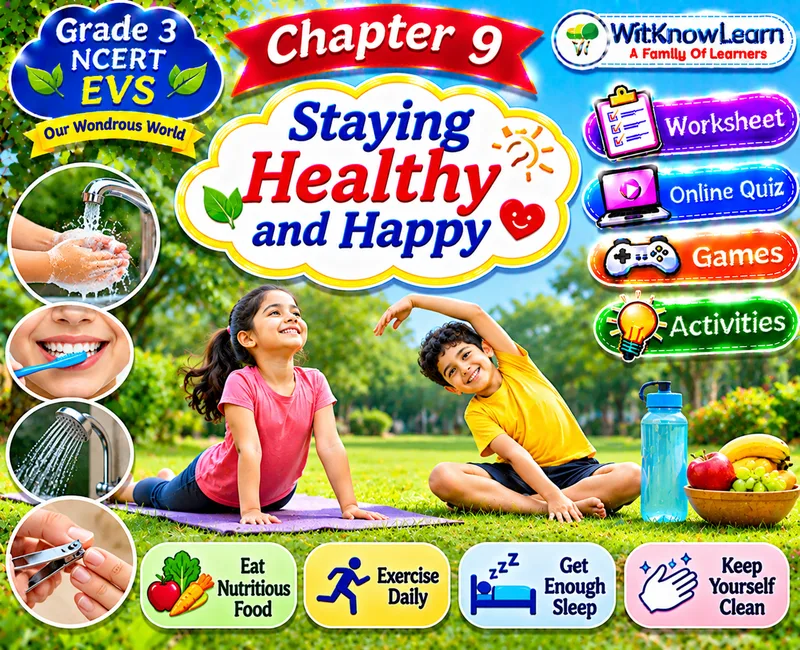
Staying Healthy and Happy Class 3 EVS Worksheet with Quiz and Activities
NCERT Our Wondrous World Chapter 9: clean habits, a healthy daily routine, brushing with a twig, exercise and games, safe places to play and staying safe from strangers. On WitKnowLearn you get the Staying Healthy and Happy Class 3 online quiz, online activities and interactive games, science labs, a virtual lab and a worksheet-style practice sheet, all on one page.
Staying Healthy and Happy Class 3 Online Quiz
20 questions: 10 easy, 5 average and 5 thinking. Tap an answer and the next question comes up.
Staying Healthy and Happy Class 3 Activities
👆 Tap a tab to switch: Learn, Games, Labs, Challenges, Virtual Lab and Practice sheet
Staying Healthy and Happy: the Chapter Story
A short read for Class 3 before you play. These notes are written for this page and are not copied from the textbook.
✨ Clean and bright
Simple habits keep our body clean and free from diseases: brushing teeth, bathing, combing hair, washing hands with soap and keeping nails trimmed.
⏰ A daily routine
A good day has handwashing, brushing twice, enough water, healthy food, good sleep and play outside. Routines may differ with where we live and the water we can get.
🌿 Moyna and Dadu
Moyna’s Dadu cleans his teeth with a fresh neem or babool twig. Moyna finds neem bitter and babool tastier. Old ways such as reetha and shikakai also keep us clean.
🍋 A home cleaner
Orange or lemon peels soaked in vinegar make an eco-friendly cleaner that is ready after two weeks in the sun.
🏃 Play and exercise
Running and jumping make the heart work harder and keep us fit. Monkeys and birds also keep themselves clean.
🚦 Play safe
We play in parks and school grounds, not on busy roads or construction sites. We say no to strangers and stay alert.
Staying Healthy and Happy Class 3 Activities
Read, play and learn about clean habits, daily routines, exercise and staying safe. Earn up to 3 stars in every activity.
A healthy body and a happy mind begin with small daily habits. This chapter helps children keep clean, follow a routine, stay active and play safely.
The activities on this page turn each idea into a game. Children sort good and not-so-good habits, pop healthy routine activities, match items with their jobs, fill gaps and choose safe places. Explore more Class 3 EVS worksheets on WitKnowLearn after this chapter.
Words and facts to know
| Word | Meaning | Example |
|---|---|---|
| Routine | Things we do every day | Brushing, bathing, sleeping |
| Datun | A twig used to clean teeth | Neem or babool |
| Stamina | Power to keep going | Running without tiring |
| Stranger | Someone we do not know | A person we meet outside |
How to use this page
- Flip the six cards and try the Healthy Habits Lab in the Learn tab.
- Play the five games and the five labs to practise each idea.
- Finish the five challenges to collect up to 15 points.
- Take the 20-question online quiz and fill in the practice sheet.
Worked examples
After waking up and before bed.
A park.
No, thank you.
This Staying Healthy and Happy worksheet for Class 3 EVS (NCERT Our Wondrous World Chapter 9) gives you online activities and interactive games that turn the chapter into play. Every activity has a goal, a hint and a short fact, so children learn while they enjoy.
Complete Guide: EVS Staying Healthy and Happy Class 3
This guide is for Class 3 students, parents and teachers who are studying NCERT Our Wondrous World, Chapter 9, Staying Healthy and Happy. It explains the main ideas in simple words and shows how to use the quiz, labs and games on this page.
Introduction to NCERT Class 3 EVS Chapter 9
Chapter 9 of Our Wondrous World is called Staying Healthy and Happy. It shows how clean habits, a good routine, exercise and safe play keep our body and mind healthy. This introduction is written for this page and is not copied from the textbook.
What is there in this chapter
- Habits for a clean body and a daily routine.
- The traditional way of brushing with a twig.
- A home cleaner made from peels and vinegar.
- How animals clean themselves.
- Exercise, skipping and outdoor games.
- Safe places to play and staying safe from strangers.
Learning objectives (written for this page, not copied from the book)
- Name habits that keep the body clean.
- Plan a healthy daily routine.
- Explain why exercise is good for us.
- Tell safe places from unsafe places.
- Know how to behave with strangers.
Learning outcomes
- The child can list five clean habits.
- The child can describe a healthy routine.
- The child can name two safe places to play.
- The child can say what to do if a stranger offers something.
Staying Healthy and Happy Class 3 resources on this page
| Resource | What it gives |
|---|---|
| Online quiz | 20 questions: 10 easy, 5 average and 5 thinking, with a full review |
| Flip cards | 6 picture cards with one-line rules |
| Healthy Habits Lab | A hands-on lab with 3 rounds |
| Games | 5 interactive games |
| Labs | 5 activity labs |
| Virtual Lab | 2 experiments with aim, procedure, observation table and conclusion |
| Challenges | 5 challenges, 15 points in all |
| Practice sheet | A worksheet-style sheet with 16 questions, name and date lines and a live score |
Key facts
| Topic | Key idea |
|---|---|
| Clean body | Brush, bathe, comb, wash hands, trim nails. |
| Routine | Water, food, sleep and play. |
| Exercise | Makes the heart work harder. |
| Safe places | Park and school ground. |
| Strangers | Say no and tell a trusted adult. |
Types of questions you may see
- Healthy habits and routine.
- Traditional cleaning methods.
- Exercise and games.
- Safe and unsafe places.
Solved examples
Soap and water.
Babool.
It makes the heart work better.
A construction site.
A pre-decided password.
They groom each other.
Common mistakes
| Mistake | Correct idea |
|---|---|
| Brushing only once a day. | Brush in the morning and at night. |
| Skipping soap. | Wash hands with soap. |
| Playing near a road. | Play in a park or ground. |
| Talking to strangers alone. | Say no and tell a trusted adult. |
Staying Healthy and Happy in daily life
Children can fill the weekly health table, make a home cleaner with an elder, play a game with friends and agree on a family password.
Tips for parents and teachers
- Make a daily routine chart together.
- Choose one exercise to do twice a week.
- Walk around the area and point out safe places.
- Decide a family password for emergencies.
Related NCERT Our Wondrous World Class 3 Worksheets
- 👪Chapter 1: Family and Friends Class 3
- 🎡Chapter 2: Going to the Mela Class 3
- 🪔Chapter 3: Celebrating Festivals Class 3
- 🌿Chapter 4: Getting to Know Plants Class 3
- 🦋Chapter 5: Plants and Animals Live Together Class 3
- 🌍Chapter 6: Living in Harmony Class 3
- 💧Chapter 7: Water A Precious Gift Class 3
- 🥗Chapter 8: Food We Eat Class 3
- 🧸Chapter 10: This World of Things Class 3
- 🏺Chapter 11: Making Things Class 3
- ♻Chapter 12: Taking Charge of Waste Class 3
Staying Healthy and Happy Class 3 FAQs
What is Staying Healthy and Happy in Class 3 EVS?
Staying Healthy and Happy is Chapter 9 of the NCERT Class 3 book Our Wondrous World. Children learn simple habits for a clean body, a daily routine, exercise and play, and how to stay safe while playing and around strangers.
What habits keep our body clean?
Brushing teeth twice a day, taking a shower, combing hair, washing hands with soap, keeping nails trimmed and clean, and rinsing the mouth after eating keep the body clean and free from diseases.
What should be in a healthy daily routine?
A healthy day includes a shower, handwashing with soap, brushing teeth, drinking six to eight glasses of water, eating food, sleeping well for at least eight hours and playing outside.
What is datun?
Datun is the old Indian way of cleaning teeth with twigs of plants such as neem, karanj and babool. In the chapter, Moyna's Dadu chews a fresh twig every day to make a brush.
Why is exercise important?
Exercise makes the heart work harder and better. We breathe faster and sweat, and the body stays fit. Walking, jumping, running and skipping with a rope are all good exercise.
How do animals keep clean?
Monkeys groom each other to remove insects, and birds use their beaks to clean their feathers.
Which places are safe to play?
A park and a school ground are safe places. A busy road, a roof without railings and a construction site are unsafe.
How should children behave with strangers?
Children should not interact with strangers unless they are with a trusted adult. They should say no to sweets or rides from strangers, and parents may use a pre-decided password if a new person must pick them up.
Does this page have Staying Healthy and Happy Class 3 questions and answers?
Yes. The 20-question online quiz ends with a full review that shows the correct answer and a short reason for every question. The practice sheet has 16 questions and a Show answers button.
Which class and book is this worksheet for?
This worksheet is for Class 3 and follows NCERT Our Wondrous World (EVS) Chapter 9, Staying Healthy and Happy. The learning objectives and all questions are written for this page and are not copied from the textbook.
What can children do on this page?
Children can take the online quiz, play interactive games, try online activities and science labs, finish challenges, do the hands-on Healthy Habits Lab, run two virtual experiments and solve a worksheet-style practice sheet. They can earn up to 3 stars in every activity.
What is included on this page?
This page has a 20-question online quiz, 6 flip cards, the Healthy Habits Lab, 5 games, 5 labs, 5 challenges, a virtual lab with 2 experiments, a 16-question practice sheet, a chapter story, a topic description, a complete guide, related NCERT Class 3 worksheets and 12 FAQs.
 Download