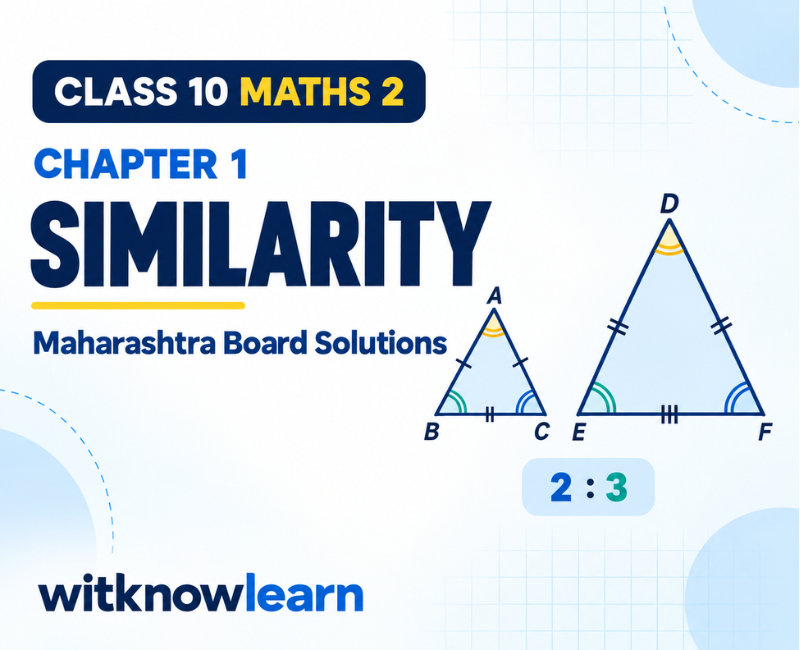
Class 10 Maths 2 Chapter 1 Similarity Solutions
Learn Similarity with complete Maharashtra Board textbook solutions written in clear, student-friendly steps. This chapter includes Practice Sets 1.1 to 1.4 and Problem Set 1 with theorem explanations, formulas, proofs and carefully worked answers.
What Will You Learn in Similarity?
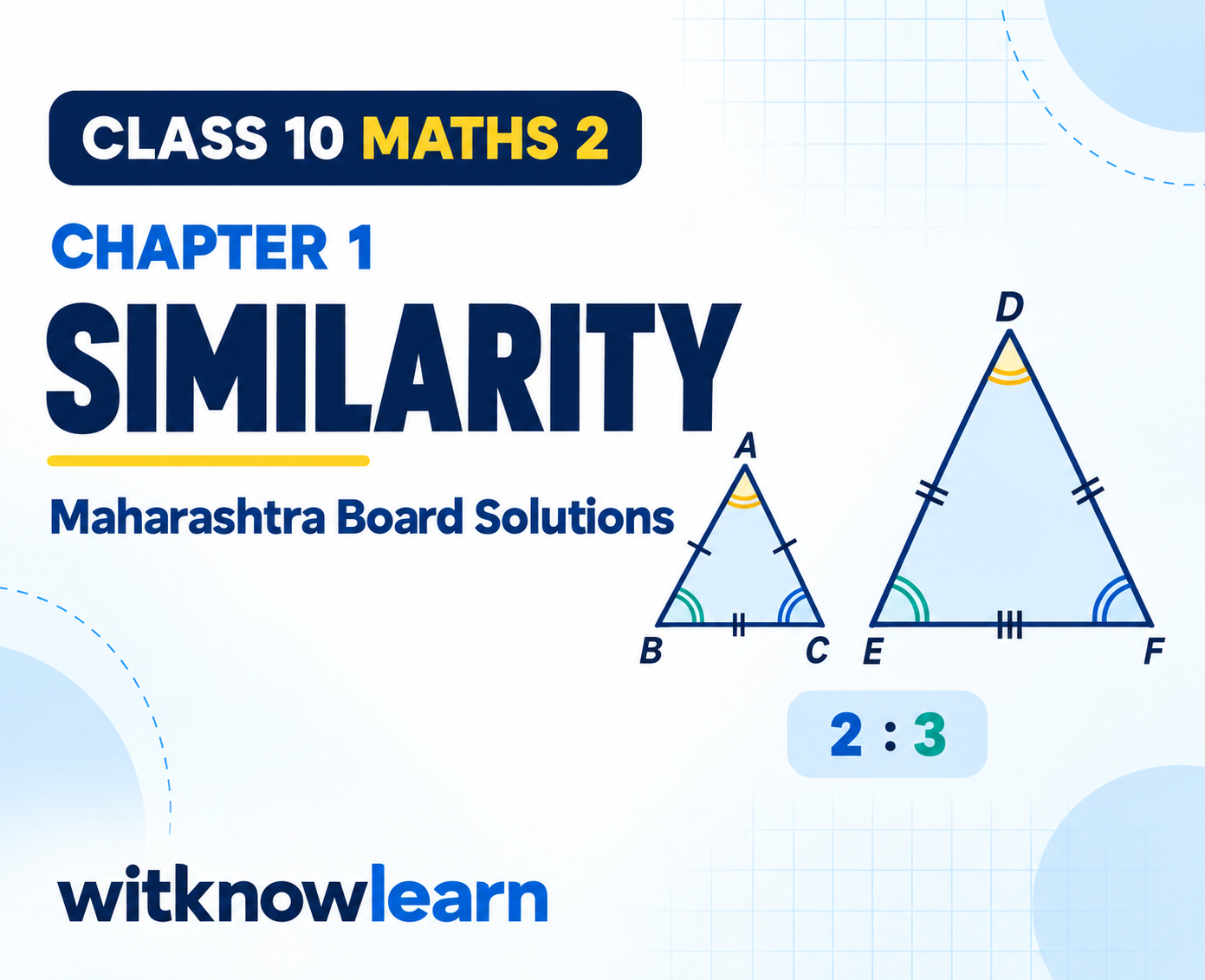
Similarity explains how two triangles can have the same shape but different sizes. Students learn to compare corresponding angles, form ratios of corresponding sides and use important theorems to calculate unknown lengths and areas.
Similar Triangles
Identify equal corresponding angles and proportional corresponding sides.
Similarity Tests
Prove triangles similar by using the AA, SAS or SSS similarity test.
Area Relationships
Use corresponding-side ratios to compare the areas of similar triangles.
Important Concepts Covered
- Ratio of the areas of two triangles
- Corresponding angles and corresponding sides
- Similar triangles
- AA test of similarity
- SAS test of similarity
- SSS test of similarity
- Angle bisector property of a triangle
- Basic Proportionality Theorem
- Converse of Basic Proportionality Theorem
- Property of parallel lines and transversals
- Ratio of the areas of similar triangles
Practice Set 1.1 Solutions
Practice Set 1.1 contains questions based on the ratio of the areas of two triangles. Students learn how bases and corresponding heights are used to compare their areas.
Area = ½ × Base × Height
A(△ABC) / A(△PQR)
= (Base of △ABC × Height of △ABC) / (Base of △PQR × Height of △PQR)
How to Find the Ratio of Areas
Practice Set 1.2 Solutions
Practice Set 1.2 includes questions based on the angle bisector property and proportional line segments. An internal angle bisector divides the opposite side in the ratio of the two adjacent sides.
BD / DC = AB / AC
How to Solve Angle Bisector Questions
Practice Set 1.3 Solutions
Practice Set 1.3 focuses on the Basic Proportionality Theorem and proportional segments formed by parallel lines. Students must check the parallel-line condition before applying the theorem.
AD / DB = AE / EC
How to Apply the Basic Proportionality Theorem
Practice Set 1.4 Solutions
Practice Set 1.4 covers similarity tests and the relationship between the areas of similar triangles. Students learn to prove triangles similar by comparing corresponding angles and sides.
AA Test of Similarity
If two angles of one triangle are equal to two corresponding angles of another triangle, the two triangles are similar.
SAS Test of Similarity
If two pairs of corresponding sides are proportional and the included angles are equal, the two triangles are similar.
SSS Test of Similarity
If all three pairs of corresponding sides are proportional, the two triangles are similar.
AB / PQ = BC / QR = AC / PR
A(△ABC) / A(△PQR) = (AB / PQ)²
How to Prove That Two Triangles Are Similar
Problem Set 1 Solutions
Problem Set 1 combines all the important concepts from the chapter. It contains questions on areas of triangles, angle bisectors, parallel lines, similarity tests, proportional sides and the areas of similar triangles.
How to Write Similarity Solutions Step by Step
- Writing corresponding vertices in the wrong order
- Using non-corresponding sides in the same ratio
- Applying the theorem without checking parallel lines
- Using similarity without mentioning the correct test
- Forgetting to square the side ratio for area questions
- Skipping reasons in theorem-based proofs
- Combining several calculations on one line
- Writing the final answer without a unit
Frequently Asked Questions
1. What is similarity of triangles?
Two triangles are similar when their corresponding angles are equal and their corresponding sides are proportional. They have the same shape but may have different sizes.
2. How do we prove that two triangles are similar?
Identify the corresponding angles and sides. Then apply the AA, SAS or SSS similarity test and write the vertices in the correct corresponding order.
3. What is the AA test of similarity?
If two angles of one triangle are equal to two corresponding angles of another triangle, the triangles are similar by the AA test.
4. What is the Basic Proportionality Theorem?
If a line is drawn parallel to one side of a triangle and intersects the other two sides, it divides those two sides in the same ratio.
5. How are the areas of similar triangles related?
The ratio of the areas of two similar triangles is equal to the square of the ratio of their corresponding sides.
6. What is the angle bisector property?
The internal angle bisector of a triangle divides the opposite side in the ratio of the two sides containing that angle.
7. Which Similarity questions are important for SSC?
Students should practise similarity proofs, angle bisector questions, Basic Proportionality Theorem problems, unknown-side questions, area ratios and activity-based questions.
8. How can students avoid correspondence mistakes?
Match equal angles first and write the corresponding vertices in the same order. Then form ratios using only the matching sides.
9. Why is the side ratio squared in area questions?
Area depends on two dimensions. Therefore, when the corresponding sides are in the ratio a:b, the areas are in the ratio a²:b².
10. Are all Chapter 1 textbook exercises covered?
Yes. The solutions cover Practice Sets 1.1, 1.2, 1.3 and 1.4, along with Problem Set 1, in the correct Maharashtra Board textbook order.
11. How should students use these solutions?
Solve each question independently first. Then compare your working with the step-by-step answer, correct your mistakes and solve the question again without looking at the solution.
Prepare Chapter 1 with Confidence
Use these Maharashtra Board Class 10 Maths 2 Similarity solutions to understand the correct methods, revise important theorems and improve your answer presentation. Regular practice will help you solve proofs, ratios and area questions accurately.
 Download