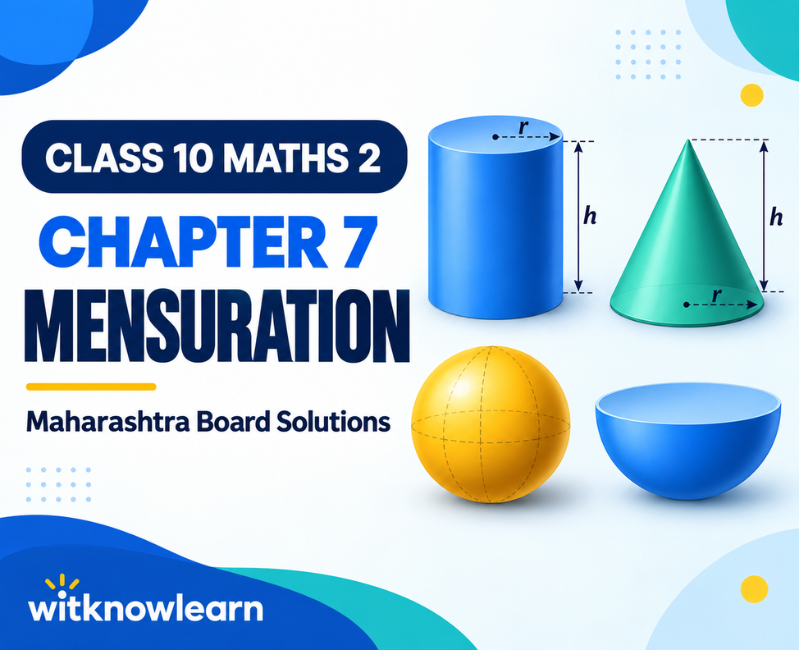
Class 10 Maths 2 Chapter 7 Mensuration Solutions
Study Maharashtra Board Class 10 Maths 2 Chapter 7 Mensuration with important formulas and step-by-step explanations. This guide covers surface area, volume, combined solids, conversion of solids, frustum calculations, Practice Sets 7.1 to 7.4 and Problem Set 7.
Chapter 7 Mensuration Solutions
Select the required practice set to study its concepts, formulas and solution methods.
What Will You Learn in Mensuration?
Mensuration is the branch of mathematics that deals with measurements of geometrical figures. In this chapter, students calculate curved surface area, total surface area and volume of different three-dimensional solids.
A solid may be a cylinder, cone, sphere or hemisphere. Some practical objects are formed by joining two or more solids. For example, a toy may consist of a cone placed on a hemisphere, while a capsule may be formed using a cylinder and two hemispheres.
Students also learn problems involving the conversion of one solid into another. When a metallic sphere is melted and recast into smaller cones or cylinders, the volume of the material remains unchanged. Therefore, the volume before conversion equals the total volume after conversion.
Surface Area
Calculate curved and total surface areas by identifying the exposed surfaces of the solid.
Volume
Calculate the space occupied by cylinders, cones, spheres, hemispheres and combined solids.
Combined Solids
Divide a complex object into familiar solids and add or subtract their areas and volumes correctly.
Important Mensuration Formulas
For a cone, slant height l can be calculated using l² = r² + h². Read the question carefully to decide whether the base is exposed. An attached circular surface should not be counted in the external surface area.
Practice Set-wise Chapter Coverage
Practice Set 7.1 Solutions
Practice Set 7.1 revises the basic formulas for cylinders, cones, spheres and hemispheres. Questions may ask for the curved surface area, total surface area, volume, radius, height or slant height.
Write the appropriate formula first and substitute all measurements using the same unit. If diameter is given, divide it by two to find the radius. When the slant height of a cone is not given, calculate it using the Pythagoras theorem before finding the curved surface area.
Practice Set 7.2 Solutions
Practice Set 7.2 deals with combined solids. A single object may be formed by joining a cylinder and hemisphere, cone and hemisphere, or other familiar solids.
Draw a rough diagram and separate the object into basic solids. For volume, add the volumes of the joined parts. For surface area, count only the surfaces visible from the outside. The common circular surface at the joint is internal and should not be added.
Practice Set 7.3 Solutions
Practice Set 7.3 includes conversion and recasting problems. When an object is melted and reshaped, no material is assumed to be lost. Therefore, the volume of the original solid is equal to the total volume of the new solid or solids.
If the question asks for the number of smaller objects formed, divide the volume of the original solid by the volume of one new object. Keep the value of π common on both sides whenever possible so the calculation becomes shorter and clearer.
Practice Set 7.4 Solutions
Practice Set 7.4 covers advanced applications such as frustums and practical mensuration problems. A frustum is obtained when the top of a cone is cut by a plane parallel to its base.
Identify the larger radius, smaller radius, vertical height and slant height carefully. Do not interchange the two radii while substituting values. Some questions may also be solved by treating the frustum as the difference between a large cone and a smaller similar cone.
Problem Set 7 Solutions
Problem Set 7 provides complete revision of the Mensuration chapter. It combines direct formula questions, combined solids, conversion of solids, capacity, volume, surface area and frustum applications.
Read the wording carefully to decide whether the question asks for area, volume, capacity, cost or the number of objects. Convert all measurements to the same unit before calculating. For capacity, remember that 1 litre equals 1000 cubic centimetres.
How to Solve Mensuration Questions
- Draw or study the solid and write all given measurements.
- Convert diameter into radius wherever necessary.
- Convert all measurements into the same unit.
- Identify whether curved area, total area or volume is required.
- Separate a combined figure into familiar solids.
- Write the correct formula before substituting values.
- Calculate one mathematical step per line.
- Write square units for area and cubic units for volume.
Common Mistakes to Avoid
- Do not use the diameter in place of the radius.
- Do not confuse curved surface area with total surface area.
- Do not count the common joined surface of two solids.
- Do not add surface areas when the question asks for volume.
- Convert centimetres and metres before substituting values.
- Use square units for surface area and cubic units for volume.
- Do not round decimal values before completing the calculation.
- For conversion questions, equate volumes rather than surface areas.
Complete Chapter 7 Solutions
These Maharashtra Board Class 10 Maths 2 Chapter 7 Mensuration solutions cover Practice Sets 7.1, 7.2, 7.3 and 7.4 along with Problem Set 7. Follow every formula and unit conversion carefully, particularly in combined-solid and recasting questions.
Frequently Asked Questions
Select any question to view its answer.
What is mensuration?
What is the difference between surface area and volume?
What is the volume of a cylinder?
What is the volume of a cone?
How is the slant height of a cone calculated?
How do we calculate the area of a combined solid?
What remains unchanged when a solid is melted and recast?
What is a frustum of a cone?
How are litres converted into cubic centimetres?
Which exercises are covered in Chapter 7?
How can I prepare Mensuration for the SSC examination?
 Download