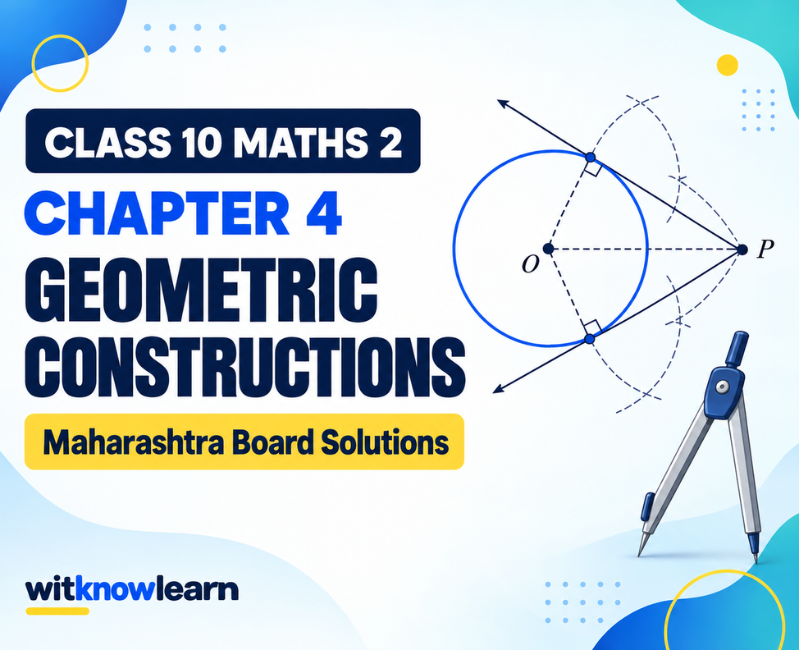
Class 10 Maths 2 Chapter 4 Geometric Constructions Solutions
Learn Maharashtra Board Class 10 Maths 2 Chapter 4 Geometric Constructions through clear analysis, accurate construction steps and simple explanations. This guide covers Practice Set 4.1, Practice Set 4.2 and Problem Set 4.
Chapter 4 Geometric Constructions
Select a practice set to study its concepts, construction method and important examination points.
What Will You Learn in Geometric Constructions?
Geometric construction means drawing an exact geometrical figure by following a logical sequence of steps. In this Maharashtra Board chapter, students use the properties of similar triangles, proportional sides, circles and tangents. Every construction should include an analysis, a rough figure, accurate construction arcs and properly written steps of construction.
The final figure alone is not enough in a board examination. Students must show the important arcs and construction lines because these markings explain how each point was obtained. The compass should be used carefully, and unnecessary arcs should be avoided.
Similar Triangle Construction
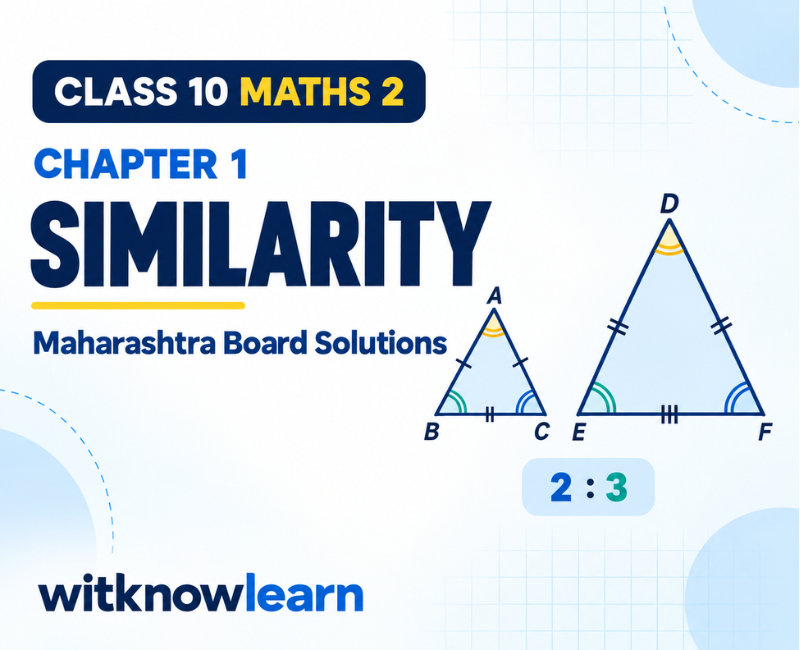
Construct a triangle similar to a given triangle according to a specified ratio. The required triangle may be smaller or larger than the original triangle.
Division of Line Segments
Divide a line segment into equal parts or in a given ratio by using an auxiliary ray, equal compass arcs and parallel lines.
Tangent Construction
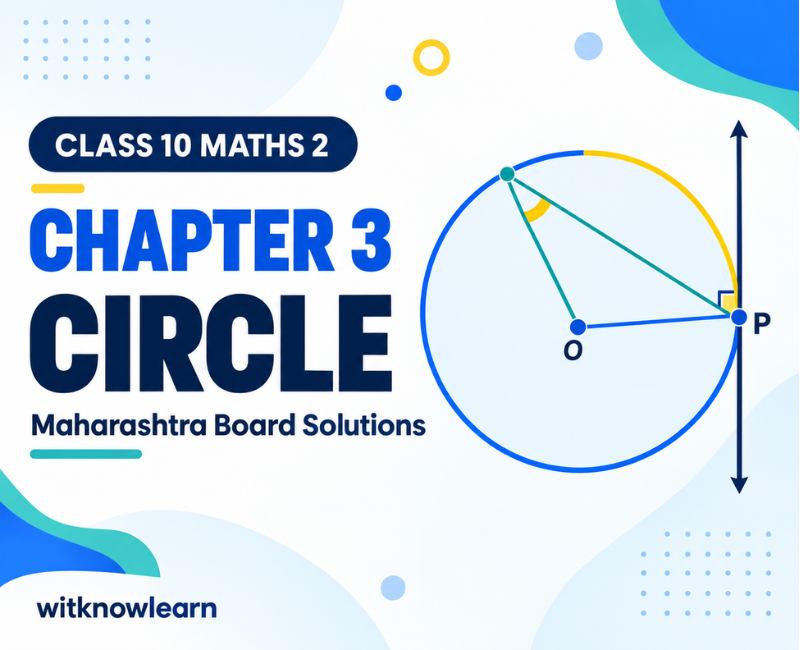
Draw tangents at a point on a circle or from an external point using the radius, perpendicular lines and circle theorems.
Important Concepts Used in Chapter 4
- Corresponding angles of similar triangles are equal.
- Corresponding sides of similar triangles are proportional.
- A line parallel to one side of a triangle divides the other two sides in the same ratio.
- A tangent to a circle is perpendicular to the radius at the point of contact.
- Tangent segments drawn from the same external point are equal.
- An angle inscribed in a semicircle is a right angle.
- The tangent-secant angle theorem can be used to construct a tangent without using the centre of the circle.
Practice Set-wise Solutions
Practice Set 4.1 Solutions
Practice Set 4.1 mainly covers the construction of similar triangles and proportional line segments. Questions may give the measurements of a triangle and a ratio between the corresponding sides of the original and required triangles.
First construct the given triangle using the stated side lengths and angles. Draw an auxiliary ray from the common vertex and mark equal parts on it. The number of equal parts depends on the numerator and denominator of the given ratio. Join the appropriate point to one vertex and draw a parallel line through the required division point. This creates the required similar triangle.
Before beginning, decide whether the new triangle will be an enlargement or a reduction. If the required corresponding side is smaller, the new triangle generally lies inside the original triangle. If it is larger, the sides may need to be extended. This analysis prevents mistakes in the final construction.
Practice Set 4.2 Solutions
Practice Set 4.2 focuses on constructing tangents to a circle. Students learn to draw a tangent at a point on the circle, construct a tangent without using the centre and draw two tangents from an external point.
When the centre is known, join the centre to the point of contact and construct a perpendicular at that point. The perpendicular line is the required tangent. When constructing tangents from an external point, join the external point to the centre and find the midpoint of that segment. Draw a circle using the midpoint as centre. Its intersections with the original circle provide the points of contact.
Some questions ask for tangents at the endpoints of a diameter. Because both tangents are perpendicular to the same diameter, they are parallel. Students should write this observation clearly after completing the construction.
Problem Set 4 Solutions
Problem Set 4 combines similar triangle construction, line division and different methods of constructing tangents. It tests whether students can identify the correct method without being told every intermediate step.
Read the ratio carefully and prepare a rough figure before drawing the final construction. For circle questions, determine whether the tangent must be drawn at a point on the circle, from an external point or without using the centre. Write the analysis first, perform the construction neatly and list each construction step in the correct order.
How to Solve Geometric Construction Questions
- Read all measurements, ratios and construction conditions carefully.
- Prepare a rough figure and mark the known and required measurements.
- Write the analysis and identify the geometrical theorem used.
- Draw the base figure accurately with a sharp pencil and ruler.
- Draw auxiliary rays, equal arcs, perpendiculars or parallel lines as required.
- Keep all important construction arcs visible in the final diagram.
- Label every point correctly and write the steps of construction in sequence.
- Check the final side ratio, angle or tangent property before completing the answer.
Common Mistakes Students Should Avoid
- Do not draw the final figure directly without showing construction arcs.
- Do not confuse the ratio of the original triangle with the ratio of the required triangle.
- Use equal compass openings while marking equal parts on an auxiliary ray.
- Do not measure a parallel line approximately; construct it using proper arcs.
- A tangent must touch the circle at exactly one point.
- Do not assume that a line is a tangent unless the required theorem or perpendicular condition is satisfied.
- Avoid thick lines, large dots and unclear labels in the final construction.
Complete Chapter 4 Solutions
These Class 10 Maths 2 Chapter 4 Geometric Constructions solutions cover Practice Set 4.1, Practice Set 4.2 and Problem Set 4. Follow the analysis, construction diagram and numbered steps carefully. Practise every construction independently using a sharp pencil, ruler and compass.
Frequently Asked Questions
Select a question to read its answer.
What is a geometrical construction?
Which exercises are covered in Chapter 4?
How do we construct a triangle similar to a given triangle?
How do I know whether the similar triangle is larger or smaller?
How is a tangent drawn at a point on a circle?
How are tangents constructed from an external point?
Can a tangent be constructed without using the centre?
Why must construction arcs be shown?
Are tangents at the endpoints of a diameter parallel?
Which instruments are required for Chapter 4?
How can I score full marks in construction questions?
 Download